The six P–N bonds are not well described as three permanently localized single bonds alternating with three ordinary double bonds. The strongly polar P–N framework has contributions from ionic bonding and nitrogen lone pair donation into neighboring phosphorus-centered acceptor combinations, including P–Cl orbitals. This negative hyperconjugation supplies additional P–N bonding and equivalent environments around the ring. Approximate planarity is compatible with these interactions, but equal lengths and planarity alone do not establish benzene-like aromaticity. Large phosphorus participation is not required.[ref]
Gallium binds to a ring nitrogen, and the two P–N bonds flanking that nitrogen lengthen. Formation of the NGaCl coordinate covalent bond changes the available nitrogen electron density and local geometry, weakening its contribution to the adjacent P–N interactions. The other four P–N bonds retain greater multiple-bond character and are correspondingly shorter. Loss of the threefold equivalence and altered local geometry permit the ring to pucker. This is a Lewis acid-base adduct, not replacement of a P–Cl bond by GaCl. Single-crystal structures and variable-temperature multinuclear nuclear magnetic resonance establish this class of nitrogen-bound group-13 adducts.[ref]
Group 13 Lewis acid adducts of [PCl2N]3 by Zin-Min Tun and others. 2011, pp. 8937–8945, adduct structures and variable-temperature NMR
Fluoride favors geminal disubstitution: after the first substitution, the second F replaces the other chloride at that same phosphorus, giving a unit and two unchanged units. The first highly electronegative F withdraws electron density inductively, maintaining or increasing the electrophilicity of its phosphorus and activating the neighboring P–Cl bond toward another nucleophile. The small fluoride ion also has little steric hindrance to attack there. In this context geminal substitution means both incoming substituents on one phosphorus; it does not describe the relative positions of different ring nitrogen atoms. Electronic activation at the substituted phosphorus competes with effects elsewhere in the ring, so the argument predicts the preferred pathway rather than an unconditional exclusive product.
Primary amines can favor geminal disubstitution through a proton-abstraction route. The first substitution leaves an exocyclic group. Its remaining N–H proton provides a pathway unavailable to a fully substituted amino group: base removes H, chloride elimination gives a reactive low-coordinate phosphorus intermediate with increased exocyclic P–N bonding, and a second amine attacks that same phosphorus. proton transfer then gives . Thus the directing effect is not simply the inductive effect of an amino group.
This needs a qualification: “primary amine” alone does not specify a universal product distribution. Substituent, solvent and base concentration affect whether the proton-abstraction route outcompetes direct nucleophilic substitution. Kinetic and trapping experiments with aromatic primary amines support the base-catalyzed route to geminal products, while also finding direct substitution pathways under other conditions.[ref]
Studies of Phosphazenes. Part 31 by Sivapackia Ganapathiappan and Setharampattu S. Krishnamurthy. 1987, p. 585 abstract, solvent/base dependence and methanol trapping
Secondary amines normally favor non-geminal disubstitution, putting the second amino substituent on a different phosphorus. The first installed group donates electron density to the P–N framework and deactivates its own phosphorus toward further attack. It is also bulkier than an initially installed primary-amino group. Crucially, has no N–H proton, so the proton-abstraction/chloride-elimination pathway that can direct a primary amine geminally is unavailable. Direct attack at a less-deactivated site is favored. The resulting non-geminal products can have cis or trans relative orientations around the ring; non-geminal substitution alone does not select one of these stereoisomers. These are useful trends, with known substituent-dependent exceptions in experimentally characterized mixed derivatives.[ref]
Regiochemical Control in the Substitution Reactions of Cyclotriphosphazene Derivatives with Secondary Amines by Serap Beşli and others. 2018, abstract, pyrrolidine/dimethylamine substitution of differently substituted rings
, with two cyclohexylamino substituents on each original phosphorus. All six P–Cl bonds have been replaced; the six N–H bonds of those substituents remain. Each equivalent of triethylamine traps one equivalent of HCl.
contains three four-membered spiro rings, one at each original ring phosphorus. Each PCl joins the two geminal NHCy groups: replacement of two of its chlorides forms two new P–N bonds and releases two HCl, consuming both N–H protons. The new phosphorus retains one chloride and a lone pair, making it three-coordinate P(III); the original six-membered ring retains P(V). The product formula is . For each spiro ring, the original phosphorus is bonded to both exocyclic nitrogens, and each of those nitrogens is bonded to the same new PCl center; the braces do not indicate a simple linear substituent.
The three new P–Cl directions permit an all-cis isomer and a cis,trans isomer. Relative to the central ring, write these as and , with cyclic relabeling giving equivalent choices. Reversing all signs does not create a third relative configuration. This describes the configuration pattern; puckering and substituent conformations are additional structural details.
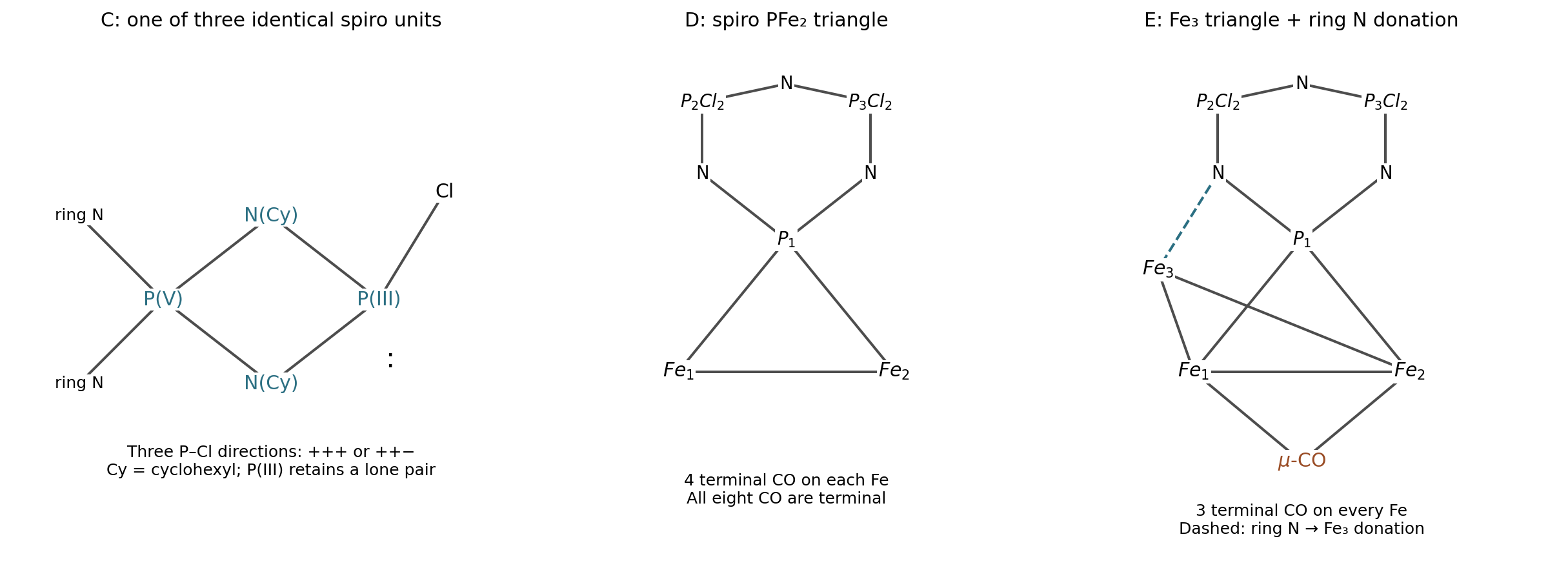

Replace the two chlorides on one ring phosphorus with the two ends of the diiron unit. has a spiro triangle, with an Fe–Fe bond, a –Fe bond to each metal and four terminal CO ligands on each Fe. The other two phosphorus atoms retain their groups. Its composition is . In neutral electron counting, each metal has .
has a triangular Fe cluster, one bridging CO, and an adjacent ring NFe bond. The two original metals remain bonded to and to one another, and each bonds to the added third Fe. Each Fe bears three terminal CO ligands; one additional bridging carbonyl ligand spans the original Fe–Fe edge. A nitrogen directly adjacent to donates its lone pair to the third Fe. The formula is therefore , satisfying retained CO ligands. The original diagram above gives all metal–metal and metal–ring connections.
The counts are an especially useful structural check. Each original Fe has . The added Fe has . Omitting nitrogen coordination leaves the third Fe two electrons short; omitting the bridging CO leaves both original metals one electron short.
In , the two untouched phosphorus sites are equivalent: an phosphorus-31 nuclear magnetic resonance system gives their doublet with integral 2, and the unique triplet with integral 1. The two equivalent nuclei do not split each other. In , coordination of one adjacent nitrogen distinguishes the two sides of the ring, producing three inequivalent phosphorus sites. Each couples to the other two and gives a doublet of doublets in the first-order limit; equal couplings or strong coupling could distort this simple pattern.
The high-frequency infrared spectroscopy bands belong to terminal carbonyl stretching modes. The extra low-frequency band is diagnostic of a strongly backbonded bridging carbonyl ligand. The number of IR bands counts allowed, possibly overlapping normal modes, not individual CO ligands. Formula, 18-electron rule, NMR equivalence and IR together select this model; the historical experimental work independently established diiron spiro rings and triiron products containing both P–Fe and N–Fe bonds.[ref]
Iron-Containing Metallophosphazenes and Their Clusters Derived from Chlorophosphazenes and Organometallic Dianions by Harry R. Allcock and others. 1984, pp. 4966–4977, diiron compound 2, triiron compound 3, and conversion with iron carbonyls
Articles by others on the same topic
There are currently no matching articles.