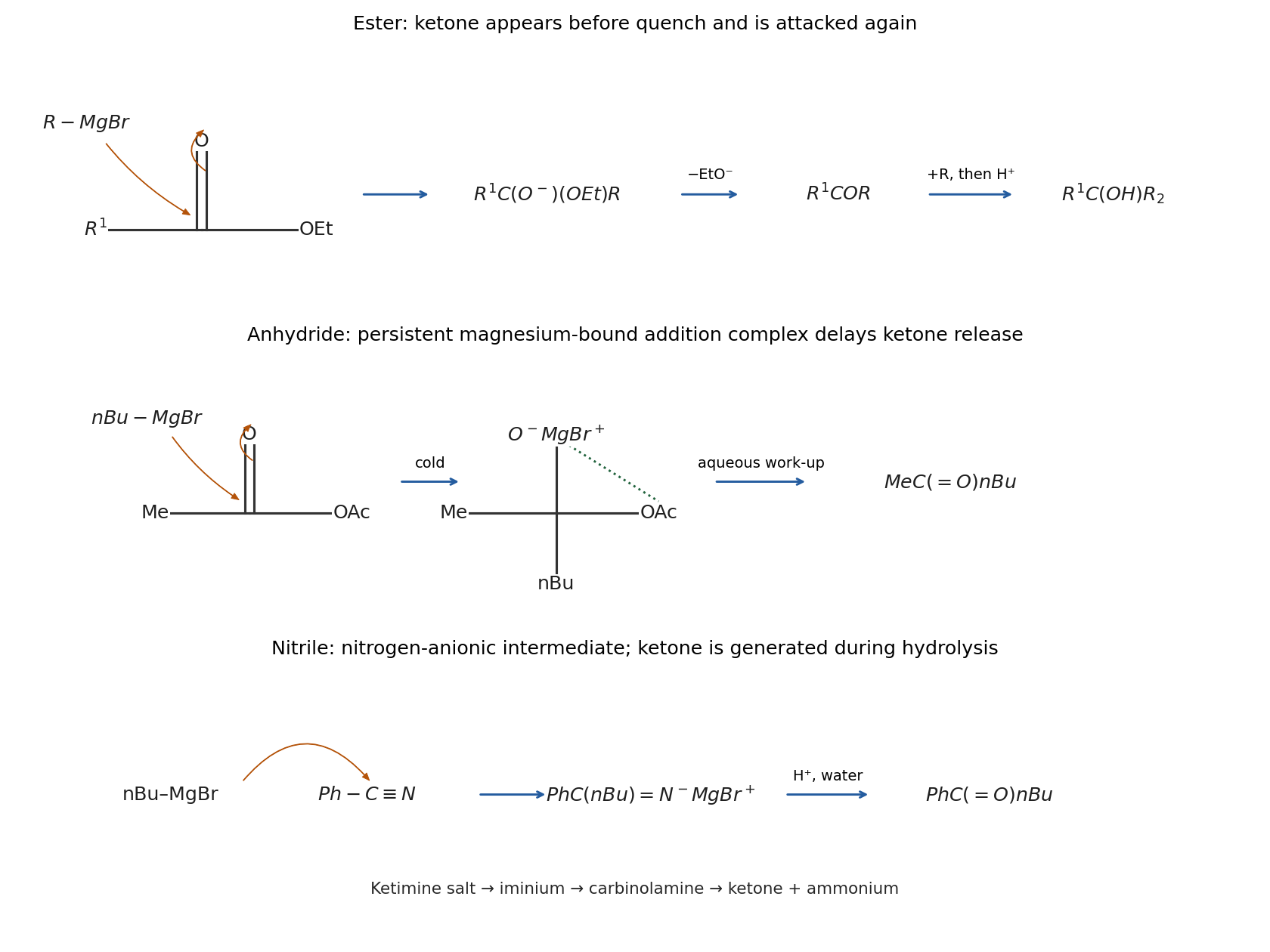
For the ordinary ester, the carbon nucleophile of a grignard reagent attacks the carbonyl carbon and moves the C=O pi pair onto oxygen. Collapse of the tetrahedral intermediate expels ethoxide, transiently giving . This ketone is more electrophilic than the starting ester because it lacks an alkoxy group's stabilizing resonance donation. A second equivalent of the grignard reagent therefore adds to it before isolation:The negatively charged intermediates are associated with magnesium counterions. Merely reducing the amount of reagent to one equivalent does not generally trap the ketone selectively; it can leave unreacted ester together with the double-addition product.
In the first successful preparation, magnesium insertion into the primary C–Br bond gives n-butylmagnesium bromide. The carbon chain has four carbons, so its acetylation produces hexan-2-one, , not pentan-2-one. Attack on acetic anhydride forms . Coordination of the anhydride-derived oxygens to magnesium can stabilize this tetrahedral addition complex. Under suitably cold, controlled-addition conditions it survives sufficiently to delay release of the free ketone until aqueous work-up has destroyed the remaining grignard reagent. Protonation followed by collapse releases acetate/acetic acid and the ketone.
This interpretation has direct experimental precedent: Melvin S. Newman and William T. Booth Jr. obtained methyl ketones by cold addition of grignard reagents to acetic anhydride, attributing selectivity to a persistent addition complex. The temperature and reagent-addition regime are genuine conditions on the explanation, rather than proof that an anhydride can never undergo overaddition; the exam scheme omits them.[ref]
The Preparation of Ketones from Grignard Reagents by Melvin S. Newman and William T. Booth Jr.. 1945, printed p. 154: proposed intermediate I and low-temperature dependence
For the benzonitrile route, n-butyl attacks the nitrile carbon and one C≡N pi pair moves to nitrogen, producing the magnesium ketimine salt . This anionic nitrogen-containing intermediate resists a second nucleophilic addition much more than a neutral carbonyl does. The ketone appears only during acidic aqueous work-up, after organomagnesium has been quenched. Protonation gives the iminium ion; water attacks its carbon, proton transfers give a carbinolamine, and C–N cleavage from its nitrogen-protonated form produces the protonated ketone and ammonia, followed by deprotonation. In the acidic mixture ammonia is present largely as ammonium. This sequence explains why nitrile addition stops at a ketone without requiring the ketone itself to be resistant to grignard reagents.
The atom-labelled hydrolysis sequence isWater's lone pair attacks the iminium carbon while its C=N pi pair moves to nitrogen; the carbinolamine oxygen then reforms C=O while the C–N pair moves to the departing protonated amino group. Final deprotonation gives the neutral ketone. The arrows involving protonation and hydrolysis also exchange protons with the acidic aqueous reservoir; the condensed sequence tracks the carbon–nitrogen and carbon–oxygen transformations rather than displaying every solvent molecule.

Articles by others on the same topic
There are currently no matching articles.