For the ordinary ester, the carbon nucleophile of a grignard reagent attacks the carbonyl carbon and moves the C=O pi pair onto oxygen. Collapse of the tetrahedral intermediate expels ethoxide, transiently giving . This ketone is more electrophilic than the starting ester because it lacks an alkoxy group's stabilizing resonance donation. A second equivalent of the grignard reagent therefore adds to it before isolation:The negatively charged intermediates are associated with magnesium counterions. Merely reducing the amount of reagent to one equivalent does not generally trap the ketone selectively; it can leave unreacted ester together with the double-addition product.
In the first successful preparation, magnesium insertion into the primary C–Br bond gives n-butylmagnesium bromide. The carbon chain has four carbons, so its acetylation produces hexan-2-one, , not pentan-2-one. Attack on acetic anhydride forms . Coordination of the anhydride-derived oxygens to magnesium can stabilize this tetrahedral addition complex. Under suitably cold, controlled-addition conditions it survives sufficiently to delay release of the free ketone until aqueous work-up has destroyed the remaining grignard reagent. Protonation followed by collapse releases acetate/acetic acid and the ketone.
This interpretation has direct experimental precedent: Melvin S. Newman and William T. Booth Jr. obtained methyl ketones by cold addition of grignard reagents to acetic anhydride, attributing selectivity to a persistent addition complex. The temperature and reagent-addition regime are genuine conditions on the explanation, rather than proof that an anhydride can never undergo overaddition; the exam scheme omits them.[ref]
The Preparation of Ketones from Grignard Reagents by Melvin S. Newman and William T. Booth Jr.. 1945, printed p. 154: proposed intermediate I and low-temperature dependence
For the benzonitrile route, n-butyl attacks the nitrile carbon and one C≡N pi pair moves to nitrogen, producing the magnesium ketimine salt . This anionic nitrogen-containing intermediate resists a second nucleophilic addition much more than a neutral carbonyl does. The ketone appears only during acidic aqueous work-up, after organomagnesium has been quenched. Protonation gives the iminium ion; water attacks its carbon, proton transfers give a carbinolamine, and C–N cleavage from its nitrogen-protonated form produces the protonated ketone and ammonia, followed by deprotonation. In the acidic mixture ammonia is present largely as ammonium. This sequence explains why nitrile addition stops at a ketone without requiring the ketone itself to be resistant to grignard reagents.
The atom-labelled hydrolysis sequence isWater's lone pair attacks the iminium carbon while its C=N pi pair moves to nitrogen; the carbinolamine oxygen then reforms C=O while the C–N pair moves to the departing protonated amino group. Final deprotonation gives the neutral ketone. The arrows involving protonation and hydrolysis also exchange protons with the acidic aqueous reservoir; the condensed sequence tracks the carbon–nitrogen and carbon–oxygen transformations rather than displaying every solvent molecule.
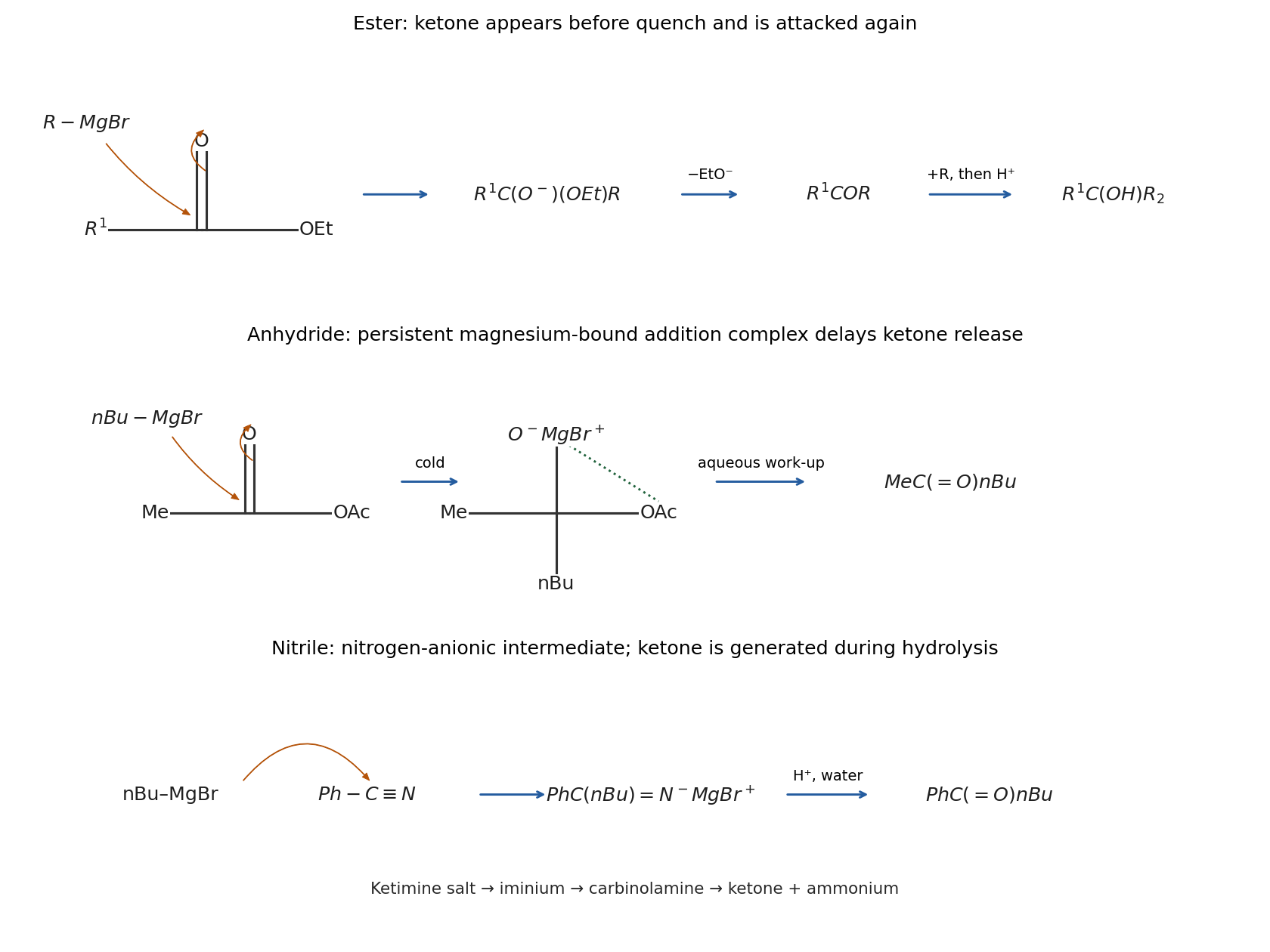
Original electron-flow summary contrasting ester overaddition with anhydride trapping and nitrile hydrolysis
. Details. The two starting ester groups are adjacent on the benzene ring. Select one ester carbon as the site receiving both incoming methyl groups. A first methyl addition gives a tetrahedral intermediate; its collapse expels methoxide to give the ortho-substituted ketone . A second methyl addition produces , with the alkoxide bound to magnesium.
The newly generated oxygen is now positioned to attack the remaining ester intramolecularly. Draw an arrow from its lone pair to that ester carbonyl and another from the C=O pi bond to its oxygen. Collapse of the resulting tetrahedral intermediate reforms the carbonyl and expels methoxide, closing a five-membered lactone. Protonation of magnesium-bound species in the work-up gives 3,3-Dimethylphthalide. Equivalently, protonation can first give the ortho hydroxy ester, followed by acid-assisted lactonization with loss of methanol; both descriptions show the same required bond formation.
The oxygen in the new ring is the oxygen of the first ester's original carbonyl; the surviving lactone carbonyl comes from the second ester. The product retains the six ring carbons and both original acyl carbons, loses the two ester methoxy carbons, and gains two carbons from methylmagnesium bromide. The favourable intramolecular five-membered closure accounts for the displayed product. It does not make the isolated lactone universally inert to a large excess of grignard reagent; stoichiometry and trapping/work-up conditions matter.
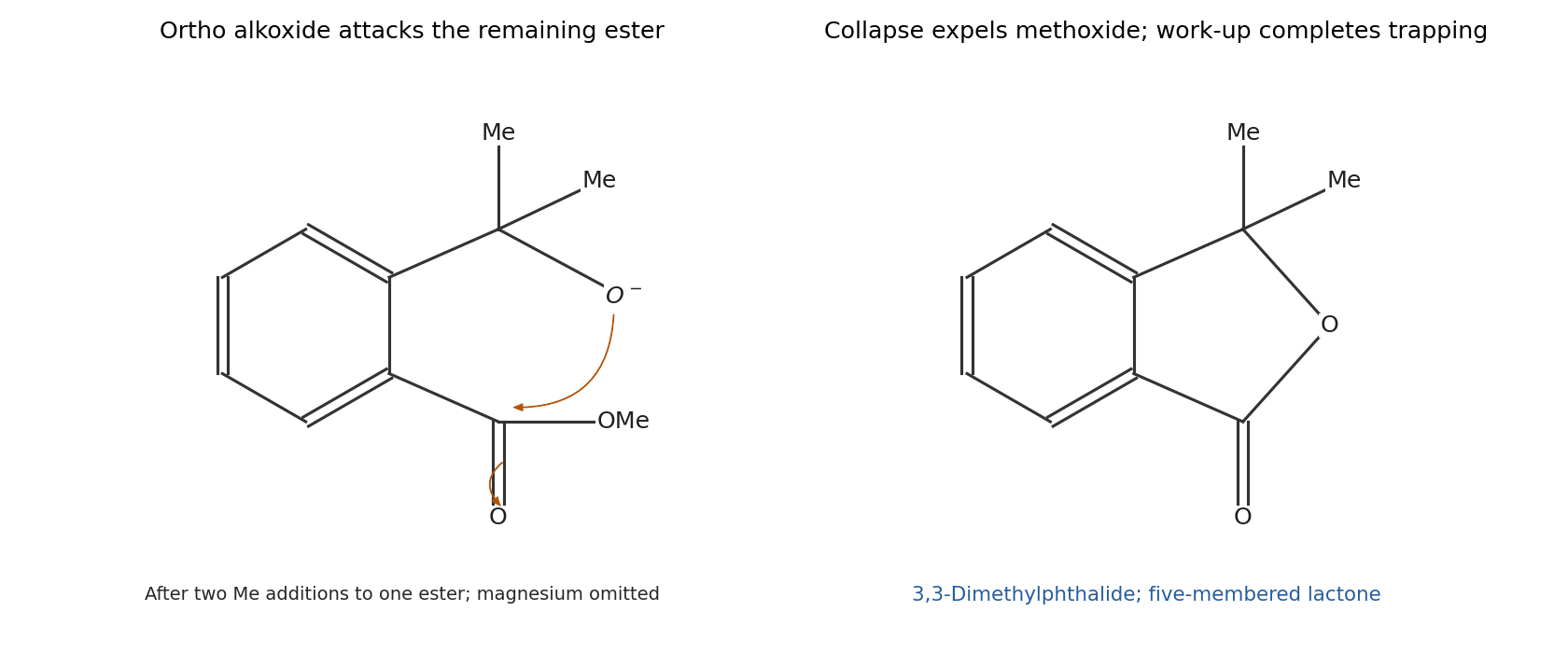
Original sequence of two methyl additions followed by five-membered lactone closure, with oxygen provenance retained
. Details. The oxygen substituent changes position through a halohydrin–epoxide sequence. First, hydroxide attacks the acetate carbonyl of , giving a tetrahedral intermediate. Collapse expels the substrate alkoxide, and proton transfer gives plus acetate. This is saponification, breaking the acyl–oxygen bond rather than replacing bromide directly with hydroxide.
A small equilibrium population of undergoes intramolecular SN2 reaction at the adjacent primary carbon: the O lone pair attacks and its C–Br pair leaves with bromide. The result is 2,2-Dimethyloxirane. Addition of HBr protonates the ring oxygen. bromide then attacks preferentially at the more substituted carbon, where the protonated ring has greater carbocation character, breaking that C–O bond and leaving oxygen attached to the former primary carbon:The middle formula denotes a three-membered epoxide, not an open-chain ether. Acidic opening of this highly unsymmetrical epoxide has the opposite regioselectivity to a simple basic nucleophilic opening at its less substituted carbon.
Finally, the primary alcohol oxygen attacks acetyl chloride. The tetrahedral intermediate collapses with chloride departure, and triethylamine removes the O–H proton and captures HCl. The product is . oxygen is carried through the epoxide to the other carbon; it is not necessary to invent a methyl migration or a carbon-skeleton rearrangement.
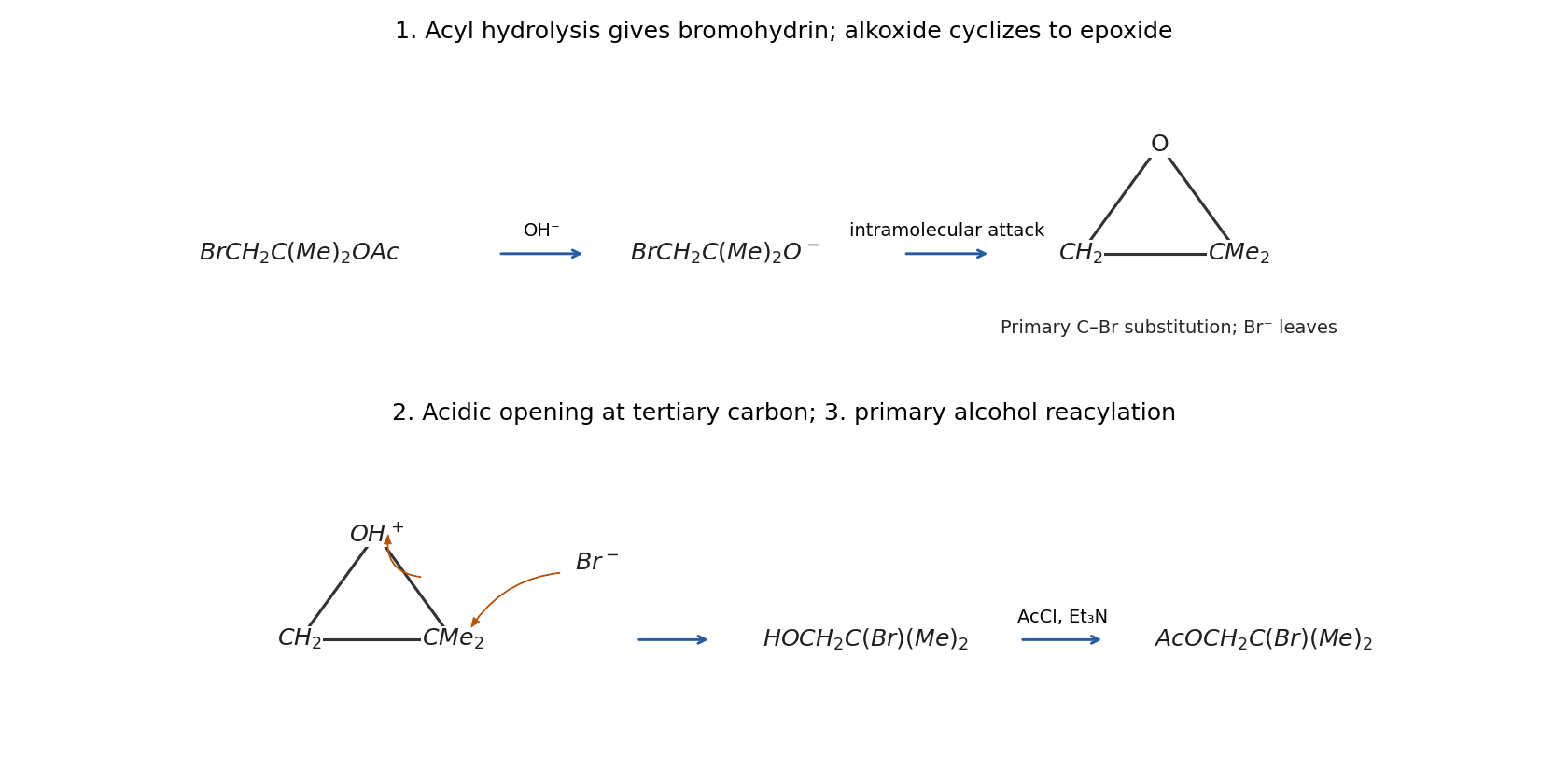
Original electron-flow drawing for bromohydrin cyclization, acid-directed epoxide opening and reacylation
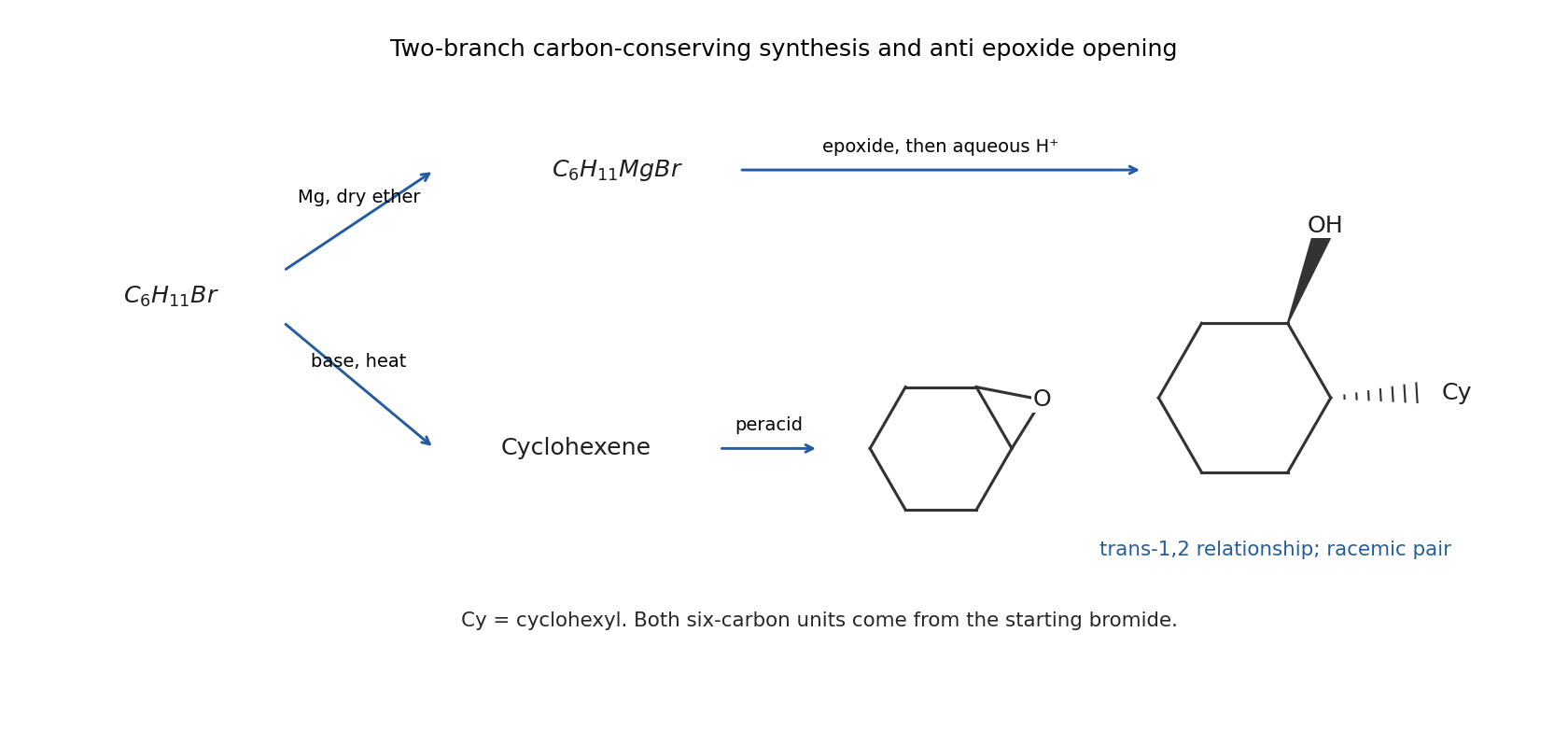
. Details. Disconnect the new bond between the two six-carbon units. One portion of bromocyclohexane supplies a grignard reagent; another supplies cyclohexene oxide:A bulky strong base can favour E2 elimination in the alkene-forming step; a peracid such as meta-chloroperoxybenzoic acid provides epoxidation. None of its carbons enters the target.
Treat cyclohexene oxide with cyclohexylmagnesium bromide, then perform acidic aqueous work-up. Backside attack on one epoxide carbon breaks its C–O bond and installs cyclohexyl opposite the retained oxygen. Protonation of the oxygen gives trans-2-cyclohexylcyclohexan-1-ol, the required relative configuration. The two six-carbon reactant portions supply all 12 target carbons. An achiral synthesis produces a racemic mixture trans pair; obtaining only the particular enantiomer represented by the drawing would require resolution or an enantioselective step. The useful stable chair can place the two large trans-1,2 substituents approximately diequatorial.


Articles by others on the same topic
There are currently no matching articles.