The two starting ester groups are adjacent on the benzene ring. Select one ester carbon as the site receiving both incoming methyl groups. A first methyl addition gives a tetrahedral intermediate; its collapse expels methoxide to give the ortho-substituted ketone . A second methyl addition produces , with the alkoxide bound to magnesium.
The newly generated oxygen is now positioned to attack the remaining ester intramolecularly. Draw an arrow from its lone pair to that ester carbonyl and another from the C=O pi bond to its oxygen. Collapse of the resulting tetrahedral intermediate reforms the carbonyl and expels methoxide, closing a five-membered lactone. Protonation of magnesium-bound species in the work-up gives 3,3-Dimethylphthalide. Equivalently, protonation can first give the ortho hydroxy ester, followed by acid-assisted lactonization with loss of methanol; both descriptions show the same required bond formation.
The oxygen in the new ring is the oxygen of the first ester's original carbonyl; the surviving lactone carbonyl comes from the second ester. The product retains the six ring carbons and both original acyl carbons, loses the two ester methoxy carbons, and gains two carbons from methylmagnesium bromide. The favourable intramolecular five-membered closure accounts for the displayed product. It does not make the isolated lactone universally inert to a large excess of grignard reagent; stoichiometry and trapping/work-up conditions matter.
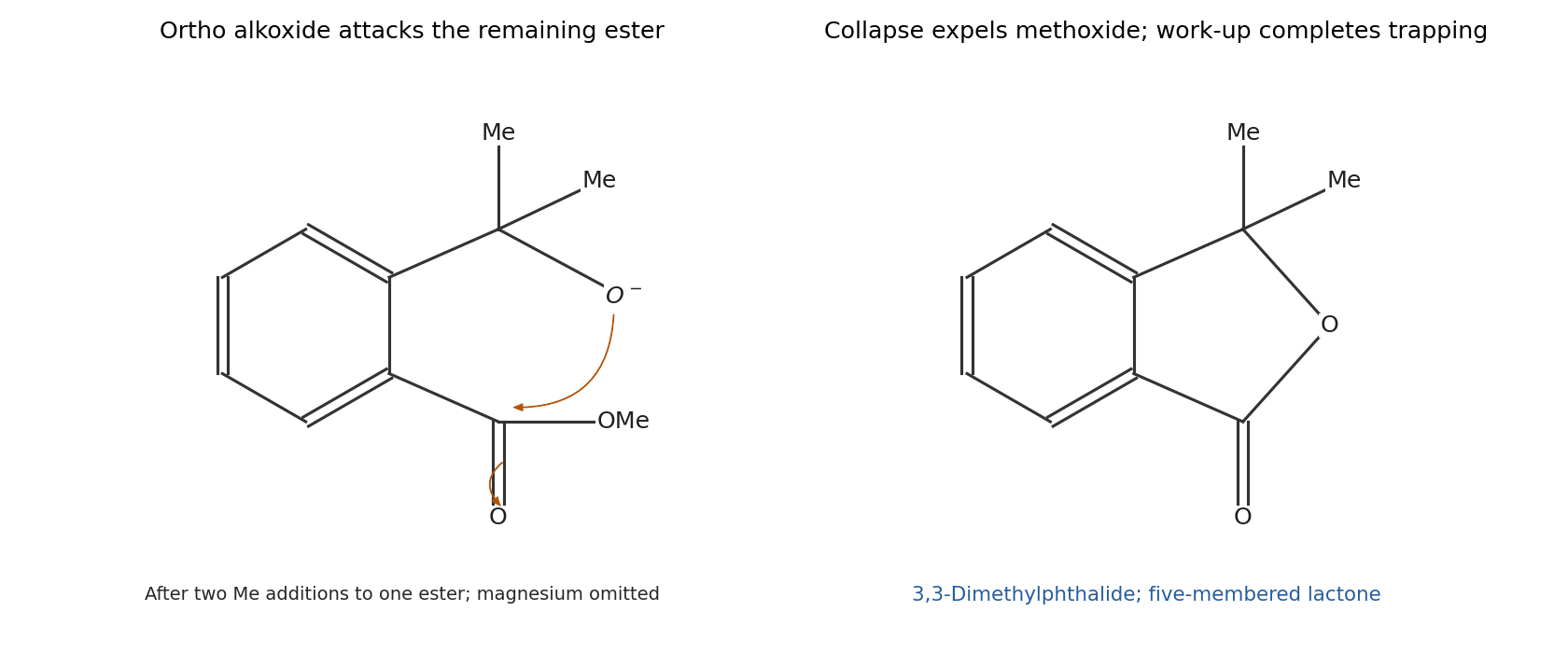
Original sequence of two methyl additions followed by five-membered lactone closure, with oxygen provenance retained
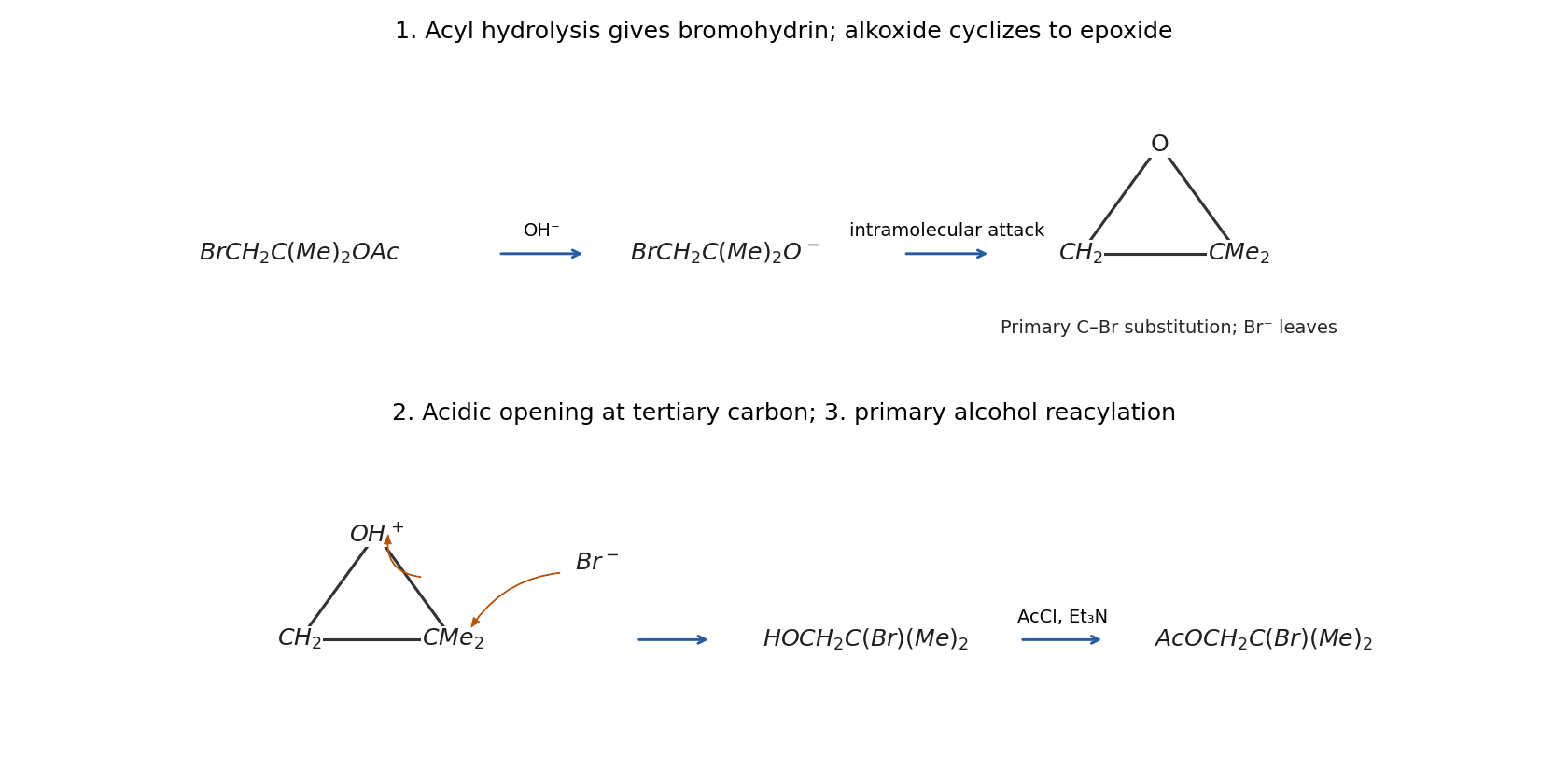
. Details. The oxygen substituent changes position through a halohydrin–epoxide sequence. First, hydroxide attacks the acetate carbonyl of , giving a tetrahedral intermediate. Collapse expels the substrate alkoxide, and proton transfer gives plus acetate. This is saponification, breaking the acyl–oxygen bond rather than replacing bromide directly with hydroxide.
A small equilibrium population of undergoes intramolecular SN2 reaction at the adjacent primary carbon: the O lone pair attacks and its C–Br pair leaves with bromide. The result is 2,2-Dimethyloxirane. Addition of HBr protonates the ring oxygen. bromide then attacks preferentially at the more substituted carbon, where the protonated ring has greater carbocation character, breaking that C–O bond and leaving oxygen attached to the former primary carbon:The middle formula denotes a three-membered epoxide, not an open-chain ether. Acidic opening of this highly unsymmetrical epoxide has the opposite regioselectivity to a simple basic nucleophilic opening at its less substituted carbon.
Finally, the primary alcohol oxygen attacks acetyl chloride. The tetrahedral intermediate collapses with chloride departure, and triethylamine removes the O–H proton and captures HCl. The product is . oxygen is carried through the epoxide to the other carbon; it is not necessary to invent a methyl migration or a carbon-skeleton rearrangement.


Articles by others on the same topic
There are currently no matching articles.