The physical curve has its bonding minimum near , with ionic endpoints at . Use electronic energies excluding the fixed . Define , , and . The one-electron contribution isThe Coulomb energy of the doubly occupied orbital isso . For localized orthogonal orbitals, a transparent illustrative approximation neglects integrals involving the product and retains the on-site repulsion and intersite direct repulsion :Since normally , spreading the occupied orbital over both atoms reduces the repulsion. At equilibrium the bonding one-electron term favours , so the minimum represents the Restricted Hartree-Fock method approximation to . At or , both electrons occupy one atom, giving the same ionic energy . At the orbital is antibonding and the one-electron contribution is raised.
The diagram below uses an illustrative set of integrals to show these landmarks; it is not a numerical calculation for the molecule. Zero orbital overlap alone does not force every exchange or three-index Coulomb integral to vanish, so the simplified expression is an explicit sketching approximation, not a consequence of orthogonality.
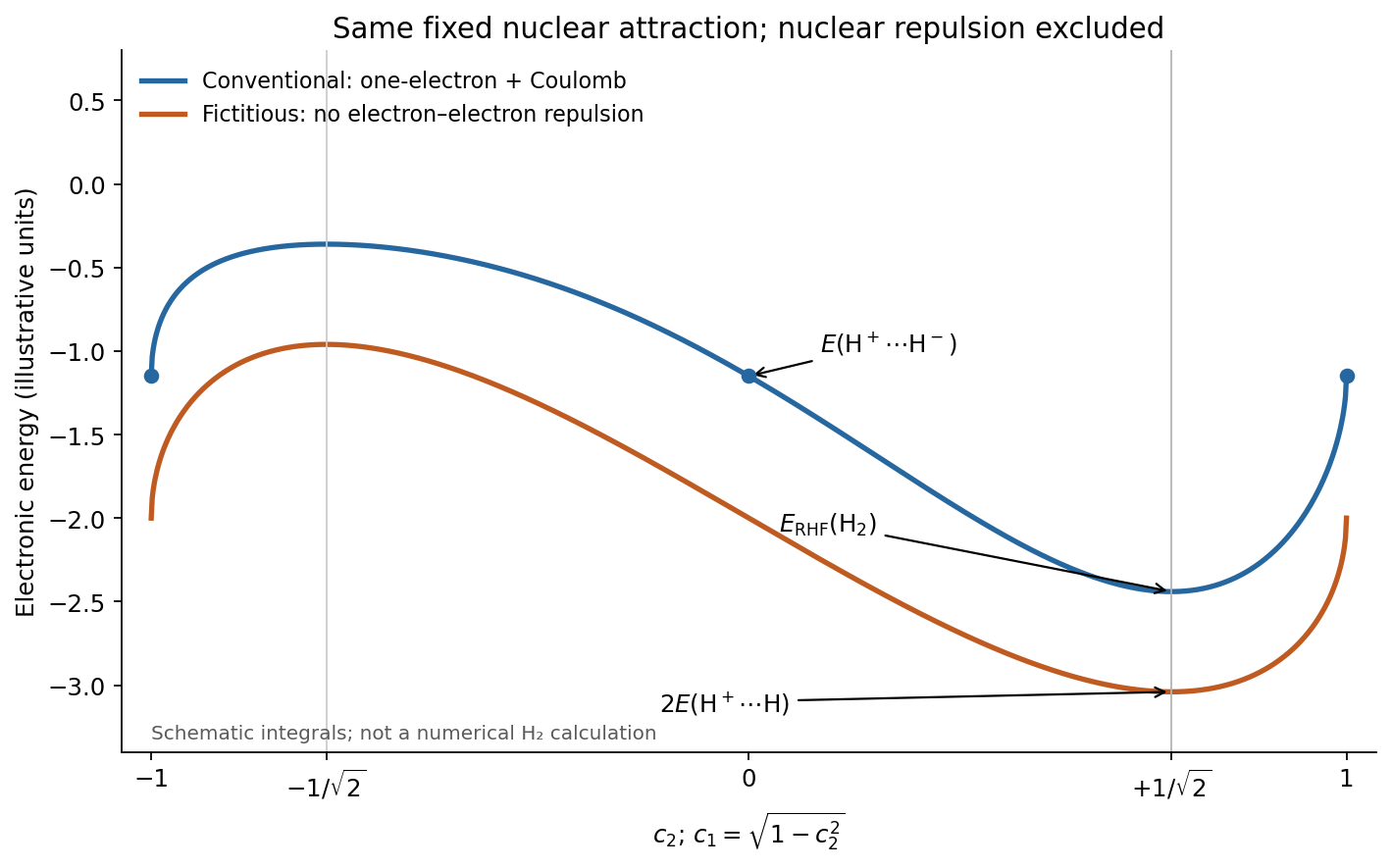

Removing electron–electron repulsion lowers the entire curve and exaggerates the bonding stabilization. In the same fixed-orbital notation and electronic-energy convention,Its minima and maxima occur at and , respectively; all three localized points have energy . The physical curve lies above it by the positive Coulomb expectation .
For the one-electron problem, the bonding energy is . Two noninteracting opposite-spin electrons may both occupy that orbital, so the lower curve's bonding minimum isThis is the third requested energy label in the common graph. If total molecular energies include nuclear repulsion, the corresponding identity is , because the two-electron molecule contains only one nuclear pair. An effective one-electron potential re-fitted after removing repulsion would be a different comparison; here the same kinetic and nuclear-attraction operators are retained.
Articles by others on the same topic
There are currently no matching articles.