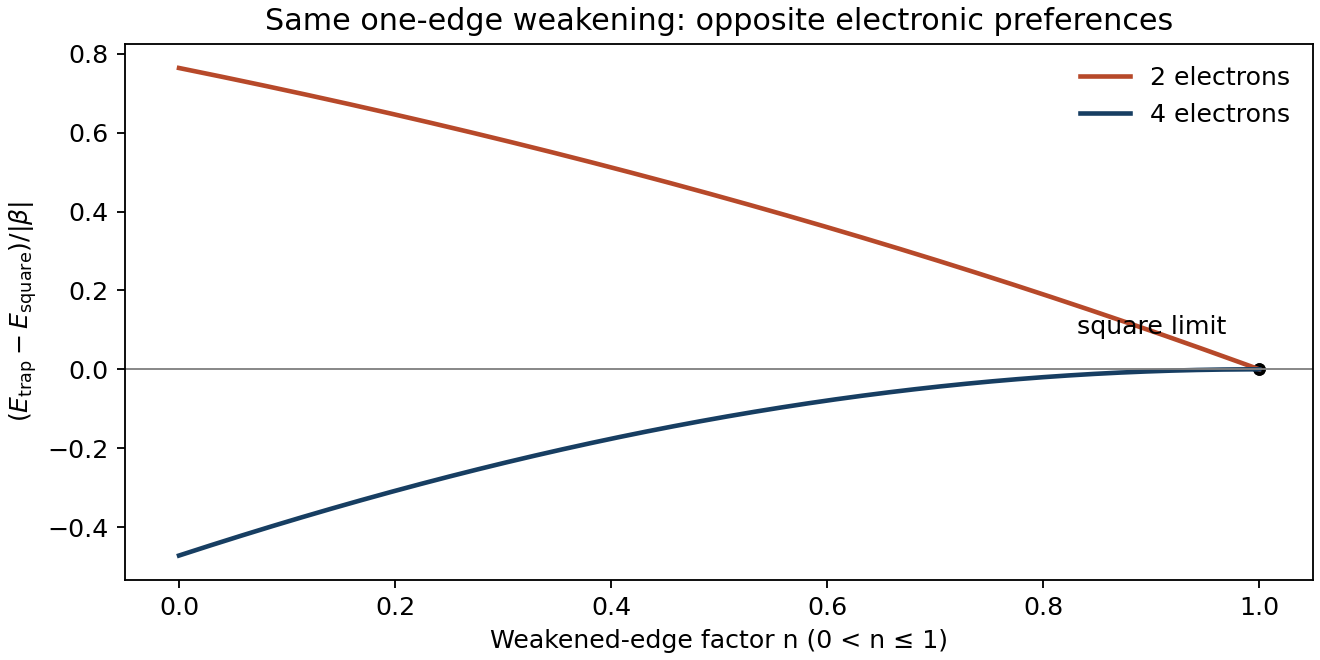
For two electrons, whenever : both sides of are positive and squaring reduces the inequality to . Since , the trapezium then has a higher total electronic energy than the square. The two-electron model favours the square. For four electrons, , so : the four-electron model favours the distortion toward a trapezium. The lower split middle orbital is occupied while the upper one is empty.
The distinction is especially clear near the square. Write ; then andIn particular the four-electron lowering in this specified one-edge model is quadratic near the square; a first-order lowering of the entire occupied sum should not be asserted merely from the middle-level splitting. This Hückel square-to-trapezium distortion is an electronic comparison under the stated fixed-, fixed-short-edge- assumptions. Nuclear repulsion, other bonding contributions and the structural cost of distortion are omitted, so an actual equilibrium geometry or optimum is not determined by this calculation alone.

Articles by others on the same topic
There are currently no matching articles.