Original paper: Released Cambridge examination PDF, physical pages 73–87; printed question pages 1–13.
Quantum tunnelling is penetration of, or transmission through, a finite potential barrier into a classically forbidden region, where the total energy is less than the potential energy. The wavefunction generally remains nonzero there, so the Born rule assigns a nonzero probability of detection. This does not require an increase in total energy; it is the classical relation between a definite position and a definite kinetic energy that cannot be imposed on the quantum state. For a bound quantum harmonic oscillator, the relevant quantity is the probability of finding the particle beyond its classical turning points; it is not an escaping transmitted beam.
For the reduced quantum harmonic oscillator, and the ground-state energy is . Thus the classical turning points satisfy , giving . Normalizing the wavefunction gives , because . The Born rule therefore gives the harmonic-oscillator forbidden-region probabilityThe factor two includes both tails. Using the exact complementary error function gives . A stationary real wavefunction has zero probability current, so this result describes forbidden-region occupancy, not continuous loss of the bound particle.
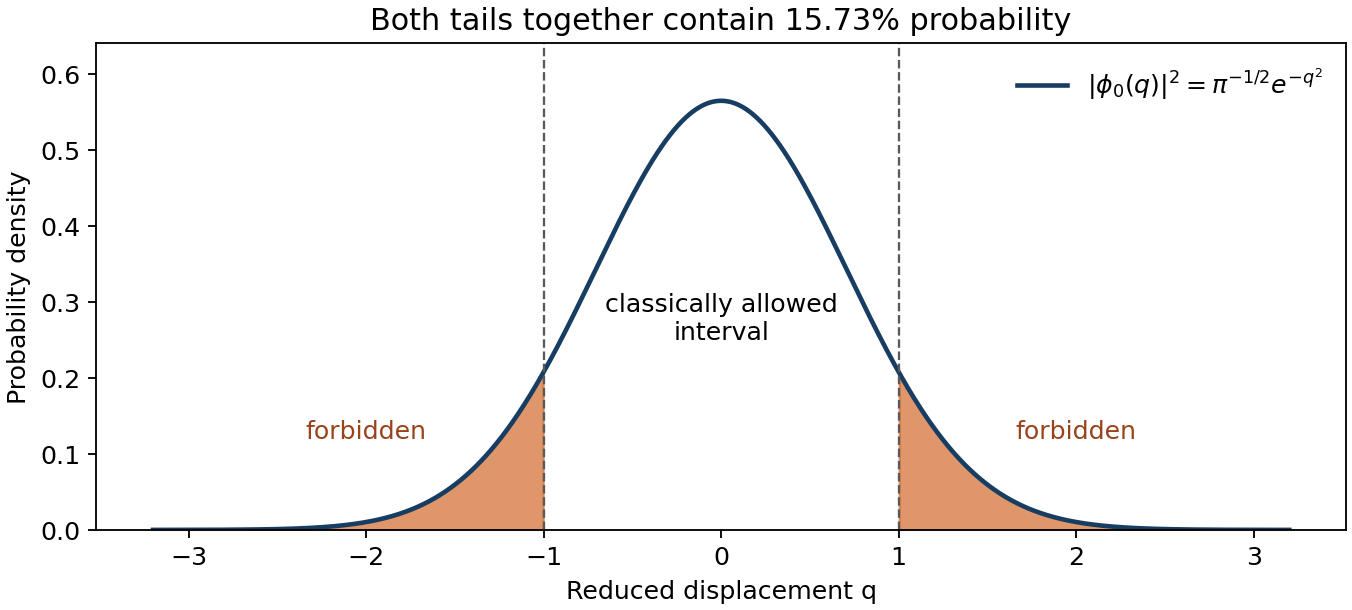
Normalized ground-state probability with both classically forbidden tails shaded
. Details. Inside the infinite square well, the Hamiltonian is purely the kinetic energy operator,Its admissible wavefunctions obey the boundary conditions and vanish outside the interval. Equivalently write with inside and an infinite confining wall outside. The boundary conditions are part of the specification of this Hamiltonian; the differential expression alone does not determine the spectrum.
Twice differentiating gives , so inside the infinite square wellThe boundary condition at zero is automatic. The other requires , hence . A nonzero eigenfunction can therefore be labelled byIf desired, its normalized form is . The positive lowest energy follows from confinement and the required spatial variation of a nonzero wavefunction.
For the proposed wavefunction vanishes identically and cannot be normalized. A negative integer gives , which differs from the corresponding positive-integer wavefunction only by a physically irrelevant global phase. Both have the same positive energy, proportional to . Thus zero is inadmissible and negative labels are redundant. A negative integer is not forbidden by a separate negative-energy argument.
Within a specified electron configuration in the LS coupling regime, Hund's rules select the lowest atomic term as follows. First maximize the total electron spin subject to the Pauli exclusion principle. Among the terms having that , choose the largest total orbital angular momentum . Finally, spin-orbit coupling places the smallest allowed lowest for a subshell less than half full, and the largest lowest for a subshell more than half full. At half filling the maximum-spin term has , hence . These rules rank terms within configurations; the exceptional neutral-atom configurations of chromium and copper must also be used.
For chromium the configuration is . The half-filled subshell has and ; aligning the spin gives , while . Therefore the ground-state term symbol is . For cobalt, has a closed pair. The subshell has the same possible values as three holes; maximizing spin and then orbital angular momentum gives , . Because it is more than half full, , giving . For copper, has a closed subshell, leaving , and . These are neutral-atom terms, rather than the terms of the common metal ions. The tabulated zero-energy levels independently confirm all three assignments.[ref][ref]
Energy Levels of Neutral Cobalt (Co I) by National Institute of Standards and Technology. Co I table, ground row 3d7 4s2 4F9/2
[ref]Energy Levels of Neutral Copper (Cu I) by National Institute of Standards and Technology. Cu I table, ground row 3d10(1S)4s 2S1/2
For the character of a localized orbital basis, take the trace of the transformation matrix: both permutation of centres and signs of atomic orbitals matter. The two metal centres lie on the principal axis and remain fixed under rotation about . At either metal the basis has the matrixThe full four-dimensional group representation is block diagonal with two such blocks. Consequently , and for the rotation of the D6h molecular point group, .
A rotation leaves both metal centres fixed but reverses each transverse p orbital: and . Its matrix is , so its character of a representation is , also obtained from .
Choose transverse directions parallel and perpendicular to the vertical mirror plane. At each metal the parallel p orbital is unchanged, whereas the perpendicular p orbital changes sign. Thus each two-dimensional block has trace . The total character of a representation is . A mirror plane passing through an orbital centre does not imply that every orbital on that centre contributes .
Use the axes actually printed: the two hydrogens lie in the plane, is the principal twofold axis, and is perpendicular to that plane. For a Cartesian-displacement group representation, only atoms left at their own sites contribute to the trace; their vector components must also be transformed. In the order , identity fixes six components, the twofold rotation exchanges the hydrogens, the reflection fixes both hydrogens with vector matrix , and the reflection exchanges them. ThereforeThe nonzero mirror character of a representation is , not six.
The C2v molecular point group has four one-dimensional irreducible representations. In the operation order used above, the character table rows are , , and . Their character inner products with giveHence , whose dimensions sum to six. The labels refer to the source axes; swapping and swaps these names.
Fix the positive lobes of the real atomic orbitals along the printed positive axes, and write , , and . A coordinate model consistent with the figure is , , and , with . For the D2d molecular point group, take the two transverse twofold axes along and , with vertical mirrors and . The character table row on is . The character projection operator isThe eight signed images needed for this projection areso . Under the standard orthonormal atomic orbital approximation its squared norm is . Therefore the normalized symmetry-adapted linear combination isAn overall minus sign describes the same quantum state; changing one local atomic orbital phase requires changing its coefficient too. If intersite orbital overlap were retained, normalization would instead use the overlap matrix.
Two contributions must be separated: the underlying contraction of the metal ion across the series and the configuration-dependent crystal field stabilization energy. Increasing effective nuclear charge across the relevant divalent ions generally contracts the metal orbitals and favours shorter metal–chlorine bonds. Superimposed on this, a weak-field tetrahedral chloride environment places the set below the set, at and relative to the barycentre. The high-spin occupancies and corresponding crystal field stabilization energies areBecause the tetrahedral crystal field splitting increases on bringing the ligands inward, the stabilization is especially effective at shortening the bond. Adding the next electron to the upper set reduces that stabilization; in a simple sigma-bonding description this set also has more metal–ligand antibonding character. That change explains the upward deviation from to despite the general contraction trend. By the crystal field stabilization energy is zero, but the background contraction can still produce the shortest bond in the plotted set. Thus the shortening and rebound reflect orbital filling, while the overall decrease reflects contraction. A zero crystal field stabilization energy does not mean no chemical bonding. Absolute distances also involve covalent bonds, repulsion and ligand interactions; this qualitative model does not determine them numerically. No inference about the missing distance is required.
The planar benzene structure has a sixfold principal axis normal to its plane, six transverse twofold axes, the molecular mirror plane and an inversion centre. Its molecular point group is , the D6h molecular point group.
The fulvene structure has an in-plane twofold axis through the exocyclic double bond and the opposite part of the five-membered ring. The molecular plane and a plane perpendicular to it containing that axis are both mirrors. There is no perpendicular sixfold axis or inversion centre. Its molecular point group is , the C2v molecular point group.
For hexa-1,5-diyne in the extended anti conformation drawn, inversion at the midpoint of the central carbon–carbon bond exchanges the two identical ends. A twofold axis through that midpoint perpendicular to the carbon skeleton plane, together with the mirror plane of that skeleton, completes the C2h molecular point group. The methylene hydrogens occur in the corresponding mirror-related pairs. Thus the answer is . The whole molecule is not linear simply because its terminal triple-bond fragments are linear; the conformation is essential to this assignment.
The planar three-radialene structure has a threefold axis normal to the plane, three in-plane twofold axes and the molecular plane as a horizontal mirror. Therefore its molecular point group is , the D3h molecular point group. Its threefold connectivity does not supply a sixfold axis.
The folded benzvalene cage has one twofold axis and two mirror planes containing it. The double-bonded edge distinguishes it from cages having higher rotational symmetry; it has neither an inversion centre nor a horizontal mirror perpendicular to the twofold axis. Its molecular point group is , the C2v molecular point group.
For a self-adjoint Hamiltonian bounded below, every nonzero admissible trial wavefunction satisfies the quantum variational principleHere is the lowest exact energy, and the trial function must obey the physical boundary conditions and have finite relevant integrals. Equality holds for a wavefunction in the ground-state eigenspace. The quotient is unchanged by normalization or any nonzero overall scalar.
Expand the trial wavefunction in a complete orthonormal set of exact eigenfunctions, , with and . The coefficients may depend on any chosen variational parameters. Orthogonality removes the cross terms in both integrals, givingConsequentlyThis proves the quantum variational principle. The denominator is positive because the trial function is nonzero. Equality requires every occupied exact state to have , allowing for ground-state degeneracy. With a continuous part of the spectrum, the corresponding nonnegative spectral integral gives the same conclusion.
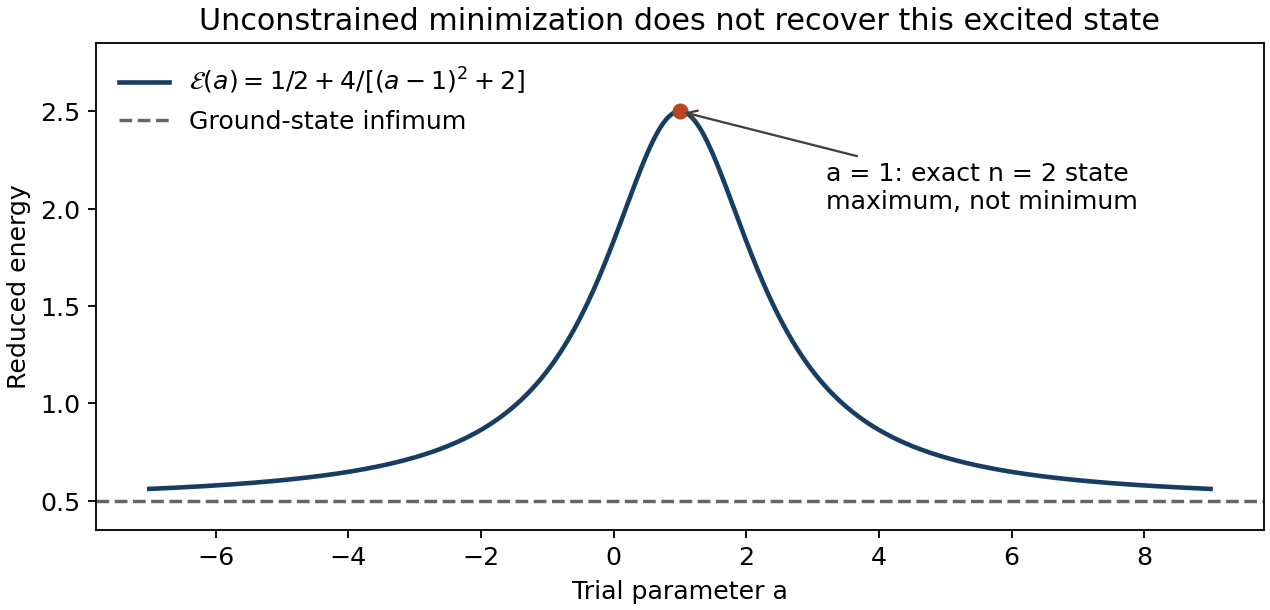
Write and . Product differentiation for the reduced quantum harmonic oscillator givesFor an eigenfunction, this must equal at every . Matching the coefficients gives , and matching constants then gives . Hence and . This is the even oscillator state. Its normalized wavefunction is .
Direct evaluation of the Rayleigh quotient exposes a problem with the requested minimization. Using the supplied Gaussian integrals,ThusThe eigenfunction value is a maximum, not a minimum. Indeed , whereas is already lower. There is no finite minimizing in this family: its infimum is , approached as , when the normalized trial wavefunction approaches the ground state. This is consistent with the quantum variational principle. The original printed instruction in this subpart is therefore inconsistent as an unconstrained minimization; a stationary Rayleigh quotient need not be a minimum.
The intended excited state can instead be obtained by imposing an excited-state variational constraint. Orthogonality to the ground state requireswhich fixes . Every member of the family is even, so it is already orthogonal to the odd state. With the ground state excluded, the lowest allowed oscillator energy is therefore . In the exact oscillator basis, is proportional to , making both the maximum and the orthogonality correction transparent.
Exact solutions of the Schrödinger equation are unavailable for most interacting or realistic molecular systems. The quantum variational principle turns the search for a ground-state wavefunction into optimization of a computable energy quotient in a tractable trial family. The result is an upper bound: enlarging a nested trial space can only lower or preserve the optimized energy, providing a systematic convergence check. Trial functions can incorporate boundary conditions and known symmetry before calculation. Near an exact normalized ground state, a small orthogonal wavefunction error changes the energy only to second order, which explains why useful energies can result from imperfect trial functions. This does not ensure that every other observable is equally accurate, nor that a restricted trial family captures correlation adequately. Excited states require orthogonality or appropriate symmetry restrictions; unrestricted minimization seeks the ground state, as the preceding calculation demonstrates.
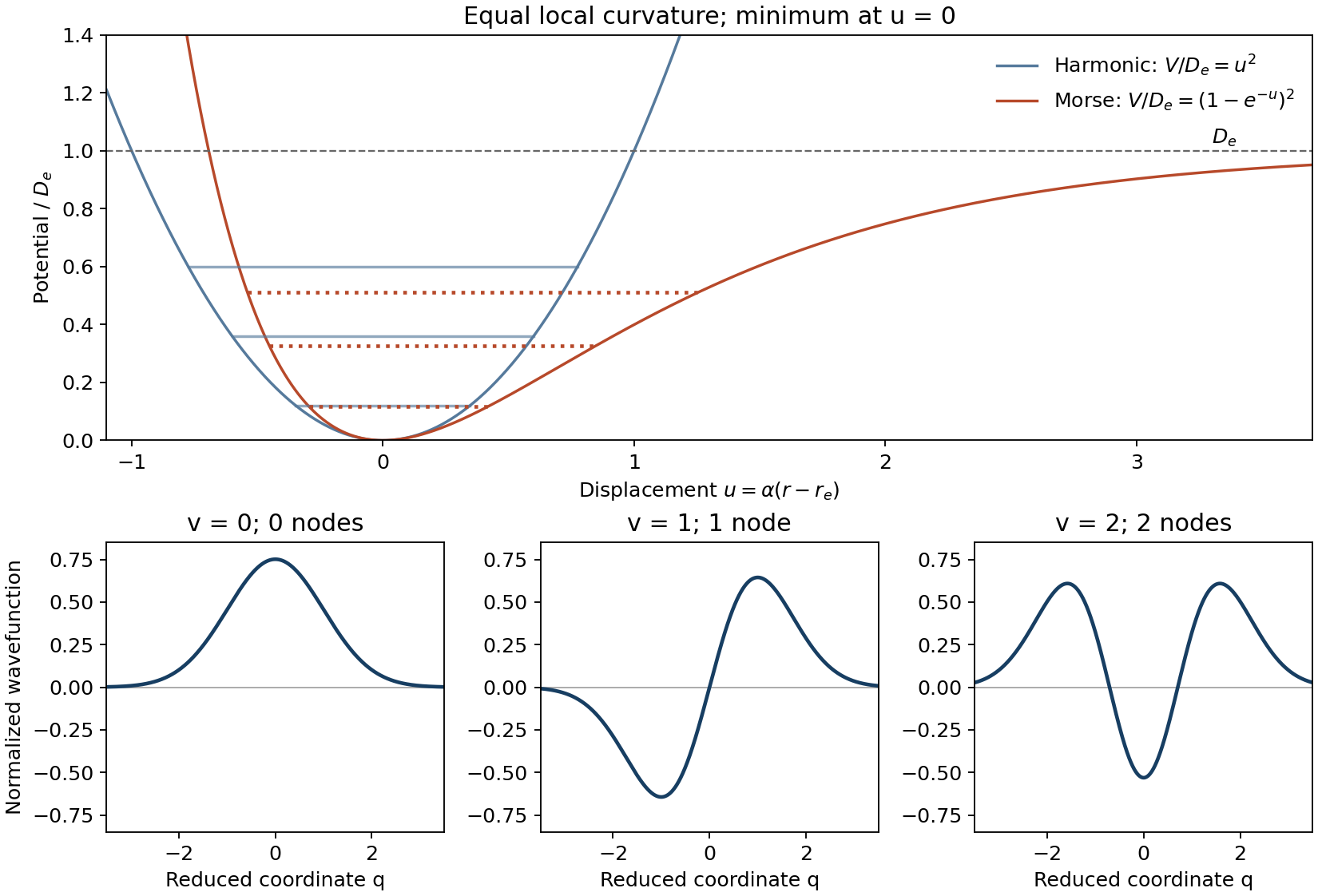
Let measure displacement from the equilibrium bond length and put the minimum of potential energy at zero. The harmonic model and the Morse potential areThe harmonic approximation is a symmetric parabola and has no dissociation limit. The Morse potential has a steep compressed side and a shallower extended side, approaching as . Matching the curvatures at the minimum gives . With denoting a spectroscopic wavenumber rather than an angular frequency, the energy levels areHere is the dimensionless spectroscopic anharmonicity constant. The harmonic spacing is constant, while the Morse oscillator spacing is and decreases as the levels approach dissociation. Only finitely many Morse oscillator levels are bound. The exactly solvable potential was introduced to model this anharmonic behaviour.[ref]
Diatomic Molecules According to the Wave Mechanics. II. Vibrational Levels by Philip M. Morse. Physical Review 34 (1929), pp. 57–64, potential and bound-level solution
For the harmonic model put , with , and . The first three normalized reduced-coordinate wavefunctions areTheir numbers of nodes are zero, one and two, and their parities are even, odd and even. The nodes are at . The diagrams below use analytic curves and arbitrary illustrative scales, with both potentials given the same local curvature.
Write and complete the square in the Morse oscillator energy:The finite bound-level sequence approaches the dissociation limit at the vertex of this extrapolated parabola. Thus the bond potential-well depth isThe continuous vertex is a convenient way to identify the limit; it is not an additional normalizable bound level at the threshold.
The ground-state dissociation energy starts at the lowest vibrational level, rather than the minimum of the potential. The zero-point energy of the Morse oscillator isSubtracting it from the bond potential-well depth givesThis distinction matters whenever a dissociation energy is inferred from a vibrational spectrum.
The strong band is the vibrational fundamental, and the weaker band near twice its wavenumber is the first vibrational overtone. At room temperature these high-frequency oscillators have overwhelmingly ground-state vibrational populations. In the harmonic-potential, linear-dipole limit the infrared selection rule is ; anharmonicity and nonlinear dipole dependence make the overtone weakly allowed. A hot band would lie near, and slightly below, the fundamental wavenumber, rather than near twice it.
Let and denote the measured fundamental and first-overtone wavenumbers, and put . Differences of the Morse oscillator levels giveConsequently , and . Substituting the two pairs of measured bands gives the following derived quantities:The conversion is , after multiplication by and consistent length units. Therefore the requested ground-state dissociation energies are and . The corresponding potential-well depths are and . These are extrapolations under the stipulated Morse oscillator model; two low-lying bands do not establish the accuracy of the real potential near dissociation.
The molecule with the larger inferred dissociation energy is assigned the stronger hydrogen–halogen bond: and . Moving from bromine to the larger iodine atom generally lengthens the bond and reduces effective overlap with the compact hydrogen orbital, so hydrogen iodide is more weakly bound. Independently, the tabulated ground-state harmonic constants near for hydrogen bromide and for hydrogen iodide agree with the inferred assignment.[ref]
Hydrogen bromide: Constants of diatomic molecules by Klaus P. Huber and others. Ground X 1Sigma+ row, harmonic wavenumber 2648.975 cm−1
[ref]Hydrogen iodide: Constants of diatomic molecules by Klaus P. Huber and others. Ground X 1Sigma+ row, harmonic wavenumber 2309.014 cm−1
The ordering is the identification criterion; the low-level Morse oscillator extrapolations above should not be presented as measured dissociation energies.The operator describes the component of angular momentum, whereas describes its total squared magnitude. For a spherical harmonic the corresponding eigenvalues areThus the magnitude is , not . For ordinary orbital rotation and . The simultaneous values are possible because these two operators commute.
Normalization of a wavefunction on the unit sphere uses solid angle , not the flat measure . Since ,where . ThereforeWith the usual phase convention this is the spherical harmonic . An arbitrary global unit-modulus factor would not change normalization or any observable.
The azimuthal derivative is , so . For the polar part of the angular Laplacian,Their sum is , hence . Comparing these two eigenvalues with and gives , . The sign of follows from both minus signs in the calculation.
For a linear rigid rotor, dividing the angular momentum squared eigenvalue by twice the moment of inertia givesThe quantum degeneracy counts the values with the same energy. It excludes nuclear-spin multiplicity and any fine or hyperfine splitting absent from this model.
Express the rotational constant as a spectroscopic wavenumber . The rotational absorption selection rule givesSuccessive lines therefore have spacing , regardless of the starting . Both observed spacings are , giving . The three lines are consequently the , and transitions within the stated precision; the first observed line is not the line.
Using the given isotopic masses, the reduced mass isWith and in , the bond length follows fromThe small common offset relative to integer multiples of the spacing is immaterial at the precision of this model. A real ground-vibrational-state rotational constant determines an effective vibrationally averaged bond length; it need not equal the exact equilibrium separation.
The drawn axes pass through opposite sites, rather than along the square edges. In the D4h molecular point group class order , an s orbital contributes whenever its centre is fixed and zero otherwise. ThusFor example, a transverse twofold rotation about the printed axis fixes sites 1 and 3, while its diagonal counterpart exchanges all four sites. Reflection in the square plane fixes every site. Taking character inner products, with class sizes , givesThese have dimensions . The label is tied to the printed diagonal-axis convention; rotating the transverse coordinate labels by would interchange and .
Treat the site atomic orbitals as orthonormal, as in the Hückel method. A normalized set of symmetry-adapted linear combinations isThe first combination is unchanged by every operation; the alternating combination has the transformation signs of for the printed axes. The last two transform together like . The squared coefficients sum to one in each case, and their pairwise inner products vanish. Any orthogonal rotation of the two combinations is an equally valid basis for that degenerate subspace.
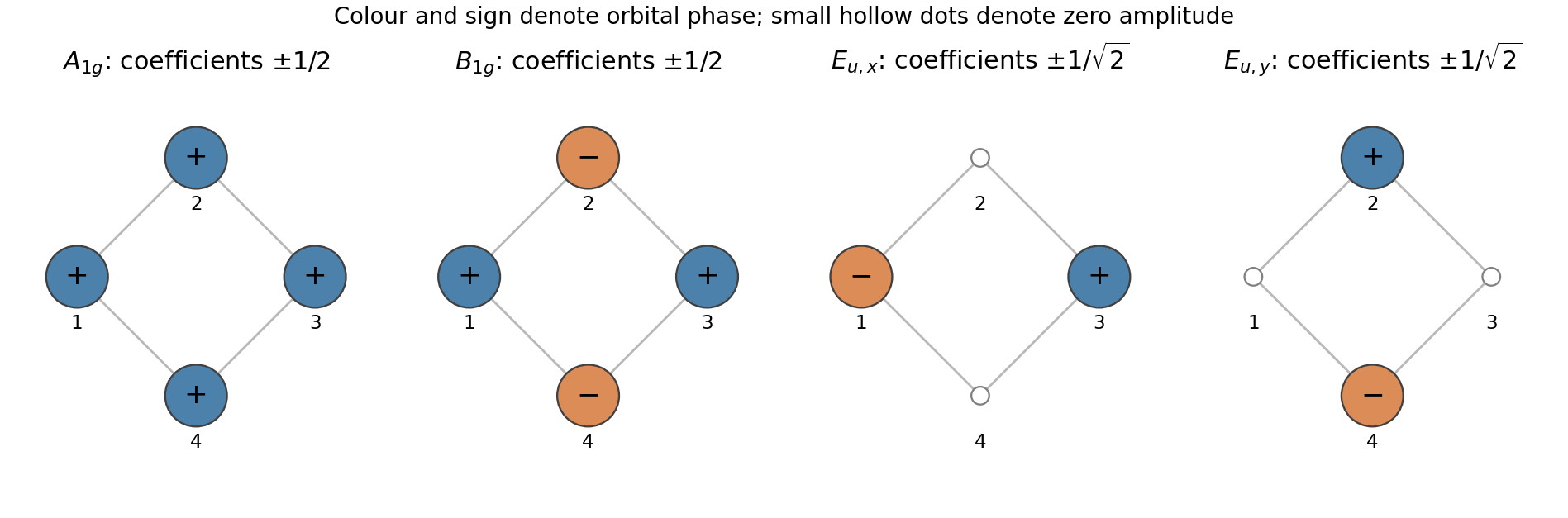
Use a common Coulomb integral on each site, a resonance integral on each adjacent pair, zero interaction across a diagonal, and the identity overlap matrix. In site order the Hückel method givesApplying it to the four symmetry-adapted linear combinations givesFor the conventional bonding sign , the all-in-phase combination is lowest and the alternating combination is highest. The combinations have canceling nearest-neighbour interactions and are nonbonding within this model.
The molecular orbital diagram has one level at labelled , two degenerate levels at labelled , and one level at labelled , in increasing energy for . Each spatial molecular orbital admits two opposite-spin electrons. The diagram below also shows how one representative distortion lifts the middle degeneracy; the distorted scale is illustrative, not a fitted molecular spectrum.
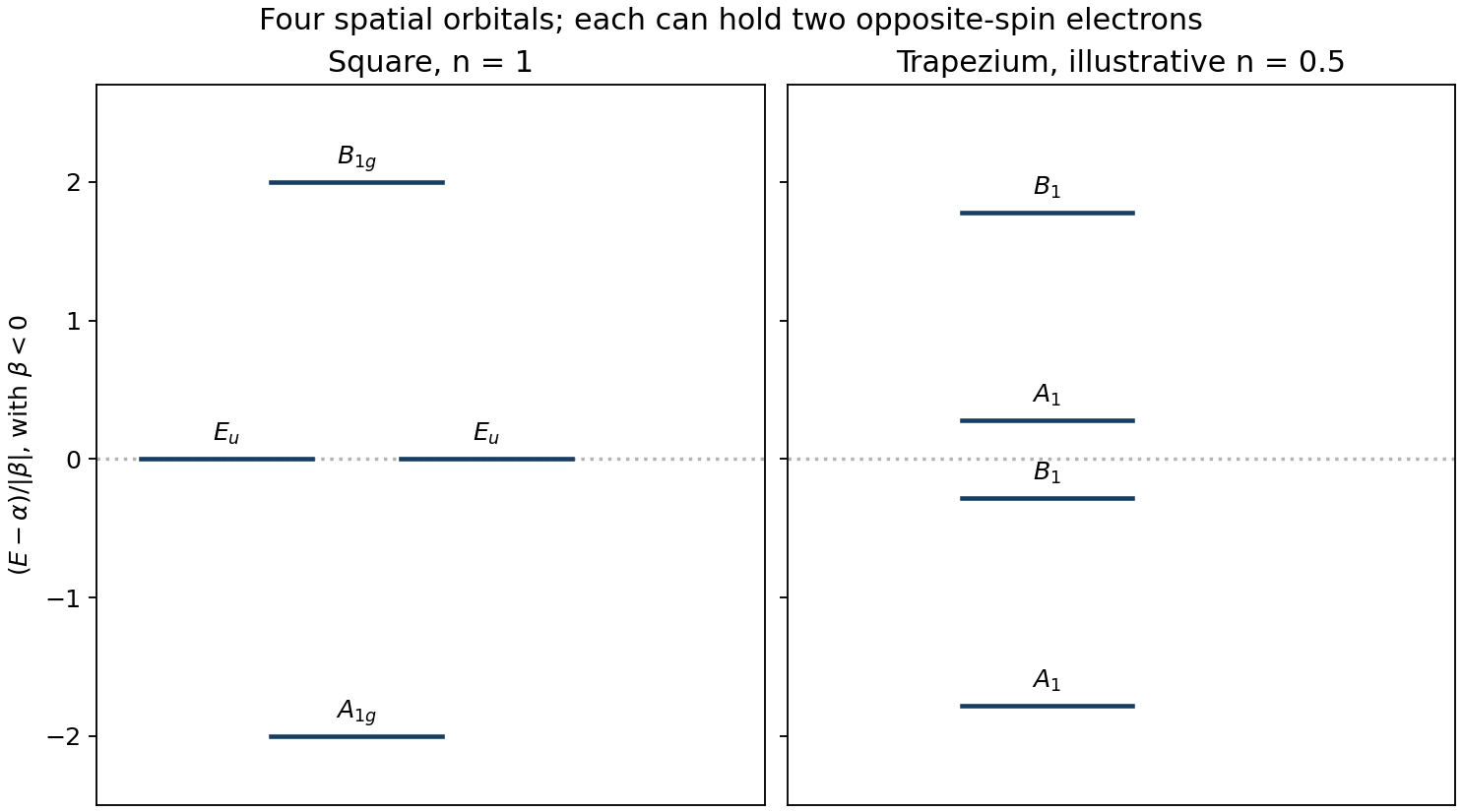
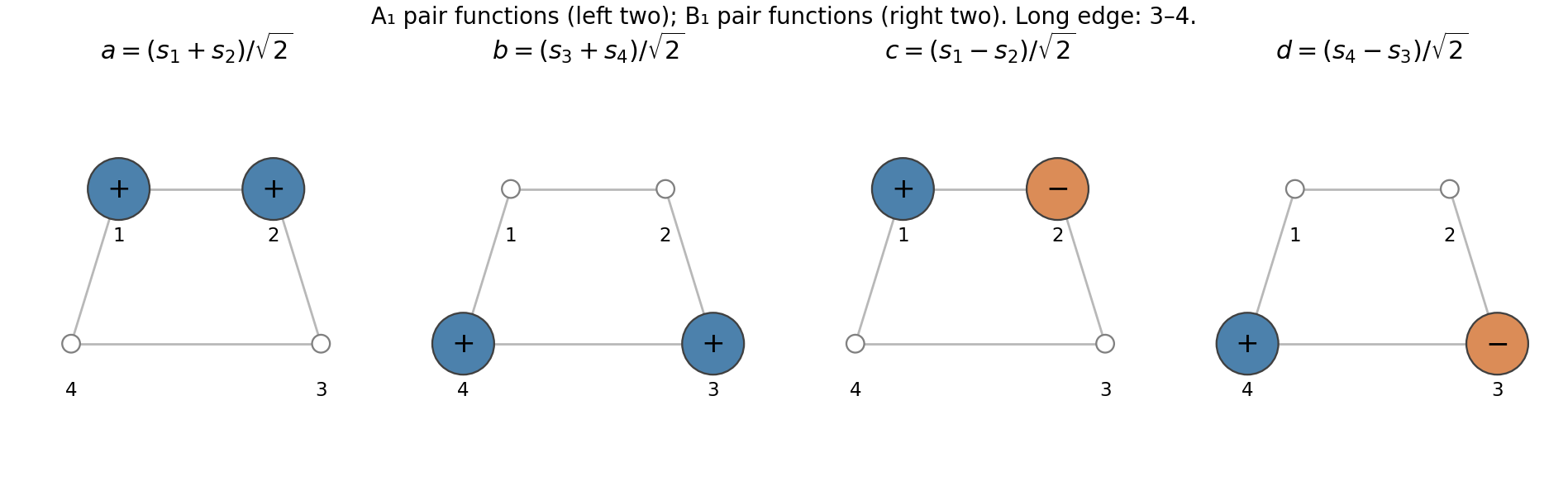
Use the trapezium's printed axes, with principal axis in its plane and perpendicular to the plane. For either site pair or , the group representation has characters of a representation in the order : identity and the molecular-plane mirror fix both s orbitals, while the other two operations exchange them. The character inner products give in the C2v molecular point group.
Within each pair the in-phase and out-of-phase combinations have and symmetry respectively. One normalized choice isThe sign convention for is chosen to make the off-diagonal interaction positive in the corresponding two-by-two block. It does not change the physical predictions. These are pair symmetry-adapted linear combinations; the actual molecular orbitals are linear combinations within each of the two equal-symmetry pairs, found by diagonalizing the blocks.


Articles were limited to the first 100 out of 107 total.
Articles by others on the same topic
There are currently no matching articles.