The drawn axes pass through opposite sites, rather than along the square edges. In the D4h molecular point group class order , an s orbital contributes whenever its centre is fixed and zero otherwise. ThusFor example, a transverse twofold rotation about the printed axis fixes sites 1 and 3, while its diagonal counterpart exchanges all four sites. Reflection in the square plane fixes every site. Taking character inner products, with class sizes , givesThese have dimensions . The label is tied to the printed diagonal-axis convention; rotating the transverse coordinate labels by would interchange and .
Treat the site atomic orbitals as orthonormal, as in the Hückel method. A normalized set of symmetry-adapted linear combinations isThe first combination is unchanged by every operation; the alternating combination has the transformation signs of for the printed axes. The last two transform together like . The squared coefficients sum to one in each case, and their pairwise inner products vanish. Any orthogonal rotation of the two combinations is an equally valid basis for that degenerate subspace.
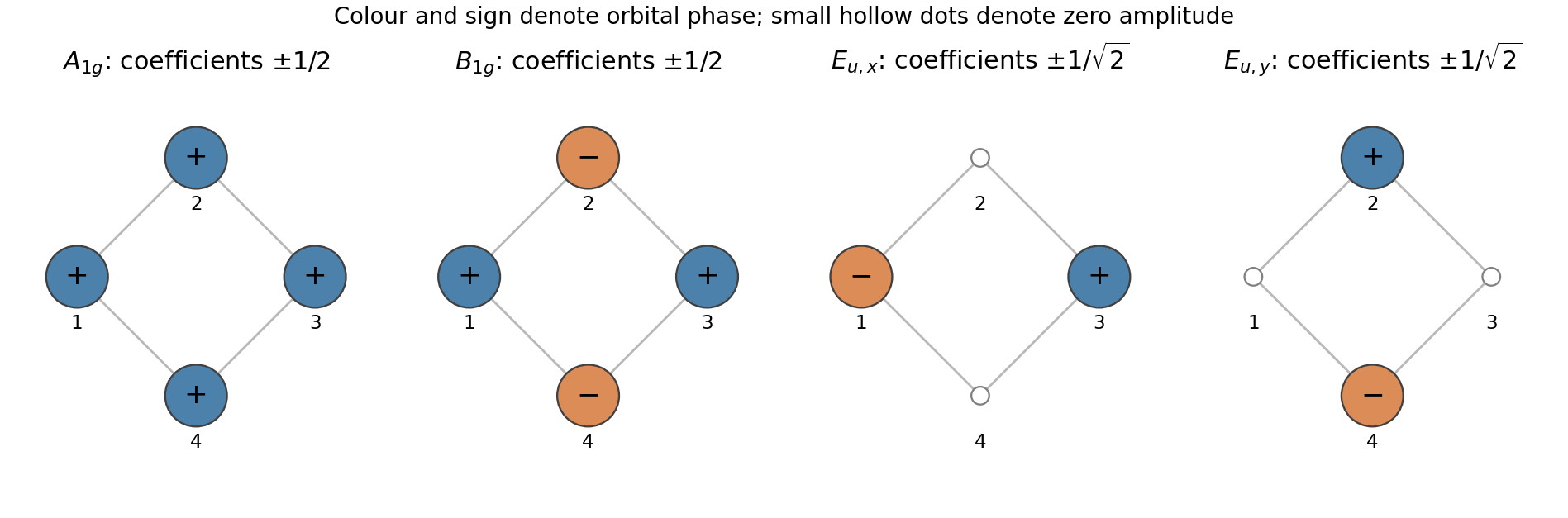
Use a common Coulomb integral on each site, a resonance integral on each adjacent pair, zero interaction across a diagonal, and the identity overlap matrix. In site order the Hückel method givesApplying it to the four symmetry-adapted linear combinations givesFor the conventional bonding sign , the all-in-phase combination is lowest and the alternating combination is highest. The combinations have canceling nearest-neighbour interactions and are nonbonding within this model.
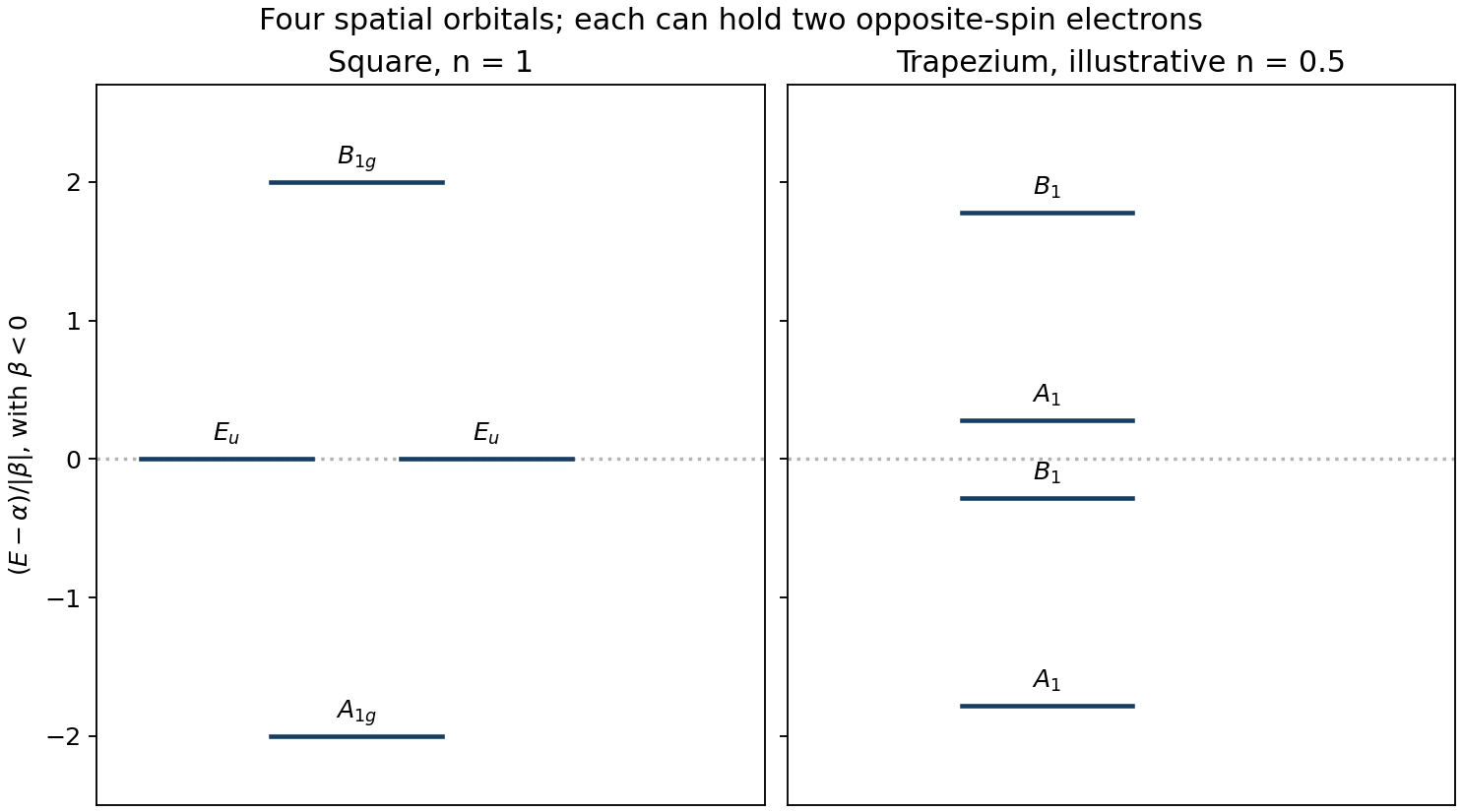
The molecular orbital diagram has one level at labelled , two degenerate levels at labelled , and one level at labelled , in increasing energy for . Each spatial molecular orbital admits two opposite-spin electrons. The diagram below also shows how one representative distortion lifts the middle degeneracy; the distorted scale is illustrative, not a fitted molecular spectrum.
Use the trapezium's printed axes, with principal axis in its plane and perpendicular to the plane. For either site pair or , the group representation has characters of a representation in the order : identity and the molecular-plane mirror fix both s orbitals, while the other two operations exchange them. The character inner products give in the C2v molecular point group.
Within each pair the in-phase and out-of-phase combinations have and symmetry respectively. One normalized choice isThe sign convention for is chosen to make the off-diagonal interaction positive in the corresponding two-by-two block. It does not change the physical predictions. These are pair symmetry-adapted linear combinations; the actual molecular orbitals are linear combinations within each of the two equal-symmetry pairs, found by diagonalizing the blocks.
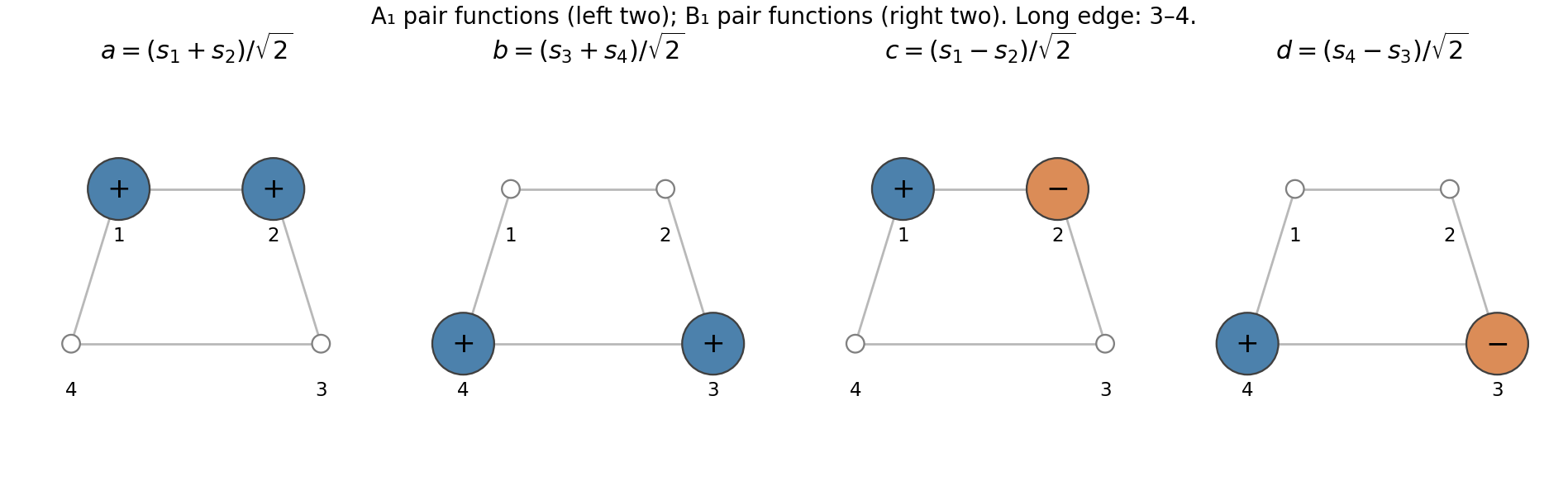
The long edge is –. In the orthonormal pair basis , its weaker resonance integral changes the second diagonal element. The two short side edges contribute an inter-pair matrix element , givingWith , its secular equation isThe eigenvalues are thereforeAt they become and , agreeing with the square limit. Symmetry permits mixing of the two pair functions; treating each pair as an isolated bond would miss the off-diagonal term.
Put . For , , since . Remembering , the two lowest trapezium molecular orbital energies areThe remaining levels lie at and . Filling the lowest spatial orbitals with opposite-spin pairs givesFor the square four-electron case, two electrons occupy the lowest orbital and two occupy the degenerate set. Their summed one-electron energy is fixed here, but this Hückel method calculation alone does not decide the spin or correlation within that open shell.
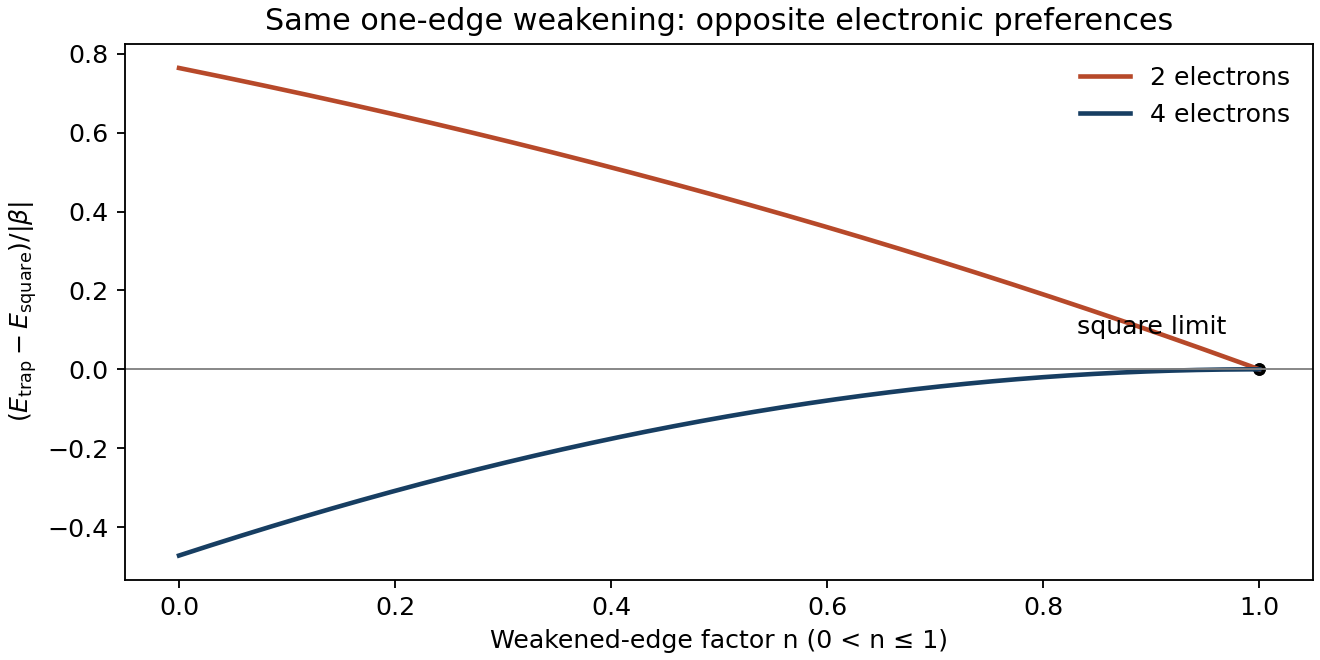
For two electrons, whenever : both sides of are positive and squaring reduces the inequality to . Since , the trapezium then has a higher total electronic energy than the square. The two-electron model favours the square. For four electrons, , so : the four-electron model favours the distortion toward a trapezium. The lower split middle orbital is occupied while the upper one is empty.
The distinction is especially clear near the square. Write ; then andIn particular the four-electron lowering in this specified one-edge model is quadratic near the square; a first-order lowering of the entire occupied sum should not be asserted merely from the middle-level splitting. This Hückel square-to-trapezium distortion is an electronic comparison under the stated fixed-, fixed-short-edge- assumptions. Nuclear repulsion, other bonding contributions and the structural cost of distortion are omitted, so an actual equilibrium geometry or optimum is not determined by this calculation alone.


Articles by others on the same topic
There are currently no matching articles.