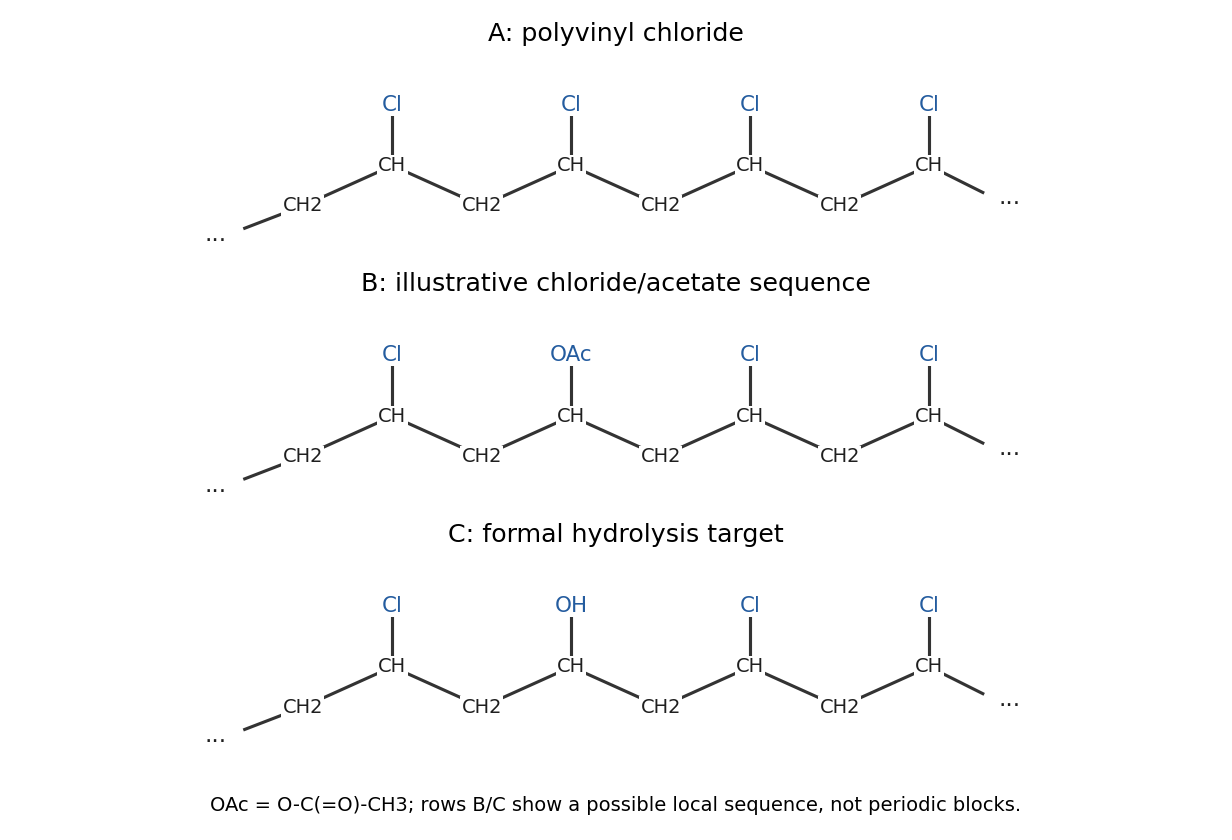
Addition consumes the carbon–carbon double bond of vinyl chloride and retains chlorine as a side substituent. The interior repeat of A is thereforenamely polyvinyl chloride. Benzoyl peroxide supplies initiating free radicals; head-to-tail addition gives the usual backbone connectivity. End groups and tacticity are not uniquely specified by this repeat formula.

Radical polymerization, a type of chain-growth polymerization. Peroxide bond cleavage initiates reactive chains; propagation adds monomer to a radical end while regenerating a radical end on the longer chain. Termination and chain transfer can then stop or redirect growth. In the propagation step there is no obligatory small-molecule condensate, so this is not a step-growth condensation.
B contains both and monomeric units distributed along the same carbon backbone: a vinyl chloride-vinyl acetate copolymer. One possible local segment isThe ester is attached through oxygen to the backbone carbon. A random copolymer should not be drawn as two long homopolymer blocks. The stated monomer feed is not enough to prove an incorporated unit ratio: monomer reactivity ratios and conversion affect composition and sequence statistics. Under an explicitly ideal equal-incorporation assumption that ratio could be used as a schematic average, not a periodic repeat.
Taking the stated melting point as the reference for a crystallizable A, introducing acetate-bearing units disrupts regular sequences and crystal packing. The expected result is a lower melting point for B, often with broader or less complete crystallization. The ideal copolymer melting-point depression estimate iswhen unlike units are excluded from the crystal. The larger vinyl ester in the drawing is vinyl pentanoate: its acyl substituent has a four-carbon alkyl chain. At comparable incorporation it should generally disrupt regular packing more and favour a still lower melting range or suppressed crystallinity, although the exact trend depends on composition and side-group interactions. The formula concerns melting of crystallites, not the glass transition; a universal numerical melting point cannot be inferred for an unspecified real PVC copolymer.
Saponification cleaves the acetate ester side groups while the intended carbon backbone remains intact:The ideal target C is therefore a vinyl chloride-vinyl alcohol copolymer, containing and units in the original sequence positions. The carbon–oxygen bond to the backbone remains; hydrolysis removes the acetyl group from oxygen. Incomplete hydrolysis would leave a three-component population of chloride, acetate and alcohol units. New hydroxyl groups can strengthen adhesion and coating interactions through hydrogen bonds.
The difficulty is competing chemistry and isolation selectivity. Alkaline treatment can promote dehydrohalogenation at chlorinated backbone units while hydrolysing the acetate side groups. Loss of HCl produces unsaturated segments, potentially followed by further degradation or cross-linking; hydroxyl formation also changes solvent compatibility and intermolecular association. The isolated material can therefore differ from the ideal undegraded C in part (e). Competing dehydrochlorination during copolymer saponification explains why selective conditions are needed.
This is not an absolute prohibition on hydroxyl-containing chloride copolymers. Analytical work on these copolymers used staged alcoholysis/saponification and polymer precipitation to restrain dehydrochlorination. The sensible conclusion is that clean, exhaustive conversion and isolation are difficult under unselective conditions, rather than that no suitable treatment can ever preserve chloride units.[ref]
Determination of vinyl acetate in vinyl chloride-acetate copolymers by Takanori Shimazaki and others. Abstract, pp. 619–623: staged treatment and precipitation used to restrain competing dehydrochlorination
Articles by others on the same topic
There are currently no matching articles.