In chain-growth polymerization, each growth step joins a monomer to a reactive site on a polymer chain and regenerates that reactive site. This is the precise mechanistic restriction in IUPAC's definition: growth occurs exclusively through these monomer–chain-site reactions. The word chain refers to the succession of site-regenerating chemical reactions. It does not merely mean that the product looks like a long chain. Chain-growth initiation starts this succession; chain-growth propagation continues it; chain-growth termination and chain transfer in chain polymerization can change its fate.[ref]
IUPAC Compendium of Chemical Terminology, fifth edition (Gold Book) by International Union of Pure and Applied Chemistry. chain polymerization, C00958, definition and notes 1–2; source recommendation p. 2306
The contrast with step-growth polymerization concerns the permitted joining partners. There, suitable reactive groups can join two existing chains, for example a two-unit chain and a three-unit chain. In chain-growth propagation, a free monomer adds to a polymerization-active site. Release of a small byproduct is a separate classification question: IUPAC explicitly allows condensative chain polymerization.[ref]
IUPAC Compendium of Chemical Terminology, fifth edition (Gold Book) by International Union of Pure and Applied Chemistry. chain polymerization, C00958, notes 3–6
The useful consequence is that a few growing chains can incorporate many monomer molecules while much of the feed remains unreacted. Their degree of polymerization depends on how those units are shared among chains, as finite chain-growth bookkeeping makes explicit.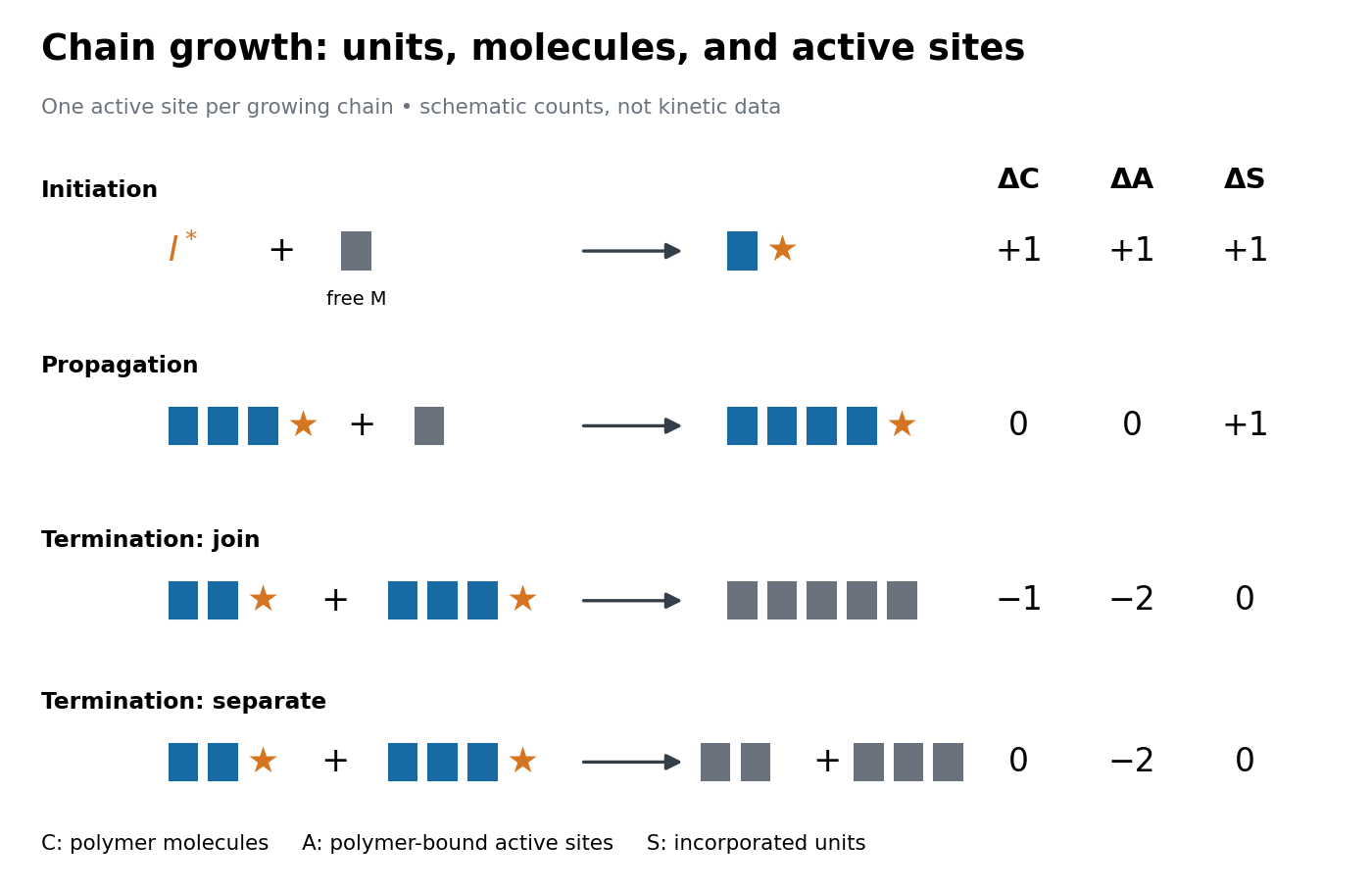
Articles by others on the same topic


Chain-growth polymerization, also known as chain reaction polymerization, is a method of synthesizing polymers in which the structure of the polymer grows by the sequential addition of monomer units. This process typically involves three main steps: initiation, propagation, and termination. 1. **Initiation**: This step begins with the formation of reactive species, such as free radicals, cations, or anions, which are necessary to initiate the polymerization process.