A face-centered cubic cell has atoms at its corners and face centers. The plane intercepts the three positive cubic axes at , and ; it is a close-packed triangular layer. Close-packed directions are the family, with the in-plane members satisfying .
Nearest neighbors touch along a face diagonal: . HenceThe body diagonal is not the touching direction for this crystal structure.
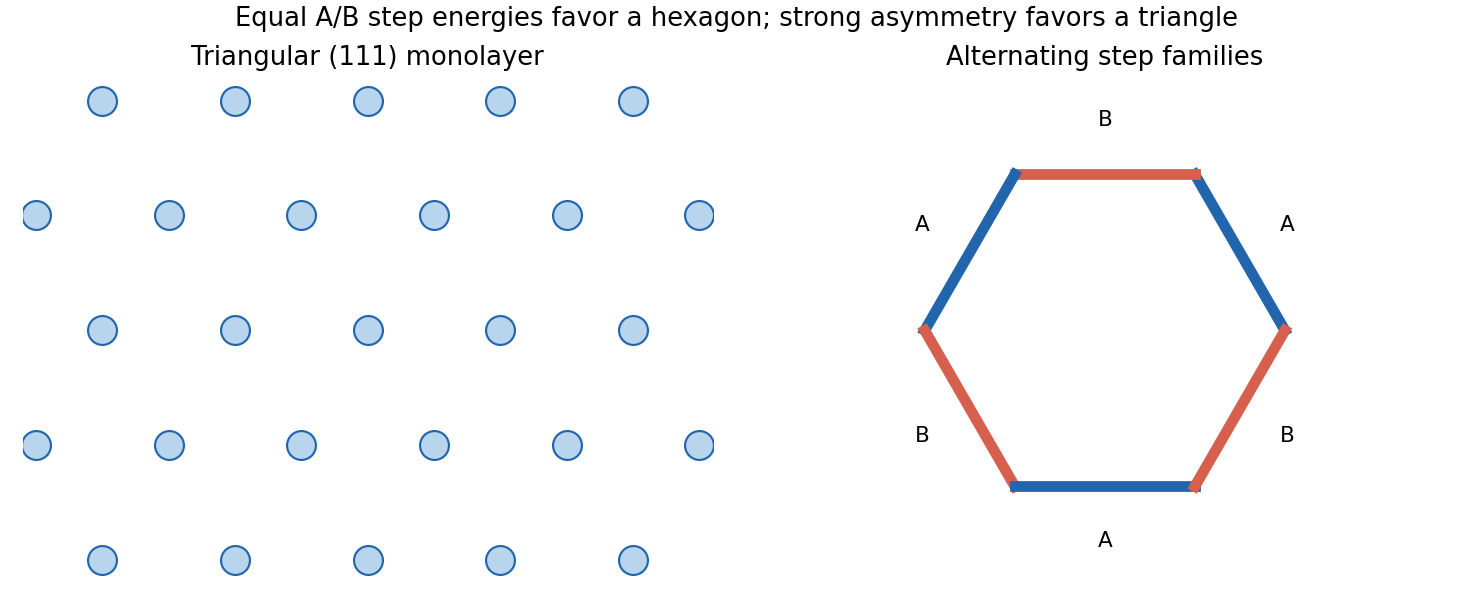
Take the outward surface normal as toward the observer and retain the supplied downward vector . The opposite vector is immediately . With the diagram's orientation, the remaining arrows areAll have zero dot product with . The last three are in-plane close-packed directions; are opposite directions perpendicular to the corresponding straight close-packed step edge.
At equilibrium and fixed island area, the relevant anisotropic step free energies, their atom coordination and any important strain determine shape through a two-dimensional Wulff construction. Since the island and substrate are the same element, lattice mismatch is not the main distinction here. Kinetic growth can change shape if equilibration is incomplete.
The two alternating step families on an fcc(111) surface have locally -like and -like microfacets. Nearly equal energies on Cu(111) favor approximately hexagonal islands. A sufficiently large difference on Pt(111) favors a truncated triangle or, in the strong-anisotropy limit, a triangle bounded by the lower-energy family.
With the hollow-site registration shown, the steps facing direction are the more close-packed -type steps and are expected to be lower in energy than the -type steps facing . Their bonding and relaxation differ even though the upper terrace is the same close-packed lattice. Exact energy ratios or triangle truncations are not fixed by the diagram alone.

One Pt(111) layer has height . In constant-height operation the separation above the island is therefore only . With the same decay constant,Thus the ideal predicted current is about . This very large increase can exceed the useful current range or risk tip-surface contact; constant-height imaging is poorly suited to unexpected monolayer steps. Constant-current feedback can follow the height more safely, subject to its response bandwidth.
Potassium is electropositive and transfers electron density toward the metal. The resulting surface dipole generally lowers the metal work function at such submonolayer coverages, reducing the tunnelling barrier and its inverse decay length .
At the same specified separation, a smaller gives a larger , so the expected tunnelling current is greater than in the barrier-dominated comparison. No numerical value follows without the modified work function and electronic density of states. A real STM image also depends on the local density of states and adsorbate corrugation; equal geometric separation does not imply equal electronic barrier height.
The reconstruction matrix has area multiplier . A bulk-terminated monatomic surface would therefore contain atoms in that projected cell, whereas the reconstructed top layer contains . Its density increases byThe denser layer can reduce the large tensile surface stress and improve the outermost layer's preferred metallic bonding, at the expense of registry/domain-boundary and elastic costs. Surface atoms need not prefer exactly the same equilibrium spacing as bulk-coordinated atoms.
Close-packed layers occupy one of three lateral registries, conventionally A, B and C. Hexagonal close packing has ABAB stacking, while face-centered cubic stacking is ABCABC. On a bulk-terminated (111) terrace the two kinds of threefold hollow differ by subsurface registry: an hcp hollow places an atom above a second-layer atom, while an fcc hollow continues the ABC sequence.
Compressing the top Au layer makes its registry drift relative to the unreconstructed layers. Parts of the cell occupy fcc hollows, others hcp hollows, and transition strips pass through less favorable bridge-like positions. Those registry changes are associated with partial-dislocation/domain boundaries. Varying local coordination and repulsion from the substrate cause vertical relaxation, producing the observed corrugation rather than an entirely flat shifted sheet.
The Au(111) surface has three equivalent in-plane directions related by rotations. A reconstruction that contracts along only one direction creates anisotropic stress. Periodically changing boundary direction among equivalent orientations redistributes that strain and lowers its long-range elastic cost, while boundary formation and bending carry their own energy cost.
The resulting compromise produces the characteristic herringbone arrangement. Threefold symmetry explains the equivalent turning directions; a balance of elastic relaxation and boundary costs, rather than symmetry alone, sets the finite repeat distance.
Articles by others on the same topic
There are currently no matching articles.