The four shortest contacts are the three Cu–N bonds and Cu–OR bond. They define an approximately square equatorial set. The two remaining Cu–O contacts are longer and define a strongly elongated axial direction, as expected for the Jahn-Teller effect of Cu(II).
Choose along the long contacts and towards the short equatorial donors. The singly occupied, predominantly metal magnetic orbital is then , with substantial Ligand in coordination chemistry admixture. All three pyrazine nitrogen donors lie in this equatorial set, so both ladder directions have strong metal–Ligand in coordination chemistry orbital overlap. Neighboring copper centers communicate through comparable pyrazine superexchange pathways. Virtual electron transfer between half-filled orbitals stabilizes the antiparallel arrangement, giving antiferromagnetic interactions in both directions with comparable magnitudes. The axial oxygen donors are much less effective exchange routes.
At high temperature, tends towards the nearly constant Curie constant of weakly correlated centers. On cooling, falls because neighboring spins increasingly correlate antiparallel. The broad maximum in marks the crossover from the high-temperature Curie-like regime to substantial short-range order.
At still lower temperature, the Magnetic susceptibility becomes small because the antiferromagnetic ladder favors a singlet-like ground state and has few thermally accessible magnetic excitations. An even-leg spin ladder can have a spin gap, which reinforces this suppression. A broad Magnetic susceptibility maximum and falling support short-range antiferromagnetic correlations; they do not establish a three-dimensional Néel transition. Such a transition would require independent evidence, rather than identifying the broad maximum itself as the ordering temperature.
An ideal cubic perovskite structure is obtained by putting La at the cube corners, Re at the body center, and N at the face centers. In fractional crystal coordinates one convenient basis isThe counting is La, one Re and N per cell. Corner-sharing octahedra form the network, with La in the larger interstices. The ideal cell illustrates the connectivity; octahedral tilting can lower the actual crystal symmetry.
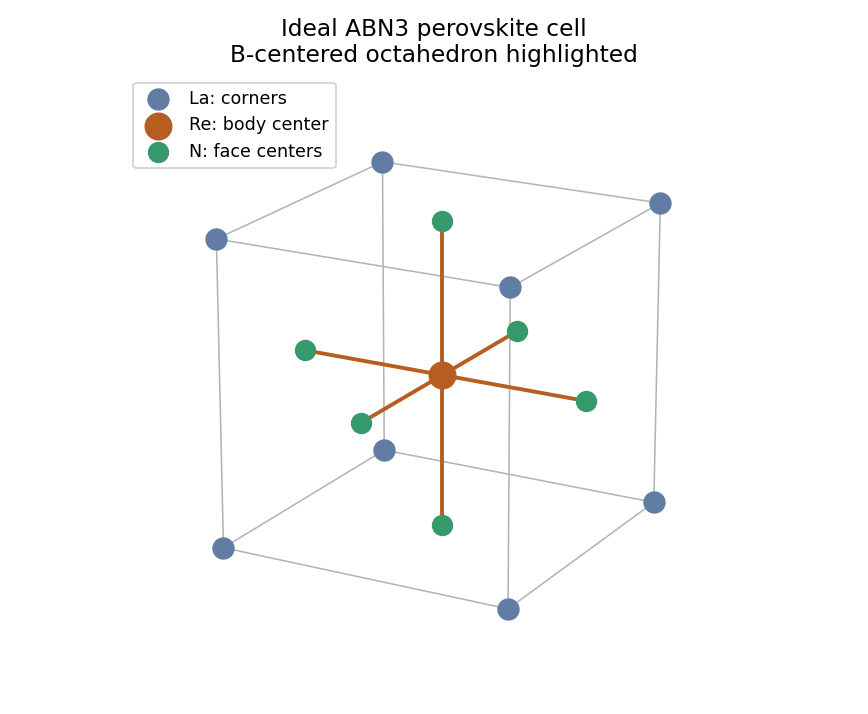

Formal ionic counting gives La(III), N(−III), and therefore Re(VI), with a configuration. An isolated localized center would carry a saturation magnetic moment of order , much larger than the value quoted. It is not a ion made diamagnetic simply by an octahedral ligand field.
The spatially extended Re orbitals overlap strongly with N orbitals. Re–N interactions raise the -derived antibonding states, while interactions mix the states with the nitrogen network. Repetition through corner-sharing octahedra turns these combinations into broad energy bands. The nominal electron occupies a delocalized, partially filled band rather than an isolated magnetic orbital.
Only electrons close to the Fermi energy change their occupations appreciably in an applied magnetic field. Consequently a Pauli paramagnetism has a small, nonzero field-induced magnetization:when is the density of states including both spin directions, expressed per formula unit and per unit energy. This band model explains a very small moment without requiring the absence of electrons in the Re-derived band. The reported material has metallic transport and a Pauli-like response.[ref]
Preparation of bulk-phase nitride perovskite LaReN3 and topotactic reduction to LaNiO2-type LaReN2 by Simon D. Kloß and others. Magnetic and transport measurements, Figure 4
The description “saturated” in the question should not be interpreted as complete alignment of one localized spin per Re: a nearly linear metallic response over a laboratory field range need not be a true fully spin-polarized saturation moment.
Articles by others on the same topic
There are currently no matching articles.