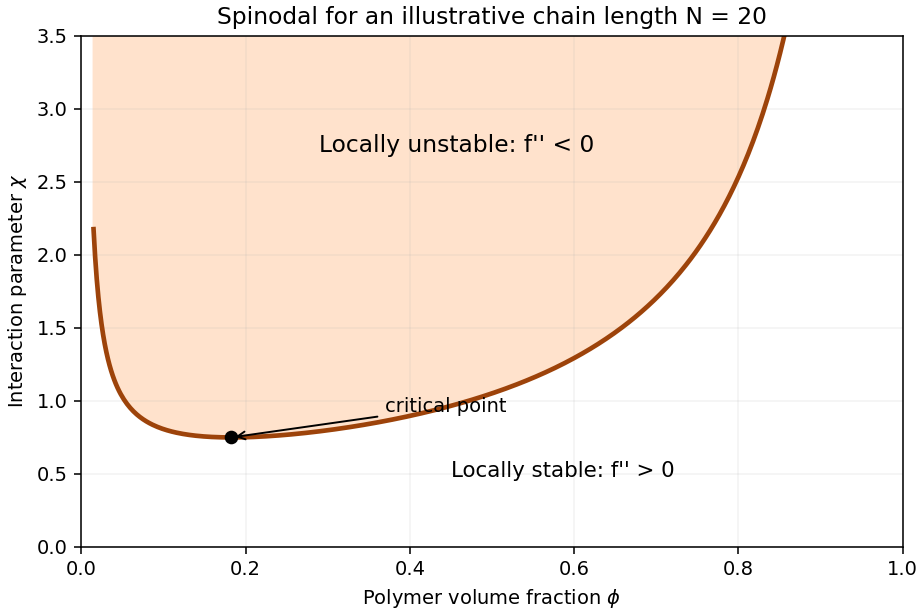
For a homogeneous polymer solution, examine the curvature of the mixing Helmholtz free energy with respect to composition. A composition fluctuation into equal volumes at changes the average free energy byThus locally resists fluctuations and amplifies them, leading to spinodal decomposition. The spinodal curve is the locus , separating locally stable or metastable homogeneous compositions from locally unstable ones. The coexistence binodal instead follows a common tangent to the free energy. Between the binodal and spinodal, separation needs nucleation.

In Flory–Huggins solution theory, is the volume fraction, is the number of equal-sized lattice segments per chain, is temperature, is the Boltzmann constant, and is the dimensionless Flory interaction parameter. The stated is the mixing Helmholtz free energy per lattice site. The first two terms describe mixing entropy; the last describes the contact-energy contribution.
At fixed and composition-independent ,Hence the spinodal isThe homogeneous state is locally unstable when . The minimum gives the critical point of a Flory–Huggins polymer solution:If depends on temperature, the equation converts this result into a temperature–composition boundary.
The critical micelle concentration is the approximate total surfactant concentration above which additional surfactant predominantly enters micelles. Below it, most surfactant is present as separate molecules; above it, the free-monomer concentration changes much more slowly while the micelle population increases.
The crossover occurs when aggregation balances the unfavorable exposure of hydrophobic tails to water against head-group repulsion and the loss of molecular translational entropy. It is an aggregation threshold, not the concentration at which every molecule becomes micellar.
A longer hydrophobic tail makes transfer from water into a micelle more favorable, lowering the critical micelle concentration within this homologous series. Ranking the four quoted concentrations therefore givesThis assignment uses the chain lengths and concentration ranking printed in the question; it does not identify the compounds by substituting an external table of measured concentrations.
For the same geometry, separation and intervening medium, the attractive Van der Waals force scales with the effective Hamaker constant. With the constants treated as applying to those same conditions,The silver particles attract more strongly. This comparison is conditional on a common geometry and on using the appropriate constants across the actual medium. Constants for particles in vacuum cannot automatically be applied unchanged across a solvent.
For two equal spheres of radius , the effective radius in the Derjaguin approximation is . The nonretarded attractive van der Waals potential isDifferentiating with respect to the surface gap givesThus the requested approximation gives an attraction of about pN. Here , whereas the Derjaguin approximation requires . This is the formal estimate requested by the hint, not a quantitatively reliable near-contact approximation for the printed dimensions.
The Stern layer is the compact near-surface layer of specifically adsorbed or closely associated ions. The diffuse layer is the more extended, thermally distributed excess of counterions that screens the surface charge.
For water near , the Debye length can be writtenFor M KCl, M and nm. For a fully dissociated 2:2 electrolyte at the same formula-unit concentration, M, giving nm, half as large. These are linear-screening estimates, not sharp boundaries of the diffuse layer.
Articles by others on the same topic
There are currently no matching articles.