A flow network is a finite directed graph with nonnegative flow network edge capacities , together with distinct source and sink vertices . A feasible flow in the nonnegative directed-edge convention is a function satisfying the capacity constraints and flow conservation:Its flow value is the net outflow at the source,which equals the net inflow at the sink by flow conservation.
A cut of a flow network is a partition of a set with and . Its cut capacity counts only directed edges leaving :The net flow across the cut of a flow network subtracts flow on edges returning into , and equals .
For the following parts, a circulation with vertex demands has no exceptional source or sink in the original directed graph. Instead it satisfies net inflow minus net outflow equal to at every vertex. Thus positive demands consume flow, and negative demands supply flow.
Write flow balance using the positive-inflow conventionRemove the lower bounds on network flow by writing , where only is nonzero. Then , and its required flow balance isIn the order , the lower-bound contribution is , soThe resulting flow network edge capacities areAdd a new source with an edge of flow network edge capacity , and a new sink with edges and of flow network edge capacities and . A feasible flow saturating these new edges is equivalent to a solution for : ordinary flow conservation in the enlarged flow network produces exactly the residual supplies and demands above. All source and sink edges must be saturated, requiring flow value .
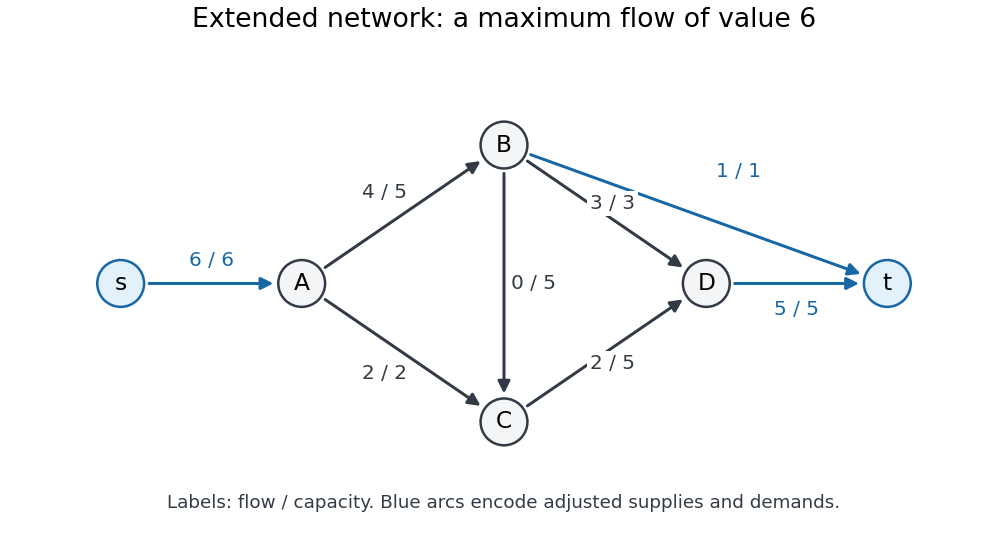
Extended flow network after removing the lower bound; labels show final flow divided by flow network edge capacity
. The auxiliary edges are blue. The displayed flow saturates the auxiliary source and sink edges, certifying that all adjusted demands are met. The original edge regains its four-unit lower bound only after this auxiliary problem is solved. Details.
Start the Edmonds–Karp algorithm at zero flow. Repeated breadth-first search in the residual network permits the following shortest augmenting paths; when paths tie, choose the one through first.
| Step | Augmenting path | Added flow | Total flow value |
|---|---|---|---|
The first augmenting path has three edges. Once is saturated, the next shortest possibilities have four edges, so steps and respect the breadth-first search rule. Each augmentation adds the usual backward edges to the residual network, though these particular augmentations need only forward edges. Now is saturated, so no further augmenting path exists. The cut of a flow network with source side has cut capacity , proving that the obtained flow is a maximum flow.
The original-edge values for are in the order . Restore the lower bound to obtainAll original capacity constraints hold, and meets its lower bound. The net inflows at are respectivelyThe original network therefore admits a feasible circulation with vertex demands.
For any feasible circulation with vertex demands, sum its defining flow balance over all vertices:Every directed edge contributes exactly once to the first sum, at its head , and exactly once to the second, at its tail . The two sums therefore contain exactly the same terms. They cancel, givingThis is global flow conservation: internal transport cannot create or destroy the total amount. Lower bounds on network flow and capacity constraints restrict which flows are feasible but do not affect the cancellation. The condition is necessary, not sufficient: insufficient flow network edge capacities can still prevent satisfying balanced demands.
For each user define its set of eligible ads byThis uses the intersection of demographic-group memberships: belonging to one advertised group suffices, because the eligibility condition is a set union. A user in several groups still receives at most one ad.
A direct algorithm is to process users independently. For user , scan ads until finding one for which some group belongs to both and . Assign that ad and stop processing this user. If no such ad exists, leave the user unassigned. There is no upper bound on the number of different users who can receive the same ad, so these decisions do not compete for an ad resource.
For correctness, every produced impression has a shared permitted group, and the stopping rule assigns at most one ad to each user. Conversely, a user with cannot receive an ad in any feasible solution. Since every other user can contribute at most one impression, every feasible solution has value at mostThe algorithm attains this bound, provingRepresent each membership set by a length- array of Boolean variables. Testing one user-ad pair costs , so all tests and input setup take time in Big O notation, which is polynomial time in all three parameters. For positive , this simplifies to .
A maximum flow formulation gives the same result if desired: add edges with flow network edge capacity , with flow network edge capacity exactly when , and with flow network edge capacity . By the integral max-flow theorem, an integral maximum flow selects valid impressions. Setting the last flow network edge capacity to would impose an extra restriction absent from this paper.
Articles by others on the same topic
There are currently no matching articles.