A phonon is one quantum of a collective harmonic normal mode of a crystal. A mode labelled by wavevector and branch has energies , with bosonic occupation statistics. The crystal momentum is defined modulo a reciprocal lattice vector; it is not generally the mechanical momentum of one atom. The phonon dispersion relation assigns its frequency and polarization to the wavevector and branch.
Inelastic neutron scattering can measure this relation in a single crystal. Determine the incident neutron energy and wavevector, scatter at a chosen angle, and analyze the outgoing energy by time of flight or a spectrometer analyzer. Energy and crystal-momentum conservation giveThe signs distinguish phonon creation and annihilation with consistent momentum convention. Repeating measurements at different momentum transfers maps peaks in the dynamic scattering response into phonon branches. The measured intensity depends on occupation, scattering factors and the projection of the mode polarization along the momentum transfer; a weak or missing peak need not mean that the corresponding mode does not exist.
Let be the longitudinal displacement of atom . Translational invariance and a symmetric harmonic pair force give the long-range harmonic-chain dispersion equationsUse a traveling normal mode . Dividing by its nonzero amplitude givesHencePositive pair constants give a nonnegative squared frequency and a uniform-translation zero mode. More general signed force constants require checking stability of the entire sum. The frequency is even in and periodic with , reflecting reciprocal-lattice equivalence. The force sum must converge in the model. A finite ordinary acoustic slope additionally requires convergence of , in which case . Both finite-range examples below satisfy this condition.
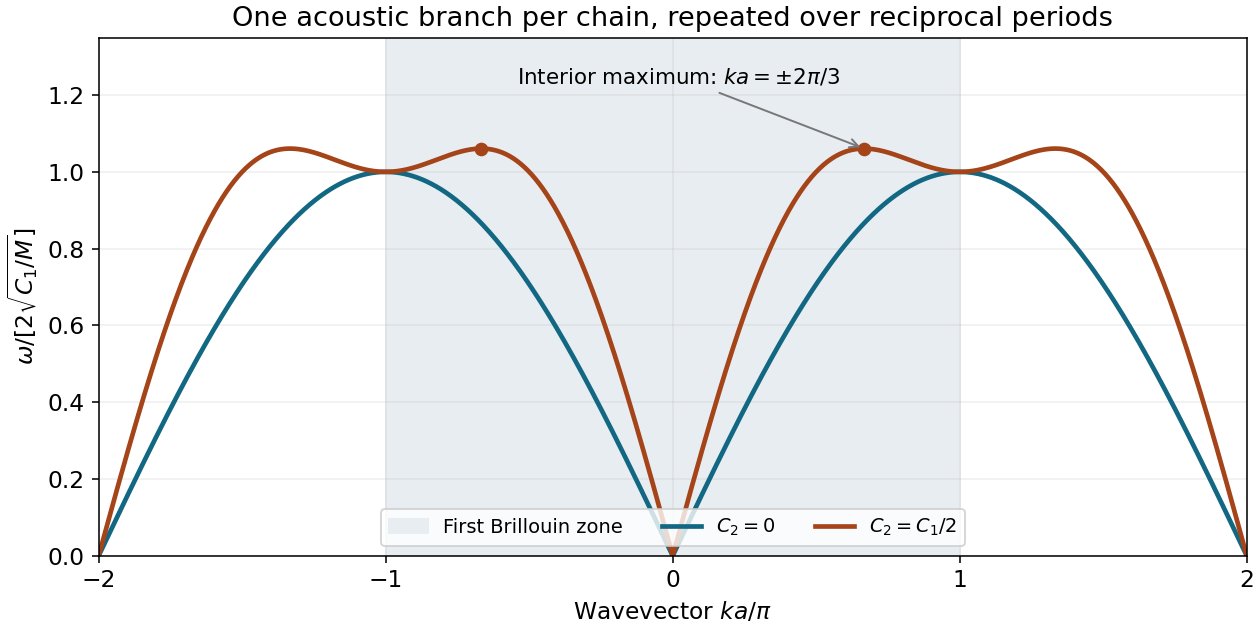
Write and use as the frequency unit. The nearest-neighbour chain and its next-nearest-neighbour extension haveThese are each a single acoustic branch, repeated over reciprocal-lattice periods. There is no added optical branch merely because a longer-range spring is introduced. The cutoff for specifies the first chain as nearest-neighbour despite the source's repeated word in its description.
For small , and . ThusThe maximum is not necessarily at the zone edge. Put , so . The second squared dimensionless frequency isIt reaches its maximum at , or in the first zone. The first chain peaks at . ThereforeAt both chains have the same frequency, but the second chain has already passed its interior maximum. The next-nearest-neighbour monatomic-chain frequency maximum is therefore crucial to a correct sketch. Periodic repetition gives the requested curves for all wavevectors.

Articles by others on the same topic
There are currently no matching articles.