Inelastic neutron scattering resolves . Through conservation of energy, a peak at positive identifies an allowed excitation energy; through momentum conservation, its location in constrains the spatial variation of that excitation. A phonon is a quantum of lattice vibration; a magnon is a quantum of a spin wave. Their different couplings make energy transfer alone insufficient to identify which was created.
Bertram Neville Brockhouse's aluminium experiment rotated a large single crystal, scanning analyzer angle for neutron groups. His vanadium comparison exposed the elastic resolution. Later magnetite measurements used a magnetic field intensity test to identify magnons.[ref]
Slow Neutron Spectroscopy and the Grand Atlas of the Physical World by Bertram Neville Brockhouse. 1994 lecture, pp. 115–121, Figs. 3–6
Successive orientations sample different wave vectors; analyzer settings distinguish outgoing energies. This supplies points on a dispersion relation, rather than only an angular diffraction pattern. Finite resolution can merge neighboring excitations; background, multiple scattering and processes involving several phonons can complicate interpretation. A lattice model is a testable explanation of selected features, not a guarantee that every spectral peak has the same origin.
A triple-axis spectrometer uses Bragg's law at an initial crystal monochromator to select and at a second analyzing crystal to select . The sample sits between these selectors. The three axes refer to the monochromator, sample and analyzer rotations. The final counter measures accepted counts; the analyzer's wavelength selection makes those counts sensitive to outgoing energy even when the counter does not measure each neutron's energy directly.
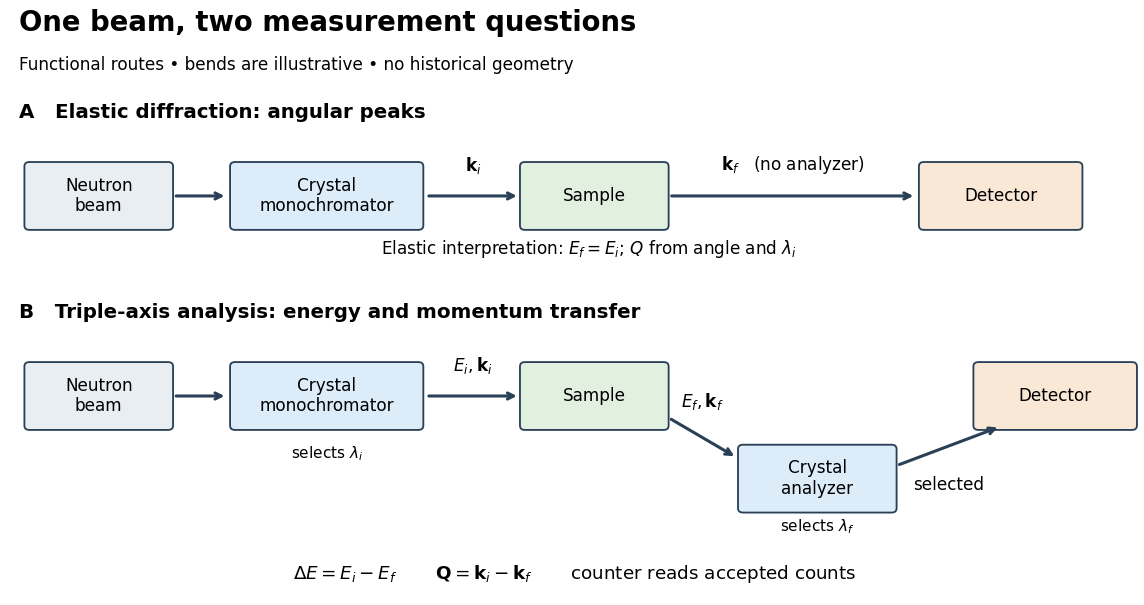

For a constant- scan, change incident or outgoing energy while coordinating sample and analyzer settings so that stays fixed. Counts versus then probe excitations at one momentum transfer. Changing only the analyzer angle generally changes both transferred quantities. Incident-beam monitoring, analyzer response and the instrumental resolution must enter quantitative interpretation; the diagram's arrows specify information flow, not an absolute intensity calibration.
Consider an original ideal one-dimensional monatomic harmonic oscillator chain with neighbor separation , mass and nearest-neighbor restoring coefficient . Its displacement equation isSubstitute the normal mode . Since ,Choose ångströms and . This is one acoustic phonon branch, distinct from the two-atom elastic example. It has and .
For coherent creation of one phonon in a crystal, the excitation's wave vector and the measured transfer obey , with a reciprocal lattice vector. To connect the dispersion relation to an illustrative intensity, take zero temperature, longitudinal displacements and the first interval , choosing . Expand the scattering phase to first order, . The constant term supplies elastic scattering; the linear term creates one phonon. Its displacement matrix element is proportional to , so the squared amplitude has weight , apart from common factors. Normalize this weight to one at :The limit follows from . Set and replace the ideal sharp line by a normalized Gaussian function:This chosen broadening illustrates readout width; it is not a measured resolution or a full spectrometer resolution function. Integrating over all gives . The small negative-energy tail is a broadening artifact, not a zero-temperature phonon-annihilation signal.
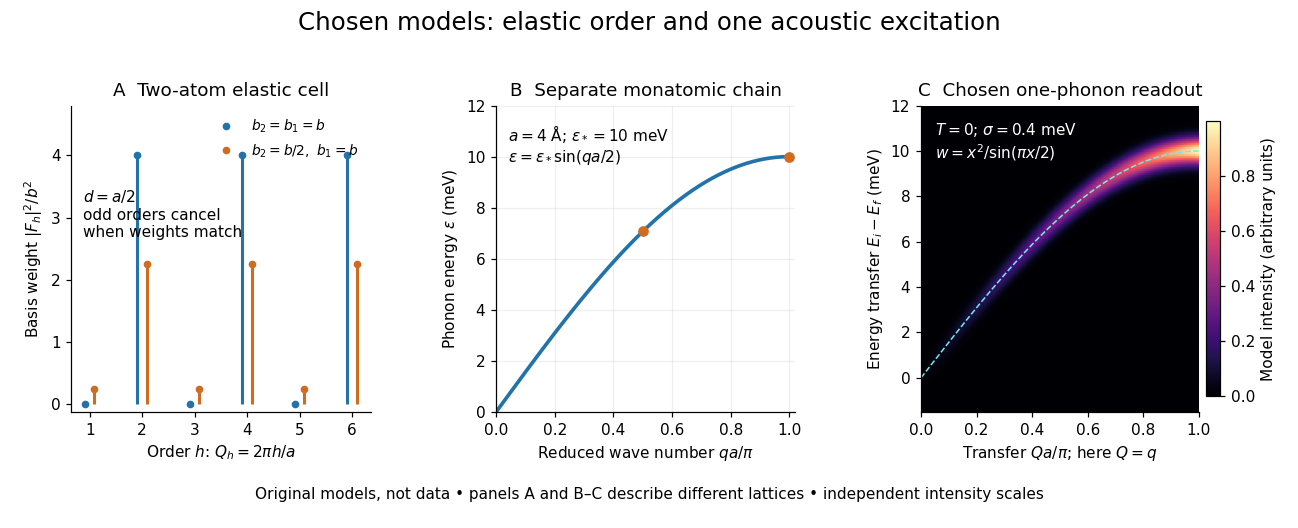

These panels separate three kinds of information: allowed reciprocal lattice positions, cancellation within a crystal basis structure factor, and an excitation's energy as a function of wave vector. The chain has no magnetic degrees of freedom, optical branches, damping or multi-phonon processes. It illustrates how one excitation could be read; it proves nothing about the completeness of a real material's excitation spectrum.
Articles by others on the same topic
There are currently no matching articles.