Source paper: www.whatdotheyknow.com/request/oxford_physics_past_papers_2/response/2340696/attach/3/Physics%20Papers%202014.pdf?cookie_passthrough=1. The cover identifies the Part B sitting of 15 June 2015, despite the annual bundle's 2014 filename. All four options are solved; lettered subdivisions organize the unlettered marked blocks.
Take one conduction electron per atom and a three-dimensional free electron gas, with spin degeneracy two and electron mass . State counting inside the occupied Fermi sphere givesThe highest occupied energy at zero temperature is , soThis relates the atomic number density to the Fermi temperature only because monovalency and the free-electron dispersion have been assumed. A real energy band can require a different density of states and band effective mass.
For the isotropic Debye model, count three acoustic polarizations up to one spherical wavevector cutoff . The number of vibrational modes per volume isWith and ,The effective is the Debye sound speed: matching the low-frequency mode density of one longitudinal and two transverse branches requires . It is not generally the arithmetic average of their speeds. The cutoff preserves the mode count; it need not coincide with the actual nonspherical Brillouin zone boundary.
Pauli exclusion principle prevents most filled electronic states from changing occupation at . Only a shell of width of order around the Fermi energy participates. Since the density of states near that energy is of order per volume and energy, the fraction of active electrons is of order . Their typical change of energy is of order , so the thermal energy increment per volume scales asDifferentiating with respect to temperature gives the electronic heat capacityThe simple shell argument fixes the linear law, not its coefficient. A Sommerfeld expansion using the spin-summed free-electron density of states gives , hence , consistent with the supplied value. The result excludes strong band-structure or interaction corrections and requires a degenerate electron population.
The Debye model treats the crystal as an isotropic elastic continuum with independent harmonic vibrational modes. There are three acoustic polarizations, approximated by linear dispersions and a common effective speed. A cutoff is chosen to retain modes for atoms. The model neglects anharmonic interactions and the detailed high-wavevector dispersion. In a multi-atom primitive cell, optical branches require additional treatment; copper has one atom per primitive cell even though its conventional cubic cell contains four atoms.
A frequency interval contains, per volume,Each phonon mode has Bose-Einstein distribution occupation . The fixed zero-point energy contributes no heat capacity. Its thermal energy density isFor , extending the upper limit to infinity gives . ThereforeThe cubic law reflects the three-dimensional acoustic mode density proportional to . It is a low-temperature limit, not a valid extrapolation through the classical high-temperature regime.
The conventional face-centered cubic lattice cell contains four atoms, soThe preceding free-electron and Debye expressions giveAt low temperature the electronic and lattice heat-capacity crossover in a monovalent metal is found fromThus the electronic term dominates for K within the normal-metal model. Both low-temperature approximations are well controlled at that crossover. At exactly zero temperature both heat capacities vanish; below sufficiently small finite-size energy scales a continuum model also needs revision.
Room temperature is not : using the cubic formula at 300 K would incorrectly predict , far above the harmonic high-temperature limit . Instead use the Dulong-Petit law as an estimate:Keeping the finite cutoff in the Debye heat capacity givesAt 300 K this is , whereas , giving . Either appropriate room-temperature estimate shows that the lattice contribution dominates. The electronic approximation remains excellent because .
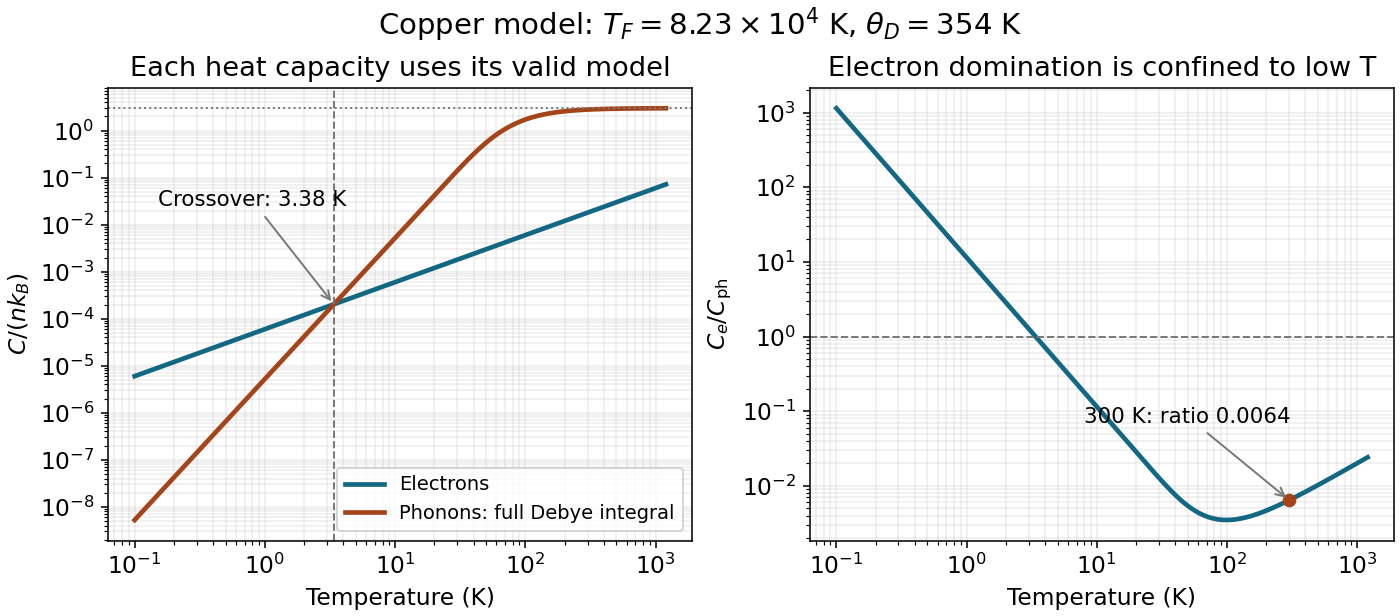
Electronic and full Debye lattice heat capacities of the stated copper model, with the low-temperature crossover and room temperature marked
. Details. 
The structure factor is the coherent scattering amplitude of the contents of a unit cell at a specified momentum transfer. Contributions from its atoms add with phases fixed by their positions. At a reciprocal lattice vector indexed by Miller indices, the crystal basis structure factor isChanging every phase sign conjugates the amplitude for real scattering factors and leaves the intensity unchanged. The positions here are fractions of the chosen cell edges. An atomic basis of a crystal should not be confused with a set of primitive translation vectors.
In kinematic elastic scattering the diffraction intensity of a Bragg reflection is proportional to , after including geometrical, polarization, thermal-displacement and experimental factors. Powder integrated intensities also include multiplicity. The many-cell interference factor selects reciprocal-lattice vectors satisfying the diffraction geometry; the unit-cell factor determines their relative amplitudes and additional extinctions. Ring positions determine spacings through Bragg's law, while intensity patterns and systematic absences constrain lattice centering and atomic arrangements. Intensity loses the overall complex phase, so structure determination is not a direct measurement of every individual atomic phase.
X-rays scatter from electron density, giving an atomic factor that changes with momentum transfer and chemical charge distribution. Neutrons scatter coherently from nuclei with bound coherent scattering lengths, which need not track atomic number; magnetic neutron scattering is an additional channel in magnetic materials. Their different elemental/isotopic contrasts make the two probes complementary.
For the four conventional face-centered cubic lattice sites , , and , their centering factor isThis is the face-centred cubic selection rule. Enumerating the nonzero representatives with givesSymmetry-related permutations and signs belong to the same powder ring, not additional rings. For Al, the basis contains one atom, . ThusFor the stated KCl basis,The all-even reflections add the two atomic factors; all-odd reflections subtract them. Ionic and each have 18 electrons, giving similar X-ray amplitudes. Their difference is much smaller than their sum, so the 111 and 311 rings are weak. Consequently the four strong rings areThis is an accidental diffraction extinction from equal atomic scattering factors in the equal-factor limit, not an extra exact fcc selection rule. Isoelectronic ions can have different radial electron distributions, so real odd reflections need not vanish exactly. Even the cruder neutral-atom estimate , makes the odd/even basis-intensity ratio only , before other ring-intensity factors.
For Si's displaced identical basis atoms,For all-odd indices, the bracket is , with squared magnitude 2. For all-even indices it vanishes when , and has squared magnitude 4 when the sum is a multiple of four. Thus 200 and 222 vanish, whereas 111, 220, 311 and 400 survive:These are the basis extinctions of the ideal diamond cubic structure. Intensity strengths within each surviving set can still differ because of atomic factors, multiplicity and geometry.
Replacing X-rays by neutrons of the same wavelength keeps the geometric Bragg positions, but replaces electron-density amplitudes by nuclear coherent scattering lengths. For Al all sites still carry the same nonzero amplitude, so its six reflections remain. For Si the identical two-site basis still has the same destructive-interference conditions, so its four reflections remain. Isotopic randomness can add diffuse/incoherent scattering but does not create a new periodic basis with different systematic Bragg absences.
K and Cl, however, have different nuclear amplitudes despite their isoelectronic ionic electron clouds. For natural isotopic composition, fm and fm. The all-odd/all-even basis-intensity ratio becomeswhich is no longer the strong X-ray cancellation. The two odd rings should therefore be observable with suitable sensitivity, givingThe numerical contrast uses the NIST bound coherent lengths.[ref]
Neutron scattering lengths and cross sections by NIST. Complete table, natural-element K and Cl rows: coherent b in femtometres; also Al and Si rows
Counts here mean allowed and reasonably observable rings in the specified range, assuming sufficient angular coverage and resolution; no theory alone fixes an instrument's intensity threshold. These nonmagnetic examples use nuclear elastic scattering, not magnetic scattering.A phonon is one quantum of a collective harmonic normal mode of a crystal. A mode labelled by wavevector and branch has energies , with bosonic occupation statistics. The crystal momentum is defined modulo a reciprocal lattice vector; it is not generally the mechanical momentum of one atom. The phonon dispersion relation assigns its frequency and polarization to the wavevector and branch.
Inelastic neutron scattering can measure this relation in a single crystal. Determine the incident neutron energy and wavevector, scatter at a chosen angle, and analyze the outgoing energy by time of flight or a spectrometer analyzer. Energy and crystal-momentum conservation giveThe signs distinguish phonon creation and annihilation with consistent momentum convention. Repeating measurements at different momentum transfers maps peaks in the dynamic scattering response into phonon branches. The measured intensity depends on occupation, scattering factors and the projection of the mode polarization along the momentum transfer; a weak or missing peak need not mean that the corresponding mode does not exist.
Let be the longitudinal displacement of atom . Translational invariance and a symmetric harmonic pair force give the long-range harmonic-chain dispersion equationsUse a traveling normal mode . Dividing by its nonzero amplitude givesHencePositive pair constants give a nonnegative squared frequency and a uniform-translation zero mode. More general signed force constants require checking stability of the entire sum. The frequency is even in and periodic with , reflecting reciprocal-lattice equivalence. The force sum must converge in the model. A finite ordinary acoustic slope additionally requires convergence of , in which case . Both finite-range examples below satisfy this condition.
Write and use as the frequency unit. The nearest-neighbour chain and its next-nearest-neighbour extension haveThese are each a single acoustic branch, repeated over reciprocal-lattice periods. There is no added optical branch merely because a longer-range spring is introduced. The cutoff for specifies the first chain as nearest-neighbour despite the source's repeated word in its description.
For small , and . ThusThe maximum is not necessarily at the zone edge. Put , so . The second squared dimensionless frequency isIt reaches its maximum at , or in the first zone. The first chain peaks at . ThereforeAt both chains have the same frequency, but the second chain has already passed its interior maximum. The next-nearest-neighbour monatomic-chain frequency maximum is therefore crucial to a correct sketch. Periodic repetition gives the requested curves for all wavevectors.
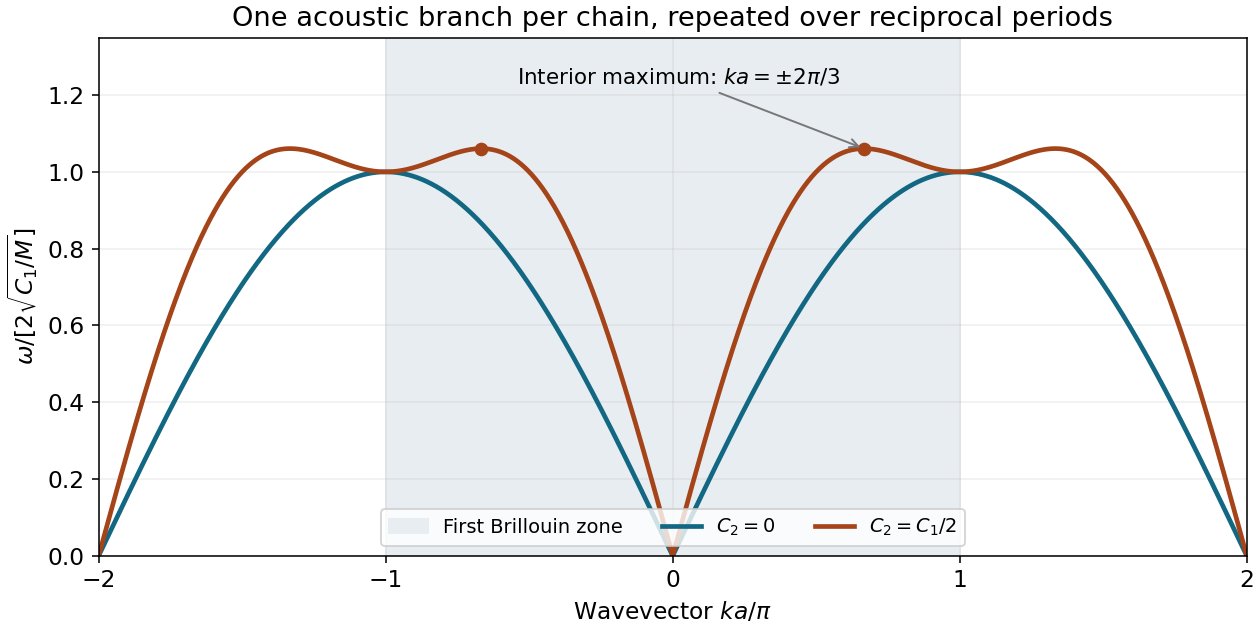
Nearest- and next-nearest-neighbour monatomic-chain dispersions in repeated zones; the second chain peaks inside the first zone
. Details. 
An intrinsic semiconductor has thermally generated conduction electrons and valence holes, with at equilibrium in the ideal undoped neutral material. Their abundance is controlled by its band gap, temperature and band density of states.
An extrinsic semiconductor has its mobile carrier populations substantially modified by electrically active impurities. A donor impurity can supply electrons, producing n-type material; an acceptor impurity can capture a valence electron and leave a mobile electron hole, producing p-type material. Compensation and incomplete ionization can modify these simple counts. At low temperature dopant freeze-out can occur; at sufficiently high temperature intrinsic pair production can overwhelm a fixed dopant density. Doping and the dominant transport regime are related but are not interchangeable descriptions at every temperature.
Assume nondegenerate three-dimensional parabolic band edges, a fixed gap and approximately temperature-independent density-of-states effective masses. Let be the chemical potential, and the band edges, and their effective density of states. Boltzmann occupation givesFor one spin-degenerate spherical conduction extremum, direct integration of givesand similarly for the valence band with its appropriate density-of-states mass. Valley and additional band degeneracies can be included in these prefactors. The factor follows from the integral .
Multiplication removes the chemical potential:The semiconductor mass-action law combined with intrinsic charge neutrality, , therefore givesThe intrinsic chemical potential is not necessarily exactly midgap: . Equal effective masses are unnecessary for the displayed carrier-density law. A changing gap, effective mass or degeneracy would make the prefactor or activation law temperature dependent.
Choose longitudinal current along , magnetic field along , and define the oriented Hall coefficient by . For one carrier type with signed charge , a stationary transverse force balance is . Since , this gives . Using ,This is the weak-field isotropic one-carrier approximation with Hall scattering factor one, not a general multiband identity.
Under the stipulated electron-dominated approximation, the given Hall magnitudes implyTake the ratio of the intrinsic activation law:Solving gives the model's activation-gap estimateThis result uses the supplied Hall-temperature ratio and the fixed-gap, fixed-prefactor assumptions. A temperature-dependent gap or changing Hall factors would modify its interpretation.
The source's description of electrons as intrinsic silicon's majority carriers needs qualification. Intrinsic neutrality gives equal electron and hole concentrations, not an electron density majority. Electrons can nevertheless dominate conductivity and the Hall response because their mobility is larger. For two weak-field carriers,At this becomes . Thus explains the negative sign, while the one-electron formula is quantitatively accurate only if the hole contribution can be neglected. Equality itself is a concrete counterexample to a literal electron-number-majority claim. The numerical deductions above retain the approximation explicitly requested by the source.
The sign must become positive, so use p-type acceptor impurities, such as boron substituting for tetravalent silicon. Assume uncompensated, fully ionized acceptors of density , nondegenerate carriers and equilibrium throughout the interval. Charge neutrality and mass action giveFor a nearly constant hole-dominated Hall coefficient, the dopant plateau must persist up to the highest temperature. Its necessary concentration scale is thereforeThe order-of-magnitude onset is , but equality is not a flat plateau: at , , changing the hole-only Hall coefficient by about 38 percent. The word approximately does not define a unique sharp minimum without a tolerance.
For , , so the hole-only varies by a fraction of order . An illustrative one-percent tolerance in that approximation is obtained with . This gives and less than one percent hole-density-induced variation. It is an explicit plateau criterion, not an exact minimum deduced from the unspecified word approximately.
At 300 K the minority electron concentration isThus the onset-scale estimate gives about , whereas the explicit ten-times-larger plateau choice gives .
The acceptor density for a stable Hall sign can be more restrictive if both carriers matter. With mobility ratio , positive Hall sign requires , or . In the strongly extrinsic limit the full two-carrier Hall correction scales as , not just . Hence a true measured-Hall tolerance can require a larger dopant density than the hole-only illustration. Mobilities and their temperature dependence are not supplied, so they cannot be used to manufacture a unique sharper minimum.
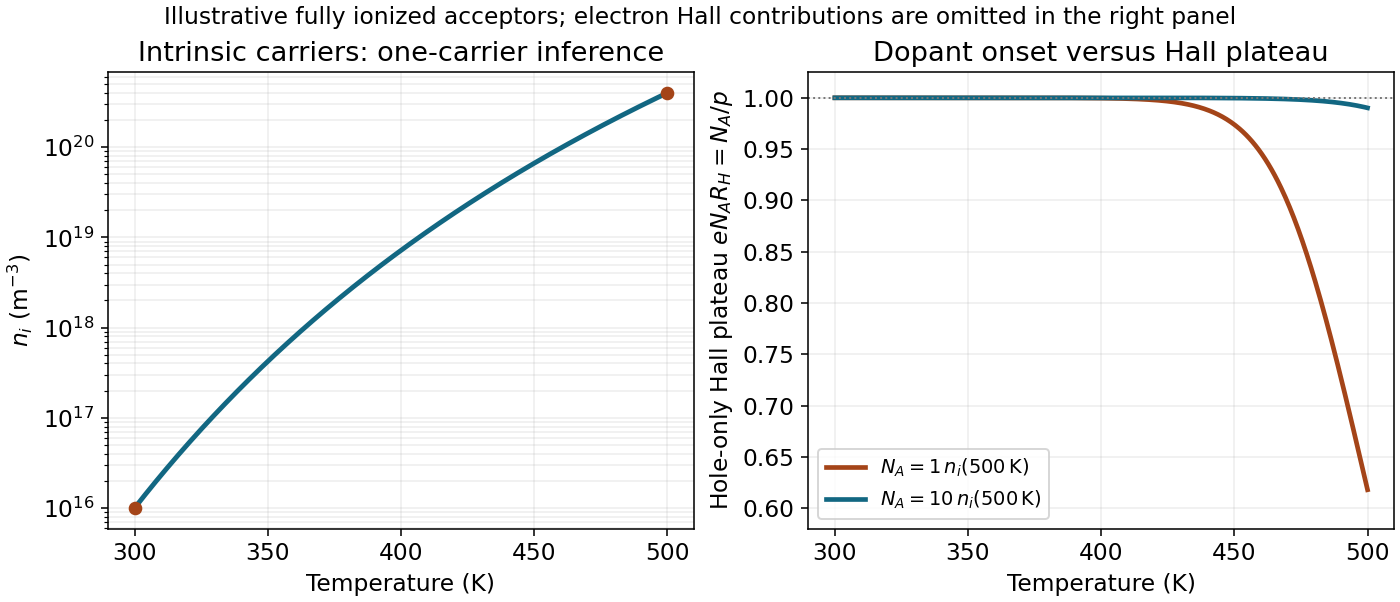
Intrinsic carrier activation and the hole-only Hall plateau for two explicitly chosen acceptor densities; concentrations are model estimates, not extra measurements
. Details. 
Articles by others on the same topic
There are currently no matching articles.