A material with paramagnetism develops a magnetization parallel to a weak applied magnetic field intensity, with positive magnetic susceptibility and no spontaneous magnetization in its paramagnetic phase. Molecular oxygen is an example; it has unpaired electron spins.
A material with diamagnetism develops an induced magnetization opposing the applied magnetic field, with negative magnetic susceptibility. A closed-shell atom such as helium is an example; its orbital response is diamagnetic.
A ferromagnet has a spontaneously ordered magnetization below its Curie temperature, even in the limit of vanishing applied magnetic field. Iron below its Curie temperature is an example. Different magnetic domains can cancel the net moment of an unmagnetized bulk sample, despite nonzero local spontaneous magnetization.
An shell has orbital quantum number and seven orbital states with . The first of Hund's rules maximizes total spin subject to the Pauli exclusion principle. Seven electrons occupy the seven orbitals singly with parallel spins, givingTheir orbital projections sum to zero, so the half-filled shell also has total orbital angular momentum , total , and Landé g-factor . These further values identify the magnetic moment used below.
The specified two-direction constraint permits magnetic moments , withwhere is the Bohr magneton. There are four magnetic gadolinium ions per conventional face-centered cubic lattice cell; the closed-shell nitrogen ions add no local spin moment. Hence the magnetic-ion number density isAt high temperature, neglect interactions and use . The one-ion partition function and mean magnetic dipole moment areIn the weak-magnetic field limit, , so . Thus the dimensionless SI magnetic susceptibility is , withThe coefficient has units of kelvin. The unrestricted-spin expression proportional to is inappropriate here: the source explicitly retains only the two orientations with . In this two-state Curie law, the squared axial moment is .
Ferromagnetic interactions enhance the response above the ordering transition. The Curie–Weiss law improves the independent-spin approximation:with positive Weiss temperature and the same high-temperature coefficient . In a simple mean-field theory, take . More generally is fitted and need not equal , and the simple pole does not give exact critical behaviour arbitrarily close to the transition.
At zero temperature, a selected ferromagnetic orientation has all magnetic moments aligned. Its saturation magnetization isEquivalently, there are per conventional cell. The moment points along either allowed easy-axis direction at zero magnetic field. This is the local or single-domain spontaneous magnetization; a macroscopic multidomain sample can have smaller, even zero, net magnetization in the absence of a selecting field.
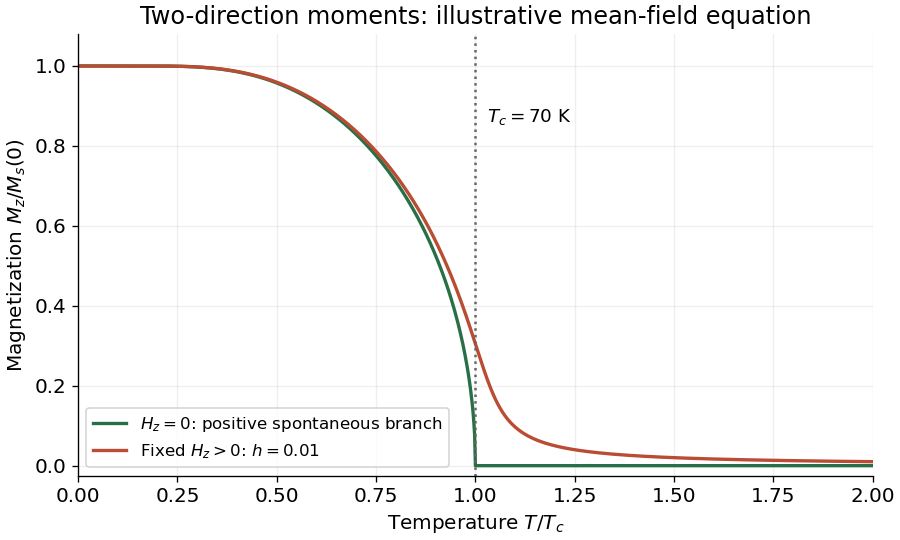
Choose the positive spontaneous branch for . Its magnetization starts at , decreases with temperature, and reaches zero continuously at . It remains zero for . There is an equally valid negative branch below ; domain averaging can instead give zero net moment.
A fixed small positive magnetic field intensity selects the positive branch. At zero temperature it still saturates at ; at intermediate temperature it increases the magnetization relative to the zero-field branch. It rounds the zero-field transition and leaves a positive magnetization above , tending in the linear-response region to . The magnetization therefore does not vanish at in the nonzero-field curve.
For a concrete labelled sketch, the figure uses the illustrative mean-field theory equationIt shows and a fixed small . The curve is an illustrative equilibrium equation of state, not a determination of the precise critical exponents of GdN. At no symmetry-breaking transition remains along this temperature sweep.

Articles by others on the same topic
There are currently no matching articles.