Source paper: www.whatdotheyknow.com/request/oxford_physics_past_papers_2/response/2340696/attach/6/Physics%20Papers%202017.pdf?cookie_passthrough=1. The cover identifies B6 on 8 June 2018; the annual bundle's 2017 filename does not determine the examination year.
A Bravais lattice is a set of points generated by integer translations along three independent primitive lattice translation vectors:Every lattice point has the same environment under lattice translations. A crystal structure consists of this Bravais lattice with an atomic basis of a crystal repeated at every lattice point; the set of atomic positions need not itself be a Bravais lattice.
The two positions in the conventional cubic cell of alpha-tungsten give a body-centred cubic lattice, with one tungsten atom per primitive cell and two per conventional cell. One possible set of primitive lattice translation vectors isTheir primitive-cell volume is .
For the conventional body-centred cubic lattice, the crystal basis structure factor of identical atoms isIt vanishes for odd and equals for even . Thus the first powder diffraction ring is the family, with interplanar spacing .
The measured deflection is the angle between incident and scattered rays, , so the Bragg angle is . Using first-order Bragg diffraction, , givesThe mass density follows from two atoms per conventional unit cell, with molar mass and Avogadro constant :Using as the Bragg angle would confuse with and give an incorrect lattice constant and mass density.
The beta phase has a primitive cubic lattice with an eight-atom atomic basis of a crystal, rather than a body-centred cubic lattice. A lattice translation must map the entire atomic arrangement onto itself. For example, the putative body-centering vector maps to modulo integer coordinates, where the given atomic basis of a crystal has no atom. None of the seven nonzero basis positions generates a translation that preserves all eight sites. ThereforeThe presence of atoms at both the origin and the body centre alone is insufficient to establish body-centering of the full crystal structure.
Initially approximate every tungsten atom by the same atomic scattering factor . Pairing the quarter-coordinate sites in the crystal basis structure factor givesFor cubic powder diffraction, increasing deflection corresponds to increasing , since . The first possibilities are
| Family | | \ | | | \ | | | \ | | | \ | | | \ | | | |
|---|
Hence the first two strong rings have Miller indicesThe powder diffraction multiplicity is six for , from three choices of nonzero axis and two signs. For it is , from six permutations and four sign choices. If the atomic scattering factors and angular corrections are taken as approximately equal for these nearby rings, their integrated diffraction intensity obeyThis is a multiplicity-based estimate. An exact measured ratio also depends on the momentum-transfer dependence of the atomic scattering factor, the Lorentz-polarization factor, the Debye–Waller factor, absorption and instrument geometry. In particular, the source does not provide the beta-phase lattice constant or instrument corrections needed to calculate those angular factors. Peak heights additionally depend on peak widths; the estimate refers to integrated ring intensities.
The two body-centre/origin sites and the other six sites have different local environments. Their effective atomic scattering factors therefore need not be identical even in an elemental, chemically pure crystal. Write them as and , respectively. The crystal basis structure factor becomesFor the low-angle families this givesThus can produce a weak extra powder diffraction ring below . This is an accidental diffraction extinction from equal atomic scattering factors: its cancellation in part d is exact only in the identical-atom-scattering approximation. Small differences in the bonding electron density, or site-dependent Debye–Waller factors, can leave a small nonzero amplitude. For instance, taking and gives while ; the corresponding intensity suppression is quadratic in . No impurity is required. The and cancellations remain for arbitrary scalar in this two-site-class model.
The chemical potential is the change in Helmholtz free energy when particles are added at fixed temperature and volume:Equivalently, identifies it as the derivative of internal energy at fixed entropy and volume. In equilibrium, systems that exchange particles have equal chemical potentials.
The Fermi energy is the zero-temperature chemical potential, or, for independent electrons, the highest occupied single-particle energy in the zero-temperature limit. Its numerical value depends on the chosen energy reference; the Fermi energy need not be measured from the bottom of a band unless that convention is specified.
Expand a single-electron wavefunction as . Project the Schrödinger equation onto to obtainTranslation symmetry suggests the Bloch state on a periodic chain of sites. Substitution givesTake the conventional positive hopping . The first Brillouin zone is ; the band has minimum at and maximum at the zone edges. Its width is . A negative hopping interchanges the extrema but does not change the density of states after replacing by .
There are allowed wavevectors and two spin states per wavevector. For the total spin-summed density of states , each interior band energy has two roots, . Using the spacing givesThus the density of states per atom isIt is symmetric about and has integrable inverse-square-root Van Hove singularities at both band edges. Its integral over the band is two states per atom. The plot labels the dispersion extrema and both singular edges.
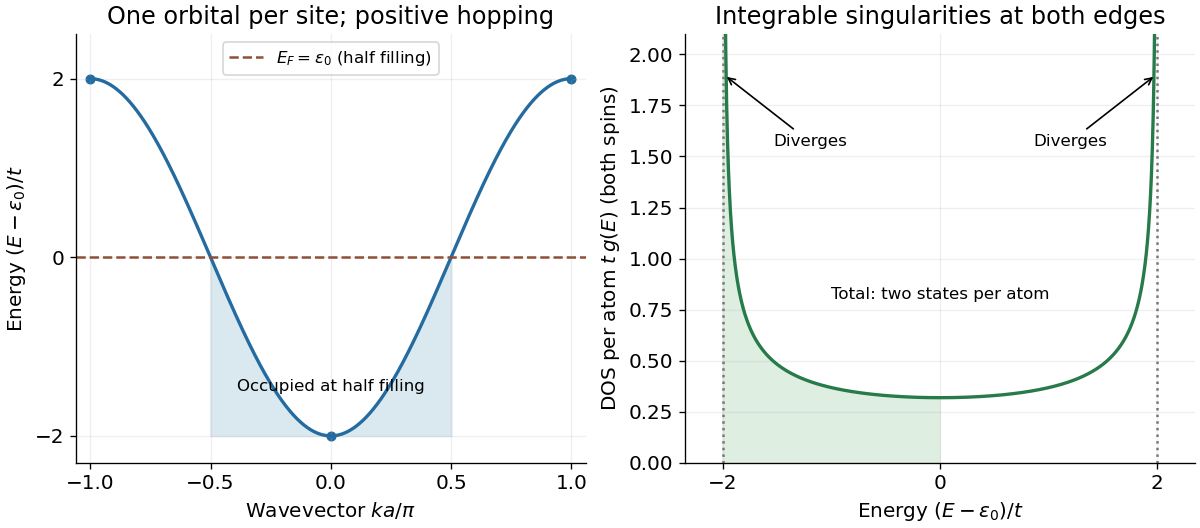
Monovalency gives one electron per atom, so the two-spin-state band is half filled. At zero temperature, occupying gives . HenceRelative to the band minimum, the Fermi energy is .
The density of states obeys . At , the Fermi-Dirac distribution satisfiesPairing the energies above and below the band centre therefore leaves exactly half of the two available states per atom occupied, at every positive temperature. Increasing strictly increases the mean particle number, so this solution at fixed half filling is unique. ConsequentlyThis particle-hole symmetry of a half-filled bipartite band argument uses the symmetric tight binding band and fixed half filling; it is not a general temperature-independence property of chemical potential in metals with additional bands or an asymmetric density of states.
The first Brillouin zone is the squareAt half filling, translation of the wavevector by exchanges the two band energies:Thus the same energy-pair argument as in part c givesAt zero temperature, the Fermi surface satisfies . Within the square Brillouin zone this is the diamondwhose vertices are and . The occupied region is the diamond's interior, containing the band minimum at the zone centre. It has half the Brillouin zone area, consistent with one electron per atom and two spin states per wavevector.
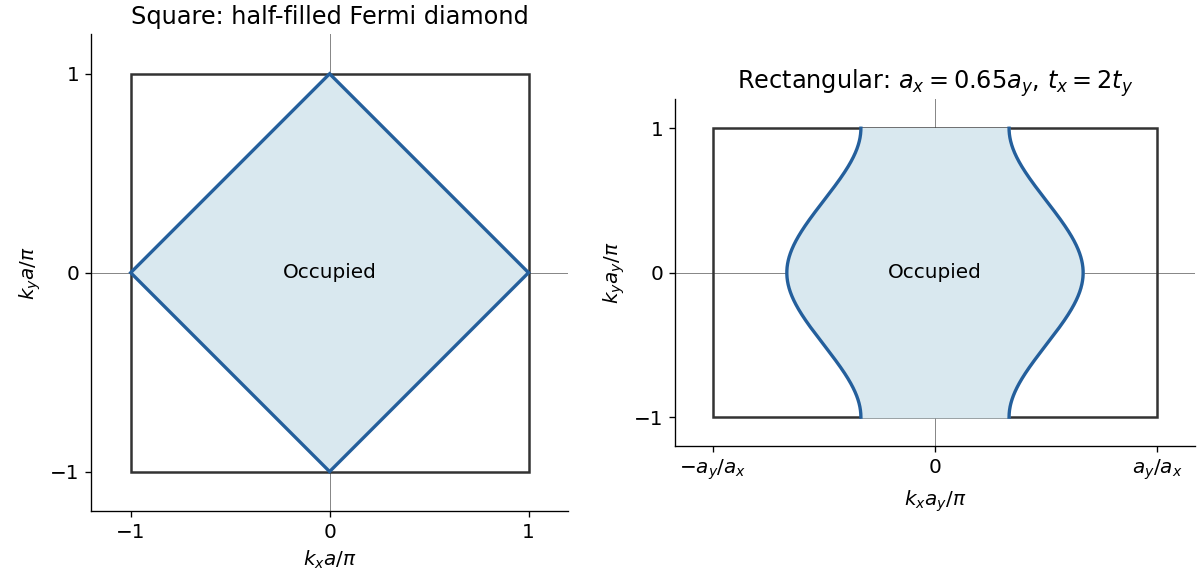
The reciprocal primitive vectors are and , so the first Brillouin zone isIt is wider in the direction because .
The geometry alone does not fix the hopping amplitudes or a unique Fermi surface. One consistent tight-binding model isrepresenting larger hopping between the closer atoms. It remains a nearest-neighbour bipartite band at half filling, so its chemical potential is . Its Fermi surface consists of the two sheetsThese meet the top and bottom zone edges and continue periodically into the neighbouring zones. The right panel of the figure gives an explicit example with and . The central region between the sheets is occupied and has half the zone area. If the hopping amplitudes instead remained equal, a geometrically stretched diamond would also satisfy the stated information. The metric inequality alone does not determine which of these shapes occurs.
A phonon is a quantum of a normal mode of Bravais lattice vibration. A harmonic mode of angular frequency has energy , and adding one phonon increases its energy by . The phonon carries crystal momentum , defined modulo a reciprocal lattice vector.
The first Brillouin zone is the Wigner-Seitz cell of the reciprocal lattice about the origin: the set of wavevectors at least as close to the origin as to any other reciprocal lattice point. Its boundaries are reciprocal-space perpendicular bisectors. It gives one representative of each wavevector modulo reciprocal lattice translations.
Put . Differentiating the Morse potential givesThe finite-separation minimum has . ThusThe positive bond-dissociation energy is , measured relative to the separated-atom value . This distinguishes the well's negative potential energy from the positive energy required to break the bond.
For the displacement , the Taylor expansion isConsequentlyThe restoring force is to leading order, identifying the bond's Hooke's law spring constant.
The mass per lead atom isLet be its longitudinal displacement. Newton's second law gives the harmonic chain equationInsert the normal mode to obtainAt long wavelength, . The sound speed is the corresponding low-frequency group velocity:The relevant inertia in this chain equation is one atomic mass. The reduced mass belongs to the relative vibration of an isolated pair and should not be substituted for in the chain's dispersion relation.
Write the Morse potential relative to its minimum as . Expanding one order beyond the harmonic term givesThe negative cubic coefficient means that stretching is softer than compression. Thermal motion therefore has positive mean displacement even though the most probable minimum is at .
For thermal expansion of a weakly anharmonic bond, classical equipartition gives . Vanishing mean restoring force, to first anharmonic order, requiresFor a bond free to expand under negligible applied tension, . Its linear thermal expansion coefficient is thereforeKeeping the leading perturbative numerical factor gives . The question only requires the scale, not that factor. The thermal expansion is positive; a purely harmonic approximation would give zero mean displacement and zero thermal expansion. The local Taylor expansion describes a bound bond and is not a globally stable cubic potential.
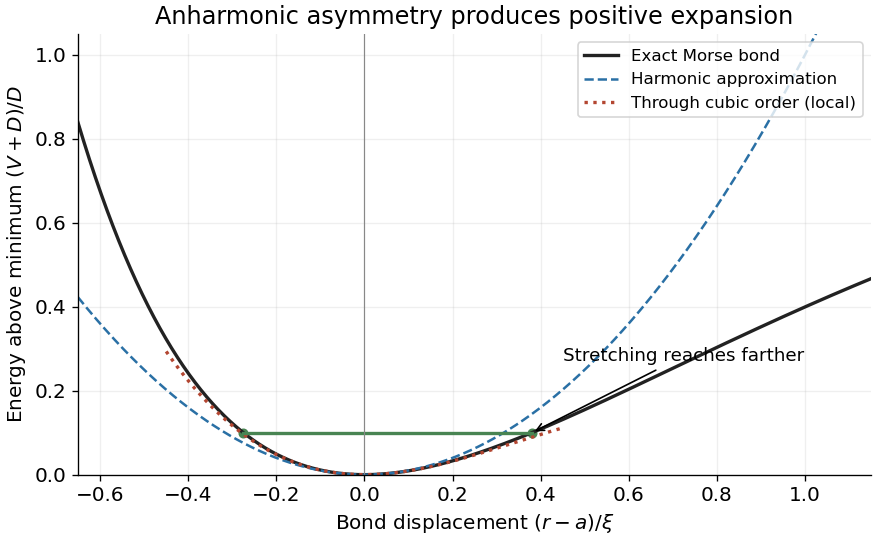
The small parameter controlling the local Taylor expansion is the typical bond displacement divided by . In the classical regime, the root-mean-square displacement is . ThusFor example, the magnitude of the cubic term divided by the quadratic term is , and subsequent terms carry further powers of this ratio. A physically safe bound-bond regime also has , or . These are the same parametric scale, differing only by a factor two. The inequalities are strong: they do not imply that a truncated local expansion is accurate close to several thousand kelvin.
At very low temperature, replace the classical fluctuation estimate by the zero-point motion as discussed in part ii. Its bond displacement is small compared with for the supplied parameters, so low temperature does not itself invalidate the local expansion. Actual melting, other neighbours and bond breaking are outside this one-dimensional bond model.
Quantum statistics matter when thermal energy is comparable with a characteristic vibrational level spacing. The chain's natural angular frequency is , givingFactors of order unity depend on which vibrational scale is used. The largest chain phonon angular frequency is , corresponding to . An isolated two-atom bond has reduced mass and angular frequency , corresponding to . Thus quantum corrections become appreciable on the scale of several tens of kelvin, and all modes are classical only when is comfortably above the largest relevant vibrational scale. Below it, high-frequency phonons are progressively frozen out and equipartition fails.
For the isolated bond, the zero-temperature root-mean-square relative displacement isIt is small enough for a local bond expansion. The classical weakly anharmonic estimate in part d therefore has a useful parametric windowwhere the lower condition means comfortably above the vibrational scale, rather than a sharp threshold. The model's upper bound concerns local anharmonicity and binding, not a prediction of the melting temperature.
A material with paramagnetism develops a magnetization parallel to a weak applied magnetic field intensity, with positive magnetic susceptibility and no spontaneous magnetization in its paramagnetic phase. Molecular oxygen is an example; it has unpaired electron spins.
A material with diamagnetism develops an induced magnetization opposing the applied magnetic field, with negative magnetic susceptibility. A closed-shell atom such as helium is an example; its orbital response is diamagnetic.
A ferromagnet has a spontaneously ordered magnetization below its Curie temperature, even in the limit of vanishing applied magnetic field. Iron below its Curie temperature is an example. Different magnetic domains can cancel the net moment of an unmagnetized bulk sample, despite nonzero local spontaneous magnetization.
An shell has orbital quantum number and seven orbital states with . The first of Hund's rules maximizes total spin subject to the Pauli exclusion principle. Seven electrons occupy the seven orbitals singly with parallel spins, givingTheir orbital projections sum to zero, so the half-filled shell also has total orbital angular momentum , total , and Landé g-factor . These further values identify the magnetic moment used below.
The specified two-direction constraint permits magnetic moments , withwhere is the Bohr magneton. There are four magnetic gadolinium ions per conventional face-centered cubic lattice cell; the closed-shell nitrogen ions add no local spin moment. Hence the magnetic-ion number density isAt high temperature, neglect interactions and use . The one-ion partition function and mean magnetic dipole moment areIn the weak-magnetic field limit, , so . Thus the dimensionless SI magnetic susceptibility is , withThe coefficient has units of kelvin. The unrestricted-spin expression proportional to is inappropriate here: the source explicitly retains only the two orientations with . In this two-state Curie law, the squared axial moment is .
Ferromagnetic interactions enhance the response above the ordering transition. The Curie–Weiss law improves the independent-spin approximation:with positive Weiss temperature and the same high-temperature coefficient . In a simple mean-field theory, take . More generally is fitted and need not equal , and the simple pole does not give exact critical behaviour arbitrarily close to the transition.
At zero temperature, a selected ferromagnetic orientation has all magnetic moments aligned. Its saturation magnetization isEquivalently, there are per conventional cell. The moment points along either allowed easy-axis direction at zero magnetic field. This is the local or single-domain spontaneous magnetization; a macroscopic multidomain sample can have smaller, even zero, net magnetization in the absence of a selecting field.
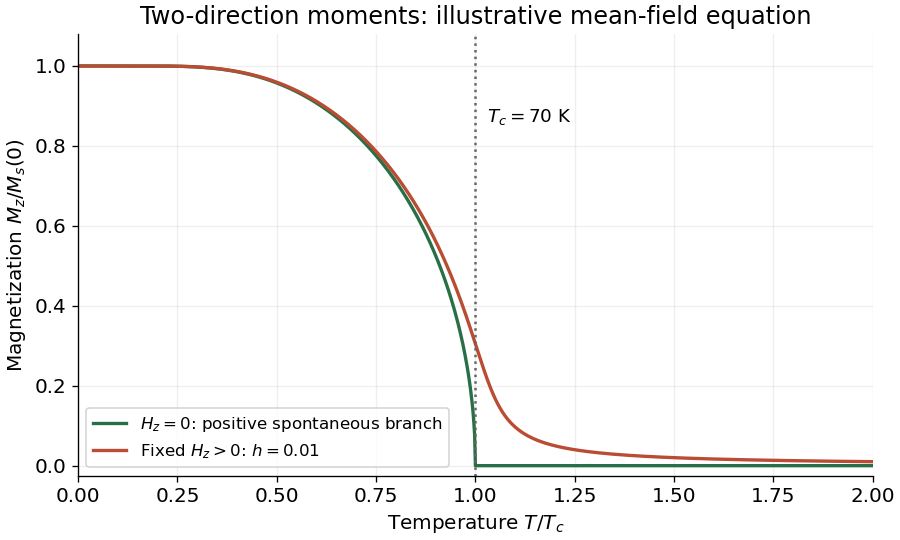
Choose the positive spontaneous branch for . Its magnetization starts at , decreases with temperature, and reaches zero continuously at . It remains zero for . There is an equally valid negative branch below ; domain averaging can instead give zero net moment.
A fixed small positive magnetic field intensity selects the positive branch. At zero temperature it still saturates at ; at intermediate temperature it increases the magnetization relative to the zero-field branch. It rounds the zero-field transition and leaves a positive magnetization above , tending in the linear-response region to . The magnetization therefore does not vanish at in the nonzero-field curve.
For a concrete labelled sketch, the figure uses the illustrative mean-field theory equationIt shows and a fixed small . The curve is an illustrative equilibrium equation of state, not a determination of the precise critical exponents of GdN. At no symmetry-breaking transition remains along this temperature sweep.


Articles by others on the same topic
There are currently no matching articles.