A parabolic isotropic band has group velocity and semiclassical force for electrons with charge , where . In the relaxation-time approximation the nonequilibrium drift velocity loses momentum at rate . Combining these givesThe relaxation term represents the average effect of scattering rather than a force on every carrier between collisions. Linear response, an approximately energy-independent and near the Fermi surface, and wavelengths long enough for a local bulk response are implicit. The equilibrium random velocities average to zero and do not themselves contribute a drift current.
Use the time dependence actually specified, , and . The component equations areAdding the second equation multiplied by diagonalizes the response. With the literal definitions , , and ,The source's printed reverses the helicity labels for these definitions. It is recovered by naming the two circular components oppositely, reversing , or changing the matching time/polarization convention. As a concrete check, with , and positive , the collisionless component equation resonates at . The printed plus-labeled denominator would instead remain proportional to . The physical result is unambiguous: only the circular polarization rotating with the electron orbit has positive-frequency cyclotron resonance.
For the convention used here, the dielectric eigenvalues are . In the lossless limit,These eigenvalues determine propagation and reflection in the Faraday geometry; changing the helicity names swaps their subscripts without changing any optical prediction.
At zero magnetic field the two circular conductivities coincide, so an isotropic material has no magnetically induced circular birefringence. In the collisionless Drude model range the dielectric function is . A high carrier density gives a large plasma frequency, often placing the screened plasma edge in the infrared or visible range.
Below that edge the real dielectric function is negative and a transverse wave is evanescent in the bulk. The material is strongly reflecting, with penetration through a skin depth and losses set by finite . Above the plasma edge propagation becomes possible, subject to absorption and interband transitions. Carrier density alone does not specify a complete optical spectrum: the statements assume the probe frequency relative to the plasma scale and the validity of the single-band Drude model.
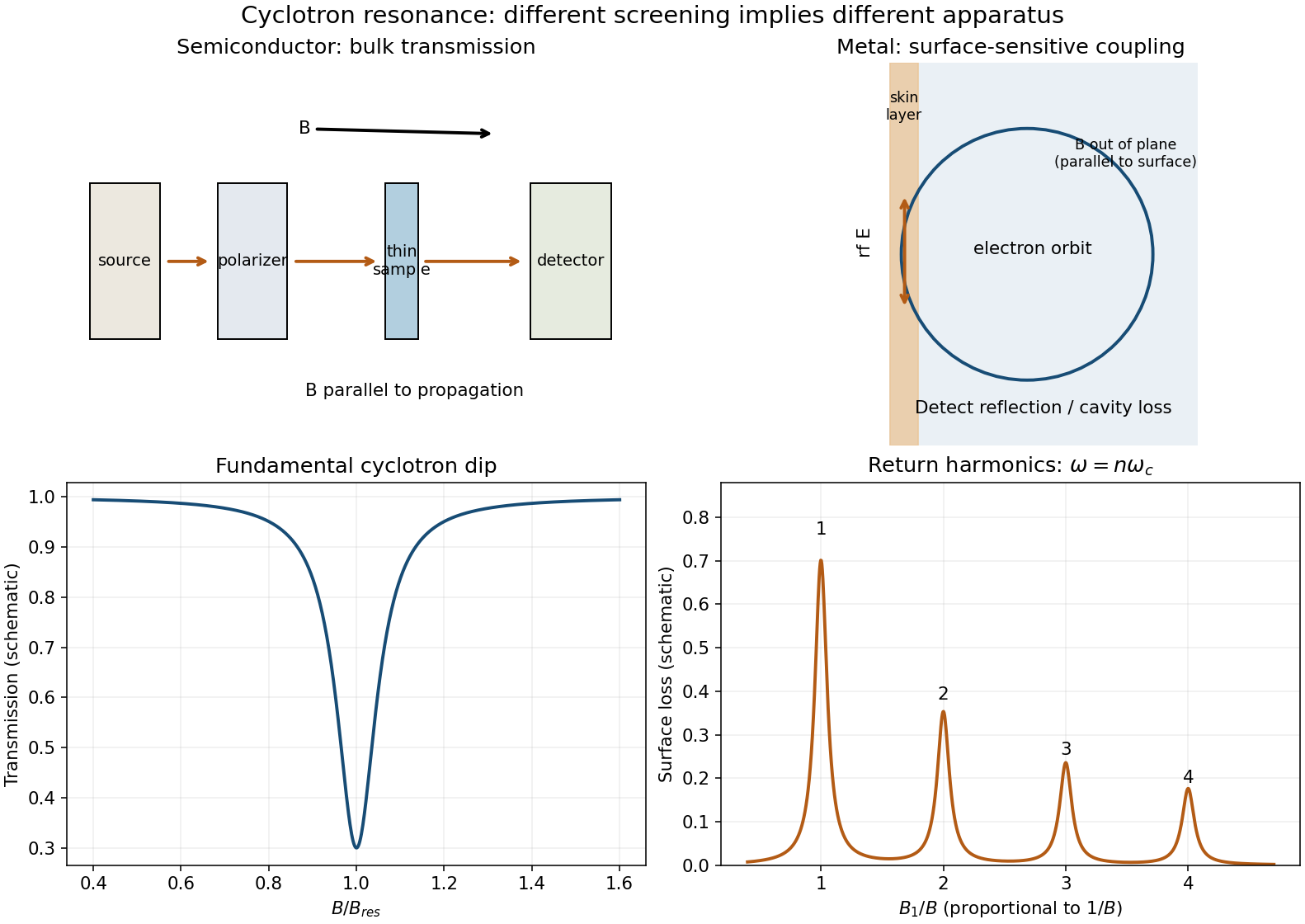
At low density, the plasma frequency and free-carrier dielectric screening are smaller, so radiation can penetrate a suitable semiconductor sample. In a high field with , the active circular component has a resolved cyclotron absorption line near , with width of order . The opposite circular component lacks that positive-frequency resonance.
Different complex refractive indices for the two components produce Faraday rotation and circular dichroism. Transmission with controlled circular polarization therefore isolates the cyclotron resonance and measures . The low-density/high-field labels do not by themselves imply complete transparency at every frequency; one must still avoid the plasma stop bands, strong interband absorption and excessive sample thickness.
At high density the plasma scale remains large, but a strong magnetic field separates the two circular dielectric responses. Ignoring damping, the positive plasma cutoffs areBetween suitable cutoffs one circular wave can propagate while the other is excluded; reflection and transmission are strongly polarization dependent. Around the cyclotron frequency the active response is resonant, while at optical frequencies far above the splitting can be a relatively small correction to a large plasma edge.
There is also a low-frequency window: for the active component, gives when losses are small. This supports a helicon-like mode even when . That does not make an ordinary metal broadly transparent; the large index, boundary coupling, collisions and skin geometry still matter. In the common regime , bulk cyclotron absorption remains hidden from straightforward transmission, motivating a surface-sensitive experiment. Thus the relevant comparisons are among , , and , not carrier density and field in isolation.
In a low-carrier-density semiconductor use a thin, cold sample in a transmission spectrometer. Direct microwave or far-infrared radiation through it, commonly with propagation parallel to and electric field transverse to it. Sweep at fixed frequency and detect transmitted power. The active circular polarization shows an absorption peak, or transmission dip, near . Resolving it requires a long enough scattering time, .
A metal's large plasma frequency usually prevents that radiation from sampling its bulk directly. In surface cyclotron resonance in a metal, put approximately parallel to a clean metal surface and excite an rf electric field in the skin depth, transverse to . Electron orbits extend into the bulk and repeatedly return to that layer. Coherent energy absorption occurs when the rf phase repeats on a return, including harmonics . Measure cavity loss, reflected power, or surface impedance rather than attempting ordinary bulk transmission. The characteristic regime has cyclotron radius larger than the skin depth and sufficiently specular, long-lived orbits.
For the spherical parabolic band the metal harmonic fields areThey are evenly spaced in , with amplitudes and widths determined by surface geometry and scattering. A semiconductor generally gives the simple bulk fundamental, whereas the metal can show this harmonic series in a surface-loss signal. For an anisotropic real Fermi surface the measured mass is the appropriate cyclotron effective mass rather than necessarily every component of a transport effective-mass tensor. These classical resonance harmonics are distinct from the Landau-level quantum oscillations in c.

Articles by others on the same topic
There are currently no matching articles.