In a conventional superconductor, an attractive pairing interaction forms Cooper pairs and a phase-coherent condensate. The elementary fermionic excitations have a superconducting energy gap ; breaking a pair into two excitations costs at least . The density of thermally excited quasiparticles is exponentially small for . Nevertheless the vanishing DC electrical resistivity below the critical temperature is a property of the coherent supercurrent, not a claim that all thermal quasiparticles disappear. Below the relevant critical-current and critical-field limits, a homogeneous bulk sample carries dissipationless current; above the superconducting transition the normal resistivity returns.
In a semiconductor, the band gap separates filled valence states from empty conduction states because of the periodic crystal potential and orbital hybridization. Thermally exciting carriers across the gap produces both conduction electrons and valence holes. For an intrinsic sample,Thus its electrical resistivity generally rises rapidly on cooling, with an activated factor up to mobility and density-of-states prefactors. This differs from the zero-resistivity condensate response. Dopant freeze-out and extrinsic-carrier regimes require their own activation scales; the intrinsic formula is not universal for every doped sample.
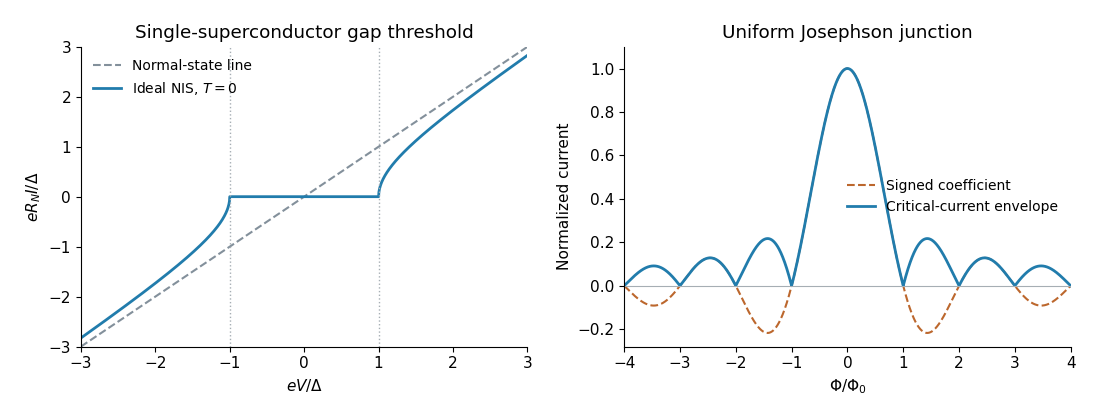
Use a normal-metal--insulator--superconductor junction with a weak tunnelling barrier. For a nearly constant normal-metal density of states, the differential conductance probes the thermally broadened superconducting quasiparticle density of states. At sufficiently low temperature, the ideal BCS theory result isThere is very little single-electron tunnelling for , while a sharp onset occurs at . The gap can therefore be obtained from the two symmetric onset voltages, . For this one-superconductor junction the threshold is , not .
Integrating at zero temperature gives the useful current sketchThe curve is odd, nearly flat inside the gap, and approaches the normal-state line at large . The ideal gap-edge singularity is in the slope, not in the current itself. At finite temperature below the transition the onset rounds and thermally activated subgap current appears. Measuring several temperatures distinguishes this rounding from the closing of .
Gap threshold in NIS tunnelling and the Josephson interference envelope
. Original ideal-model plots. Left: the zero-temperature single-electron current into a fully gapped superconductor, with the normal-state line for comparison. Right: the signed sinc coefficient at a fixed phase and its nonnegative critical-current envelope. Finite temperature, nonuniform junction current density and self-field effects are omitted. Details.
Rearrange the source's condensate-current expression and integrate around a closed path lying in the superconducting material:Single-valuedness of the superconducting wavefunction requires , and Stokes theorem gives . Thus the exact result is fluxoid and flux quantization in a superconductor:Reversing the winding orientation absorbs the sign of . Since a Cooper pair has , the positive superconducting flux quantum isFor a thick ring, choose the path deep enough that the supercurrent is negligible; then the enclosed magnetic flux is . This is the flux quantization usually intended in the question.
Qualification of the unqualified flux claim: a thin ring can have a nonzero kinetic contribution around every available path, so it is the fluxoid that is exactly quantized. For example, with zero applied flux and geometric and kinetic inductances , a metastable winding- state has but . This concrete counterexample satisfies the given current law while its magnetic flux is not an integer multiple of .
Let cross the barrier from electrode 1 to 2, let run along its width, and take . In the ideal barrier-only model choose , which has . Then the crossing integral at fixed is . With the sign convention used in the source,Reversing the field or the phase orientation reverses the slope and does not change the interference envelope. The same result follows by comparing two paths across the junction and using the enclosed magnetic flux.
If field penetration into thick identical electrodes is included, the effective magnetic thickness is approximately , where is the London penetration depth. Replace and consistently by and . The linear phase profile assumes a uniform applied field and negligible magnetic self-field of the junction current.
Let be the junction length perpendicular to the width and be uniform. Put . Integrating the local current-phase relation of a superconducting weak link over the junction givesThe odd-in- term integrates to zero. At fixed central phase , define . ThenThe value at zero flux is the continuous limit, and zeros occur at nonzero integer multiples of . This signed formula is the source's expression for a fixed phase. If the measured quantity is the maximum sustainable current, maximize over the central phase instead:For example, at the signed coefficient is , whereas the critical current is positive. The absolute-value envelope is the Fraunhofer pattern of a Josephson junction, shown in the right panel of the original tunnelling figure. Its simple form relies on uniform and the linear phase profile; it is not the two-junction cosine pattern of a DC SQUID.
Articles by others on the same topic
There are currently no matching articles.