The square-root reduction of a quadratic eikonal equation explains why two initial normal derivatives are possible. Set . Charpit's equations are , , , , . Parametrize the initial semicircle by , . Tangential compatibility gives , and gives . Thus there are two normal-gradient choices, , , .
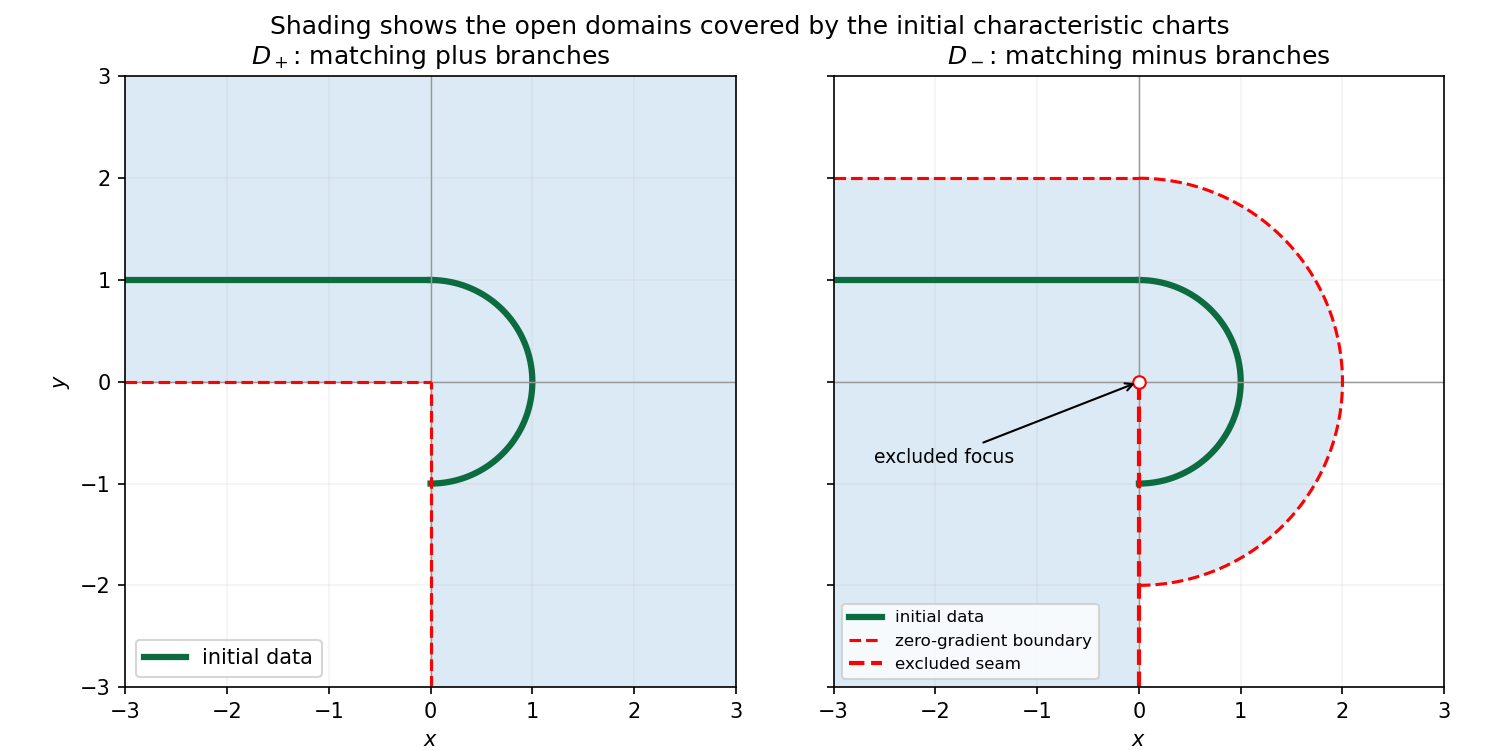
Integration gives the requested parametric solutionsFor , , so on the whole right half-plane. For , before focusing at the origin, , so on , . The origin is a caustic for this inward family. The circle is approached only as characteristic time tends to negative infinity, where and its gradient vanish. It cannot be crossed by this initial characteristic chart. Thus the initial data alone permit two branches; each is locally unique only after its normal-gradient sign is chosen.
On the added half-line write , , . Tangential differentiation gives and , . Its characteristics giveThe plus branch is on ; the minus branch is on . On the positive -axis, the semicircle traces are and , respectively. Therefore only matching sign choices are continuous throughout their common positive-axis coverage. Mixed choices agree merely at the initial junction .
For the matching-plus branch the data-covered open domain isFor the matching-minus branch it isIts formula is in the right portion and in the left portion. The origin is excluded. The negative -axis must also be a cut: the two formulas have different traces there, so including it would destroy continuity. Both matching solutions are across the included positive-axis seam; generally their second transverse derivatives differ, which is compatible with this first-order problem. Values beyond these characteristic charts can sometimes be continued, but are not selected by the initial data through a nonsingular characteristic graph.

Articles by others on the same topic
There are currently no matching articles.