For an admissible variation with ,Stationarity for every variation therefore gives the Euler-Lagrange equationThe first energy term is bending energy: the curvature of an inextensible planar beam is . The shortening relative to the straight reference is . A prescribed compressive dead load does positive work on that shortening, so its potential-energy contribution is minus times that integral. A minimizer must satisfy the stationary equation, but a stationary solution need not be a minimizer.
Set . The endpoint interval becomes , and multiplication of the dimensional equation by givesThe energy in these variables is . Thus measures load relative to the first linearized eigenvalue for the angular endpoint conditions actually imposed.
Linearization gives . The two homogeneous Dirichlet conditions select . For any small trial amplitude in this mode, , soFor every nonzero quadratic variation is positive by the sharp Poincaré inequality. For , the first mode gives negative energy at sufficiently small amplitude, so zero cannot be a local minimum.
The printed strict “only if” conclusion omits the critical case. At the quadratic test is degenerate, not negative. In fact zero is still the unique minimum of the full displayed functional: use and to get , with strict inequality for a nonzero continuous function because when . In particular on the critical first mode,Thus strict positivity of the second variation holds for , while local minimality of the full energy holds also at . This is the distinction captured by critical-load minimality of the angular Euler strut.
Near the first eigenvalue, load detuning supplies a term , while the first nonlinearity in is cubic. Balancing them gives , so .
Put . At order ,The operator has kernel , so Fredholm solvability requires its forcing to be orthogonal to that function. Since and ,When this holds the nonresonant forcing is ; for instance is a solution after absorbing its arbitrary first-mode component into the amplitude convention.
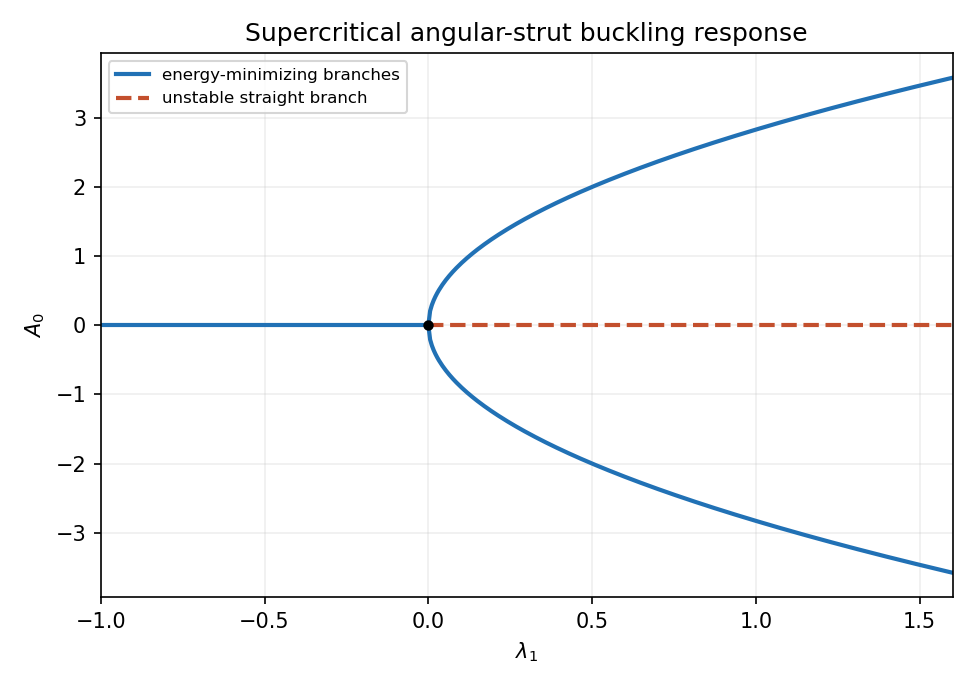
The branches are . This is a supercritical pitchfork bifurcation. The leading reduced energy is proportional to : the nonzero branches are minima for , while zero loses minimality on that side. At the origin the quartic term still stabilizes the critical state.

Articles by others on the same topic
There are currently no matching articles.