Take positive upwards, so the source's sign convention makes a downward applied load. The small-slope tension contribution on a short interval is . Let be the upward contact reaction. Force balance gives . Nonpenetration is , and reaction is absent where . ThereforeThe contact boundary must have continuous to avoid a broken string, and continuous slope in this smooth-contact model with no concentrated point force. Integrating force balance over a vanishing interval around a contact endpoint gives when the load and reaction are locally bounded. This is the one-dimensional obstacle problem, with its reaction acting as a nonnegative constraint force.
For any admissible , put . At endpoints . On the contact set, and imply , while away from contact the reaction is zero. Hence everywhere. Integration by parts givesRearranging proves the requested variational inequality. Piecewise integration is legitimate because the slope is continuous at the contact boundary, so there are no omitted point-force terms.
The small-slope excess length is , so the first term is the work needed against uniform tension. The second is the potential energy of the downward distributed load. Their sum is total potential energy subject to the obstacle constraint.
Expand the difference exactly:The first two integrals together are nonnegative by part (b), and the square is nonnegative. ThusFor this also proves uniqueness: equality for two minimizers forces identical derivatives, and the fixed endpoints remove their additive constant. The convex admissible set and strictly convex energy make the variational inequality a global minimization condition.
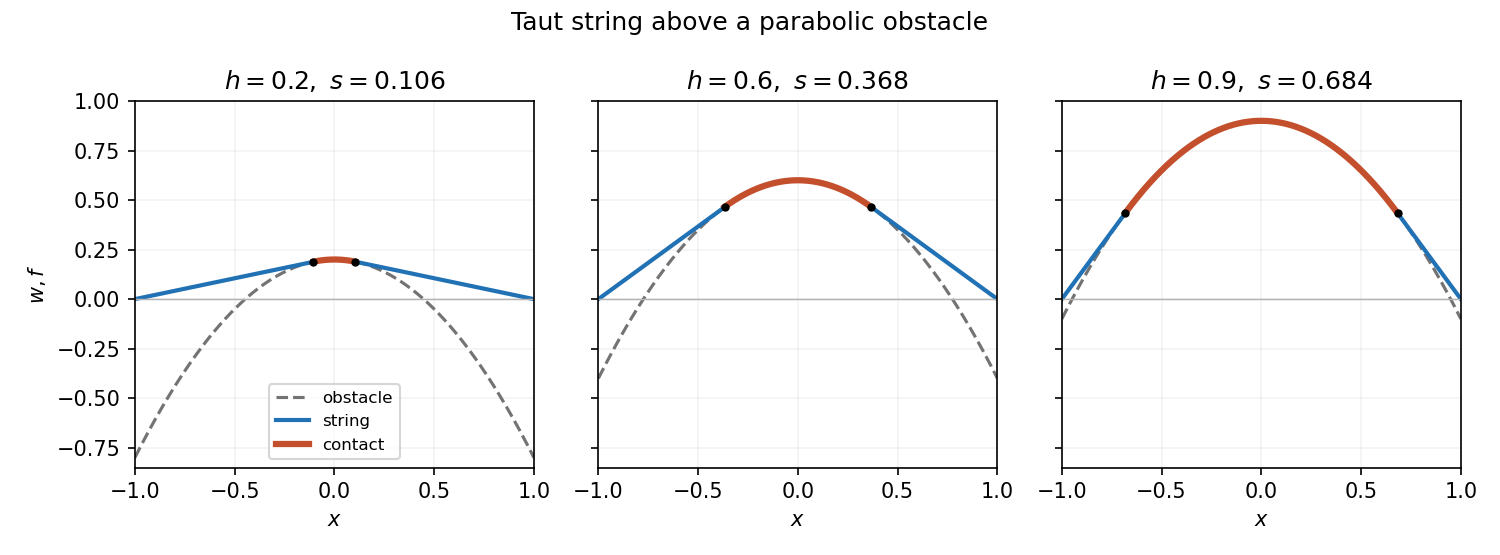
With no applied load the free string segments are straight, while in contact . By symmetry use contact and a right-hand line through tangent at . The tangency conditions are and , giving on and . ThereforeThe other algebraic root is outside the admissible contact interval except at the coincident endpoint .
Verification makes the construction complete: the values and slopes match at , the endpoints are zero, and outside contact . Inside contact ; outside it , so complementarity holds. The minimization argument proves this verified solution is the unique equilibrium. At the contact set is the single point and ; at contact fills the whole interval. This is the parabolic obstacle under a taut string.

Articles by others on the same topic
There are currently no matching articles.