Let be the single-mirror power reflectivity and the propagation angle inside the gas. Define as the vacuum wavelength. Successive transmitted complex amplitudes differ by a round-trip factor , where, for real dielectric reflection coefficients whose product has positive sign,The cosine arises by comparing successive emerging rays on the same outgoing wavefront; it is not the literal zigzag distance . Equivalently, the round-trip phase is . If the source's is the angle in external air, Snell's law gives andIf denotes the internal angle, simply set .
For identical lossless mirrors, their power transmission is . In an energy-normalized amplitude convention this is ; more general interface amplitudes require the corresponding wave impedance factors. The geometric series of transmitted amplitudes givesHenceThis is Fabry–Pérot transmission from multiple reflections.[ref]
Fabry-Perot Interferometer, University of Washington Physics 331. Theory equations (1)–(2), including the coefficient of finesse
At normal incidence, for nondispersive and zero net reflection phase modulo , the resonance condition is . The resonance frequencies and free spectral range areFor finite the resonances have finite width, and transmission away from them is nonzero. Thus “only discrete frequencies” is an ideal high-reflectivity description of the selected resonances, not an exact statement about the support of the transmitted spectrum. For example, at still gives .
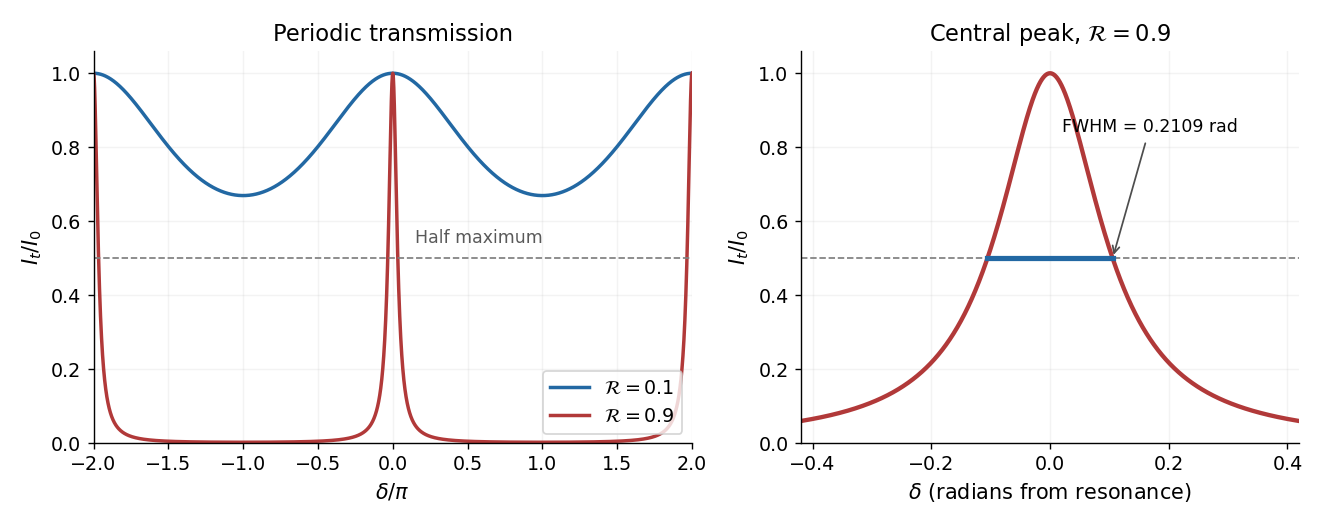
At half the unit peak, . Measuring the phase displacement from a resonance yieldsThe last expression is the high-reflectivity approximation, with finesse . At , the full phase width is about radians and . At , the minimum transmission is , so the trace never reaches half the peak and this full width at half maximum is not defined. The exact half-maximum condition requires .

For the absorbing Fabry–Pérot mirror phase and transmission, write and let be the power transmission of one mirror. Optical absorption makes . The transmitted intensity becomesHere the phase formula is at normal incidence. The peak is reduced below unity, while a change in changes the width. The complex reflection phase also moves the resonances: if is approximately constant,If either or depends on frequency, this is an implicit condition and the free spectral range need not be constant. No numerical shift is determined without the mirrors' optical response.
Articles by others on the same topic
There are currently no matching articles.