With constant isothermal sound speed , the equation of state is . Spherical hydrostatic equilibrium and mass continuity requireTry . With no central point mass, , and hydrostatic balance becomes . The positive-density branch is thereforeThe constant external pressure fixes the truncation radius through , givingThis is the pressure-truncated singular isothermal gas sphere, one hydrostatic solution, not a claim that every isothermal cloud has a singular centre. Its central density diverges, but its enclosed mass tends to zero as .
For inside-out collapse of a singular isothermal sphere, the expansion front is at . The original mass swept by this front isThus the only time-independent accretion scale is . The front-sweeping estimate has coefficient two, but gas takes time to fall from the front to the object; it is not an exact central accretion coefficient. Writefor fixed mean particle mass . Determining the dimensionless coefficient requires the collapse solution; it is not fixed by front propagation alone and is not needed for the requested temperature scaling.[ref]
Self-Similar Collapse of Isothermal Spheres and Star Formation by Frank H. Shu. 1977 expansion-wave solution: central accretion and the free-falling envelope
Well inside the front, where the point mass dominates and infall is approximately pressureless and locally steady, . Conserving the radial mass flux gives the free-fall density profile around a growing point mass:The inner slope is , versus in the undisturbed outer cloud. For constant and negligible initial object mass, and the inner normalization varies as . These are inner asymptotes, not an assertion of an abrupt exact power-law join at the front.
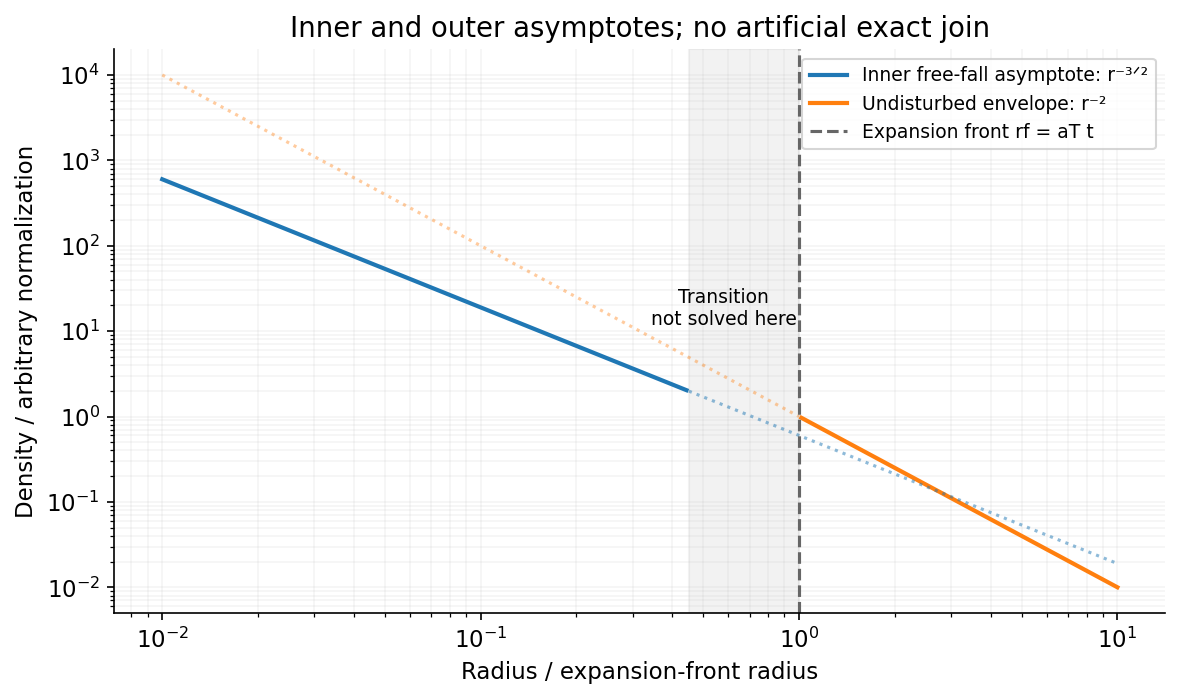
An inside-out collapse has a freely falling inner density slope distinct from the undisturbed isothermal envelope
. Source. Details. At distance , one grain intercepts power through its projected area and emits through its full surface:The blackbody dust sublimation radius follows by setting :Here the supplied luminosity is . The grain radius cancels because both cross-sections scale as . The temperature exterior to this boundary scales as . This estimate assumes isotropic illumination, no shielding, and unit absorption/emission efficiency as specified; real grain emissivities can change it. The numerical evaluation uses the external conversion values and .[ref]
CODATA recommended values of the fundamental physical constants 2014 by National Institute of Standards and Technology. Stefan-Boltzmann constant, rounded at the precision relevant here
The dust-cooled equilibrium is thermally stable under the stated constant irradiation, with fixed dust properties and dust-to-gas ratio. At a fixed position, absorbed power per grain is independent of its temperature, while emission is . A positive temperature perturbation increases cooling, causing a restoring energy loss; a negative perturbation reduces cooling, allowing reheating.
For heat capacity of a grain together with its thermally coupled gas,so the perturbation decays. The thermal stability of externally heated blackbody dust relies on remaining below sublimation with the grain population intact; destruction, variable illumination or finite dust-gas equilibration can change the response. An isobaric parcel with a fixed grain-to-gas ratio has the same restoring sign when heating and cooling are compared per particle.
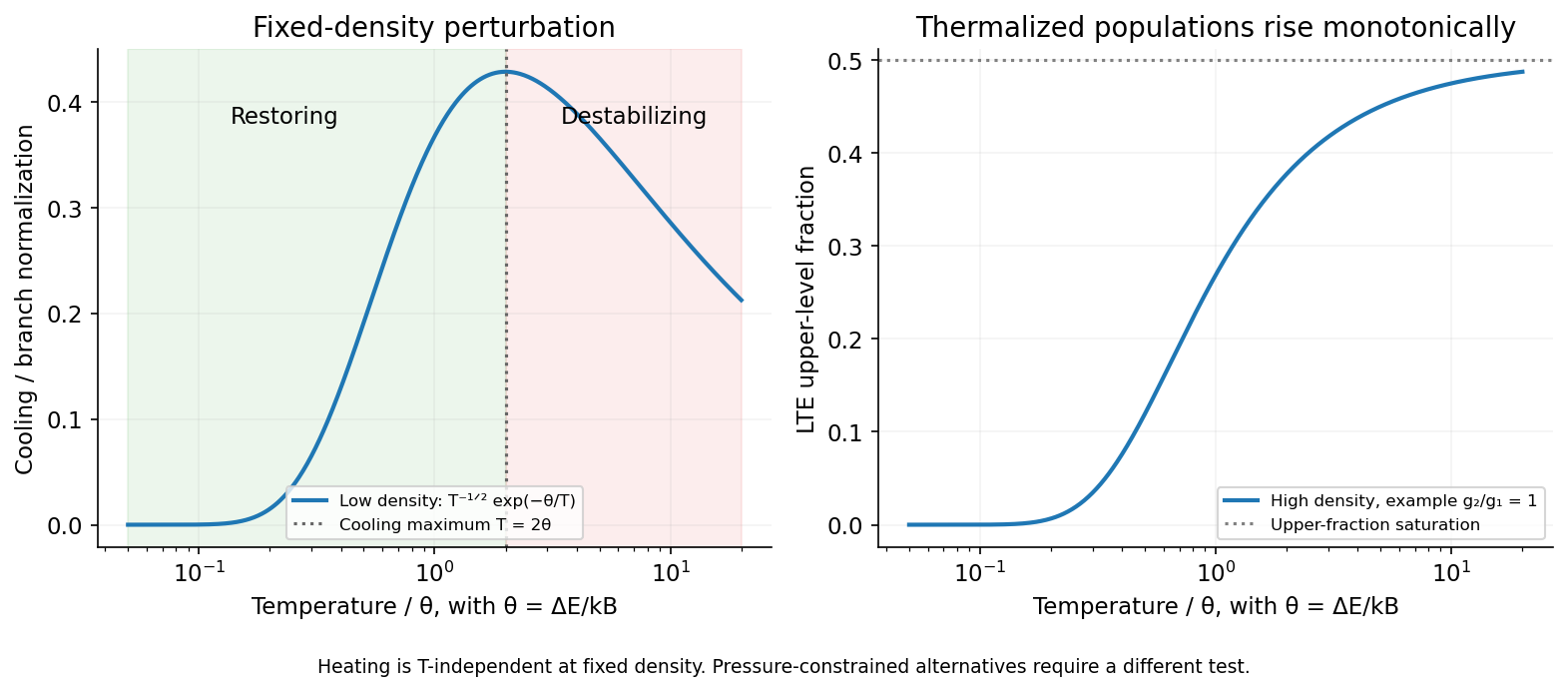
First specify the perturbation: take fixed gas density, fixed ionic abundance and the same temperature-independent heating, so thermal stability requires at an equilibrium. Let , be the collider density and the atomic density. A two-level optically thin balance isThe critical density of an atomic transition is approximately . At low density, each rare collisional excitation is followed by an escaping photon, soThe isochoric thermal stability of a collisionally excited line therefore givesAt the linear restoring coefficient vanishes; the cooling maximum is marginal to first order and is not robust two-sided stability.
At high density, collisional de-excitation competes successfully with radiative decay, and collisions establish local thermodynamic equilibrium level populations. Detailed balance gives , where . The cooling is thenThus the high-density fixed-density branch is stable for finite , becoming weakly restoring as the upper fraction saturates at high temperature. It is incorrect to retain the low-density factor in the radiative cooling law once populations are thermalized.[ref]
AGN Emission Lines by Hagai Netzer. Section2.2: collisional excitation, critical density and the high-density Boltzmann limit
The isobaric thermal stability of a two-level coolant is a distinct question. If the intended heating is a fixed rate per particle, then and stability tests the cooling per particle. The low-density boundary becomes ; the high-density cooling per particle remains proportional to , so remains stable. If instead heating is constant per volume, the isobaric low-density boundary is , and the high-density stability condition is . The source gives no pressure constraint or explicit heating normalization: the boxed result is the fixed-density answer, with these conditional alternatives stated to avoid asserting a universal boundary.


Articles by others on the same topic
There are currently no matching articles.