The Brillouin function is odd, increases monotonically through zero, and approaches for . Its small- slope is . For , the magnetic ions overwhelmingly occupy the largest field-aligned moment projection, so the magnetization reaches magnetic saturation:The sketch shows several values; all have the same limiting values, while their slopes differ.
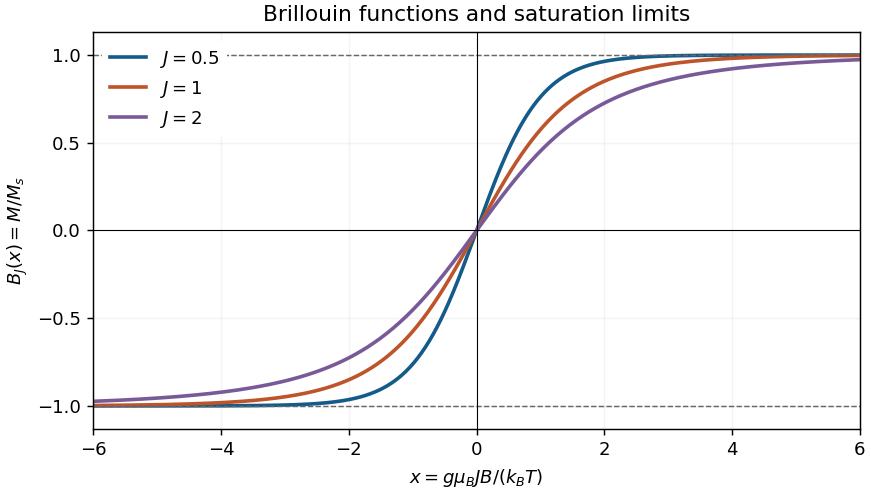
Brillouin functions approaching magnetic saturation
. Details. 
The terms in the Brillouin function cancel. Keeping the linear terms givesConsequently,Use the dimensionless SI magnetic susceptibility and , as in the source's molecular-field convention. The Curie law isIf susceptibility is instead defined as , its coefficient is and is dimensionful. The SI convention above makes the subsequent Curie–Weiss law and consistent.
For positive , a fluctuation of magnetization produces a Weiss molecular field in the same direction, reinforcing alignment. The mean-field self-consistency equation isLinearizing in the paramagnetic phase givesAt zero applied field, the right-hand side's slope at is . Below this exceeds one, and the saturation of the Brillouin function allows stable nonzero solutions of opposite sign: spontaneous ferromagnetism. Above , only the zero-field solution remains stable. The stated linear susceptibility is the paramagnetic branch for ; it must not be continued as a negative susceptibility below the transition.
Using the supplied iron parameters givesAn internal Weiss molecular field depends on temperature through . Its low-temperature saturation estimate uses :At and above the zero-applied-field magnetization vanishes in this model, so this is a saturation estimate, not the field at .
Use the paper's stipulated face-centered cubic lattice, which has twelve nearest neighbours. The saturated one-ion alignment scale isDividing the effective field among twelve equivalent neighbours gives the per-bond exchange interaction scaleTo specify the convention, write the Heisenberg model as , with dimensionless angular-momentum operators and each bond counted once. Then , so here. A convention with instead has . The total saturated interaction energy per ion is ; the factor of one half avoids counting each bond twice.
Articles by others on the same topic
There are currently no matching articles.