Displacement must be specified relative to an observer. In transverse-traceless gauge the free particles can have fixed coordinates, while their measured proper lengths oscillate. In a local, freely falling orthonormal frame, the geodesic deviation equation for an initial separation is, to first order in ,Its general solution with physical displacement and initial physical velocity isThe source has been running indefinitely, so there is no wave-free initial state. Its initial conditions for an eternal monochromatic gravitational wave need more than positions to fix . The usual bounded, periodic response selects ; if the particles instead start at physical rest at , set and retain the linear term. Both solve the same linear geodesic deviation problem. The distinction between fixed TT coordinates and measured separation is explained in [ref].
Choose so the wave phase at the detector is . For the bounded response the four initial placements then giveThese are displacements from the specified positions at ; positions are . Equivalently, relative to mean positions the usual oscillatory displacement is to first order. The response repeats after .
Both plus polarization and cross polarization occur with equal amplitude and a quarter-cycle phase difference. Their superposition is circular gravitational-wave polarization, with handedness reversed when the viewing direction or source rotation is reversed. The principal stretching axis turns through half the wave phase. There is no leading longitudinal motion.
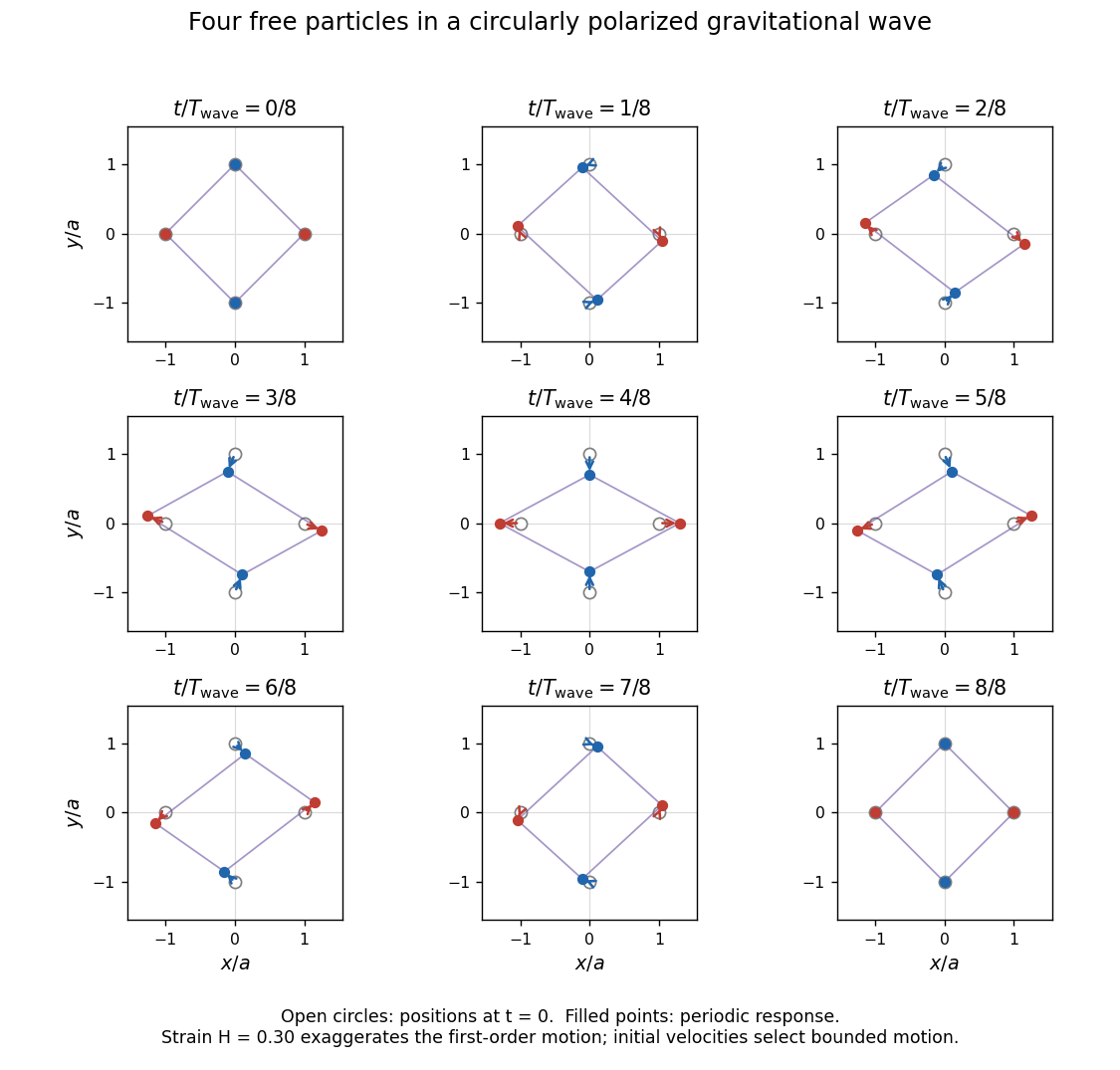
One full circularly polarized gravitational-wave cycle, with the four particles at their specified initial positions at phase zero
. Details. 
Articles by others on the same topic
There are currently no matching articles.