No. A motionless isolated point mass produces a static gravitational field. All its mass multipole moments are time independent, so there is no outgoing gravitational radiation. In the quadrupole formula, .
No, for steady rotation of the uniform sphere. Its mass quadrupole moment is zero by spherical symmetry; its rotating mass current is stationary when the rotation axis and rate are fixed. A stationary source does not emit gravitational waves. Rotation by itself is insufficient: a time-dependent nonaxisymmetric distribution, or another changing radiative multipole moment, is required. The conclusion concerns a sphere with the stated constant density and steady motion, rather than a deformed or time-varying rotator.
No, for a uniform or otherwise axisymmetric disc in steady rotation. Although individual material elements accelerate, the mass density and mass current at every spatial point remain constant, and the mass quadrupole moment is time independent. There is no gravitational radiation. Axisymmetry of the material distribution is necessary for this conclusion: the source does not explicitly specify the disc's density. A counterexample to an unconditional answer is a disc with two equal dense spots at opposite radii; their rotating mass quadrupole moment produces gravitational waves at twice the rotation angular frequency.
Yes, for genuine precession of a nonspherical disc. Let its unit normal be . Its trace-free mass quadrupole moment has the axisymmetric formThe entries vary at , and at . Their nonzero second and third time derivatives give an oscillating far-field metric perturbation and positive average radiated power. For the terms vanish but the terms remain. The precise condition is and : the literal inequality also allows , where the normal is fixed and no such gravitational radiation occurs. For a uniform thin disc of mass and radius , , confirming that it is not zero.
Use metric signature and transverse-traceless gauge, . To resolve the source's origin ambiguity, put the detector centre at and the source centre at , so the gravitational wave travels in the positive direction. Reversing that direction replaces by . Work in the weak-field approximation, with , , and detector size . The radiation reaction is neglected, so the rod maintains the prescribed steady motion.
At the retarded source time , take the source positions as . The arbitrary constant specifies the initial source phase. The second mass moment tensor obeysThe quadrupole formula projects away the transverse trace, which is already constant here. Differentiating twice therefore givesAll time and longitudinal metric perturbation components vanish in transverse-traceless gauge. The gravitational-wave frequency is in angular units; is each source mass, not their sum, and the detector mass does not enter the strain. The plane wave approximation holds the amplitude fixed at ; retaining spherical spreading replaces its denominator by near the axis. The retarded quadrupole formula and the distinction between source and wave frequency are derived in [ref].
Displacement must be specified relative to an observer. In transverse-traceless gauge the free particles can have fixed coordinates, while their measured proper lengths oscillate. In a local, freely falling orthonormal frame, the geodesic deviation equation for an initial separation is, to first order in ,Its general solution with physical displacement and initial physical velocity isThe source has been running indefinitely, so there is no wave-free initial state. Its initial conditions for an eternal monochromatic gravitational wave need more than positions to fix . The usual bounded, periodic response selects ; if the particles instead start at physical rest at , set and retain the linear term. Both solve the same linear geodesic deviation problem. The distinction between fixed TT coordinates and measured separation is explained in [ref].
Choose so the wave phase at the detector is . For the bounded response the four initial placements then giveThese are displacements from the specified positions at ; positions are . Equivalently, relative to mean positions the usual oscillatory displacement is to first order. The response repeats after .
Both plus polarization and cross polarization occur with equal amplitude and a quarter-cycle phase difference. Their superposition is circular gravitational-wave polarization, with handedness reversed when the viewing direction or source rotation is reversed. The principal stretching axis turns through half the wave phase. There is no leading longitudinal motion.
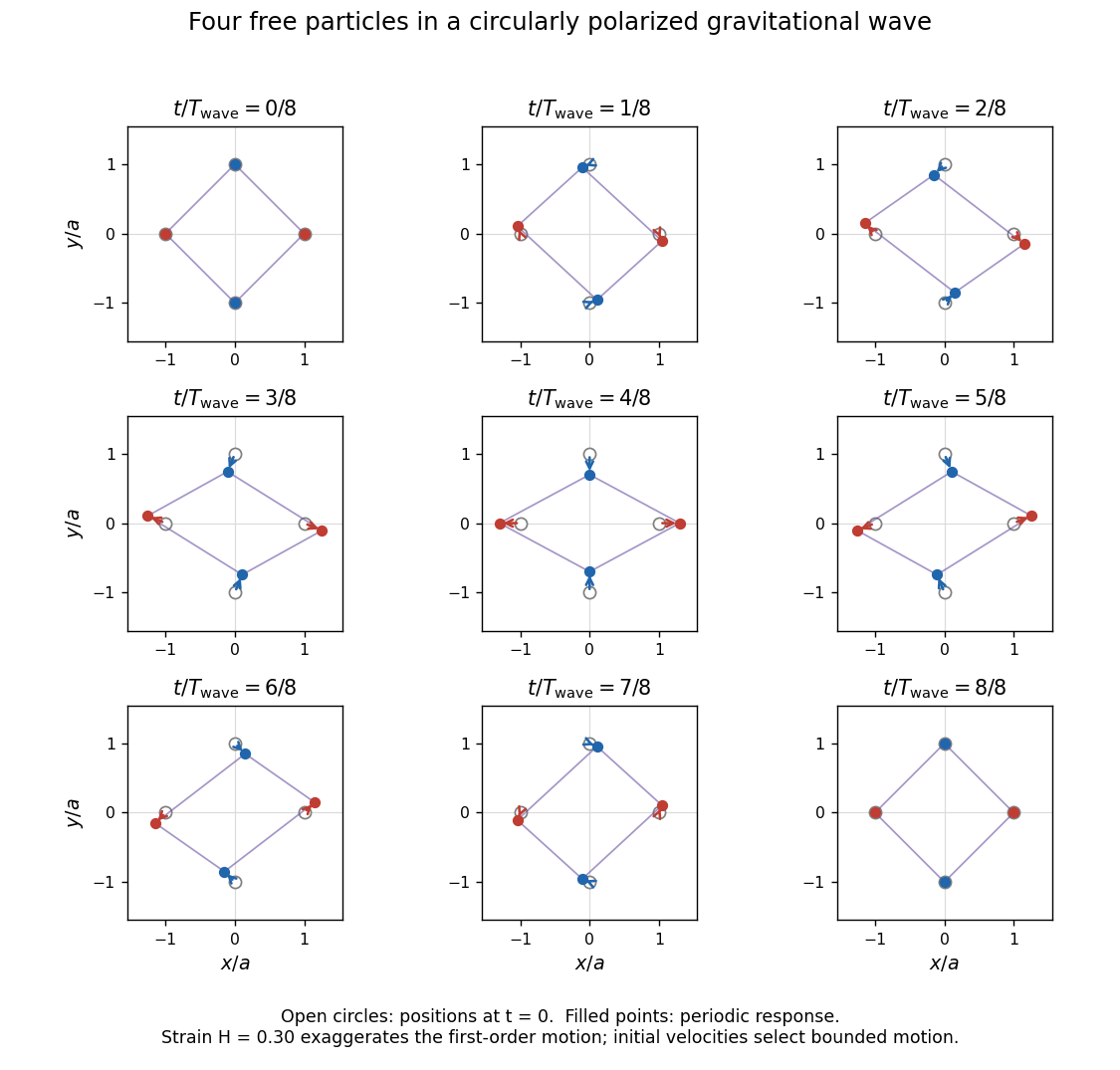
One full circularly polarized gravitational-wave cycle, with the four particles at their specified initial positions at phase zero
. Details. 
Gravitational radiation admits polarization: general relativity has two transverse tensor modes, plus polarization and cross polarization, whose relative amplitudes and phase give linear, elliptical or circular gravitational-wave polarization. Their axes transform through twice a rotation of the transverse coordinate frame, unlike the vector polarization of electromagnetic radiation. Measuring these modes is physically plausible with several differently oriented detectors; a single detector generally measures only one projected combination.
Gravitational waves can exhibit interference. In linearized gravity, overlapping strains add, so coherent contributions can enhance or cancel the measured response. Independent astrophysical sources generally have unrelated phases and average to a stochastic background rather than stable fringes. More plausible coherent paths arise when gravitational lensing sends different parts of the same signal to the detector with different delays; fringes require sufficient overlap and coherence. The relevant quadratic radiative energy flux contains the cross terms even though the leading wave equation is linear.
In a local inertial frame in vacuum, gravitational waves travel at in general relativity; there is no ordinary material index of refraction analogous to a transparent dielectric. Ordinary matter couples so weakly that laboratory prisms for gravitational waves are implausible. Propagation through a varying background gravitational field nevertheless changes ray directions and travel times, giving gravitational lensing and Shapiro time delay. In weak static coordinates , the null condition gives an effective coordinate index of refraction . This useful description depends on coordinates and does not change the local propagation speed. Thus astronomical gravitational refraction is plausible, while a substantial everyday material effect is not.
Gravitational waves also exhibit diffraction: the geometrical optics ray description fails when a propagation structure or lens delay is not large compared with the wave's wavelength or period. For a compact lens of mass , a useful dimensionless parameter is ; of order one signals potentially appreciable wave effects, with cosmological lens redshift supplying an additional factor when needed. Astrophysical gravitational lensing can therefore produce diffraction and frequency-dependent amplification. Ordinary objects are poor opaque screens for gravitational waves, so everyday slit-and-screen demonstrations are implausible despite the large wavelengths, which are about km at Hz.
Articles by others on the same topic
There are currently no matching articles.