The paper occupies bundle pages 132–137. Its cover establishes 2021; the attachment filename uses 2020.
In general relativity, gravity is the geometry of spacetime, whose curvature is related to the stress-energy tensor, and freely falling test particles follow timelike geodesics of its metric tensor.
The apple's proper time is the time read by a clock carried with it, with for metric signature . At any event choose a local inertial frame with coordinates , in which free motion satisfies at that event. The chain rule givesMultiplying by the inverse coordinate Jacobian matrix yields the exact geodesic equationHere are the observer's coordinates, is the apple's four-velocity, and the Christoffel symbols describe the Levi-Civita connection. The last expression applies when the coordinates are locally inertial at the event considered; one such chart need not remain inertial throughout a finite region.
Choose , so . In the weak-field approximation and at small spatial speed compared with , the leading spatial geodesic equation isIt is exact at the release event when all spatial vanish, and is the intended approximation to the displayed expression in the source. Terms and cannot generally be dropped; the time component must also be retained to find changing . For a concrete counterexample to the unrestricted expression, a straight free trajectory , in flat spacetime has polar radius and , although . The missing angular term supplies that radial coordinate acceleration.
Approximate Earth by an isolated, nonrotating, spherically symmetric body. By Birkhoff's theorem, the exterior vacuum metric tensor is the Schwarzschild metric. With it isHere is the areal radius, and are spherical angles, is Schwarzschild time normalized to the proper time of a static observer at infinity, is Earth's mass, the gravitational constant, and the speed of light. The nonzero diagonal metric tensor components are , , , .
The apple is a test particle; neglect its effect on the metric tensor, air resistance, Earth's rotation and nonspherical structure, and external tidal forces. Near Earth's surface, , , and the falling speed remains much smaller than . Thus the Newtonian limit of this metric tensor is appropriate, while the exact radial geodesic is available as a check. A static observer under the tree has proper time , up to an additive constant. Such an observer is supported by the ground and has nonzero proper acceleration; the released apple instead has zero proper acceleration.
Write and . The Christoffel symbols follow fromThe relevant time and radial entries, using , areFor the angular geodesic equations, , , and . Thus, with primes on coordinates here denoting proper time derivatives,Initial conditions are preserved by these ordinary differential equations. The motion is therefore radial, with constant angular coordinates. Choose the polar axis so the apple is away from the angular coordinate singularities.
The exact remaining radial geodesic equation and four-velocity normalization areEliminating gives the particularly simple exact result . The supported observer's proper time differs from the apple's proper time by relative corrections of order and . Consequently, to leading order in the weak-field approximation and , , with and zero initial radial velocity. HenceThe proper height measured along a static radial ruler is at this accuracy. The use of means the ground clock's elapsed time, with propagation delays corrected; raw visual arrival times include the changing light travel time.
If variation of over the fall is retained but relativistic corrections are neglected, a useful parametric solution isIts small- expansion gives the same constant- result. For an exact check on the choice of clock, the initial coordinate acceleration measured using is , which reduces to the displayed approximation.
The time-translation Killing vector field of the Schwarzschild metric gives a conserved Killing energy per unit rest mass,For unit rest mass, this is the total energy relative to infinity, including rest energy. At release , so the four-velocity normalization gives andSubstitution into the radial four-velocity normalization yieldsChoosing the inward square root and evaluating at the ground provesThis identity is exact within the assumed Schwarzschild metric, despite its familiar Newtonian mechanics form. The quantity is not exactly the locally measured speed. A Schwarzschild static observer measures . Thus the distinction disappears in the stated weak-field approximation, giving for .
No. A motionless isolated point mass produces a static gravitational field. All its mass multipole moments are time independent, so there is no outgoing gravitational radiation. In the quadrupole formula, .
No, for steady rotation of the uniform sphere. Its mass quadrupole moment is zero by spherical symmetry; its rotating mass current is stationary when the rotation axis and rate are fixed. A stationary source does not emit gravitational waves. Rotation by itself is insufficient: a time-dependent nonaxisymmetric distribution, or another changing radiative multipole moment, is required. The conclusion concerns a sphere with the stated constant density and steady motion, rather than a deformed or time-varying rotator.
No, for a uniform or otherwise axisymmetric disc in steady rotation. Although individual material elements accelerate, the mass density and mass current at every spatial point remain constant, and the mass quadrupole moment is time independent. There is no gravitational radiation. Axisymmetry of the material distribution is necessary for this conclusion: the source does not explicitly specify the disc's density. A counterexample to an unconditional answer is a disc with two equal dense spots at opposite radii; their rotating mass quadrupole moment produces gravitational waves at twice the rotation angular frequency.
Yes, for genuine precession of a nonspherical disc. Let its unit normal be . Its trace-free mass quadrupole moment has the axisymmetric formThe entries vary at , and at . Their nonzero second and third time derivatives give an oscillating far-field metric perturbation and positive average radiated power. For the terms vanish but the terms remain. The precise condition is and : the literal inequality also allows , where the normal is fixed and no such gravitational radiation occurs. For a uniform thin disc of mass and radius , , confirming that it is not zero.
Use metric signature and transverse-traceless gauge, . To resolve the source's origin ambiguity, put the detector centre at and the source centre at , so the gravitational wave travels in the positive direction. Reversing that direction replaces by . Work in the weak-field approximation, with , , and detector size . The radiation reaction is neglected, so the rod maintains the prescribed steady motion.
At the retarded source time , take the source positions as . The arbitrary constant specifies the initial source phase. The second mass moment tensor obeysThe quadrupole formula projects away the transverse trace, which is already constant here. Differentiating twice therefore givesAll time and longitudinal metric perturbation components vanish in transverse-traceless gauge. The gravitational-wave frequency is in angular units; is each source mass, not their sum, and the detector mass does not enter the strain. The plane wave approximation holds the amplitude fixed at ; retaining spherical spreading replaces its denominator by near the axis. The retarded quadrupole formula and the distinction between source and wave frequency are derived in [ref].
Displacement must be specified relative to an observer. In transverse-traceless gauge the free particles can have fixed coordinates, while their measured proper lengths oscillate. In a local, freely falling orthonormal frame, the geodesic deviation equation for an initial separation is, to first order in ,Its general solution with physical displacement and initial physical velocity isThe source has been running indefinitely, so there is no wave-free initial state. Its initial conditions for an eternal monochromatic gravitational wave need more than positions to fix . The usual bounded, periodic response selects ; if the particles instead start at physical rest at , set and retain the linear term. Both solve the same linear geodesic deviation problem. The distinction between fixed TT coordinates and measured separation is explained in [ref].
Choose so the wave phase at the detector is . For the bounded response the four initial placements then giveThese are displacements from the specified positions at ; positions are . Equivalently, relative to mean positions the usual oscillatory displacement is to first order. The response repeats after .
Both plus polarization and cross polarization occur with equal amplitude and a quarter-cycle phase difference. Their superposition is circular gravitational-wave polarization, with handedness reversed when the viewing direction or source rotation is reversed. The principal stretching axis turns through half the wave phase. There is no leading longitudinal motion.
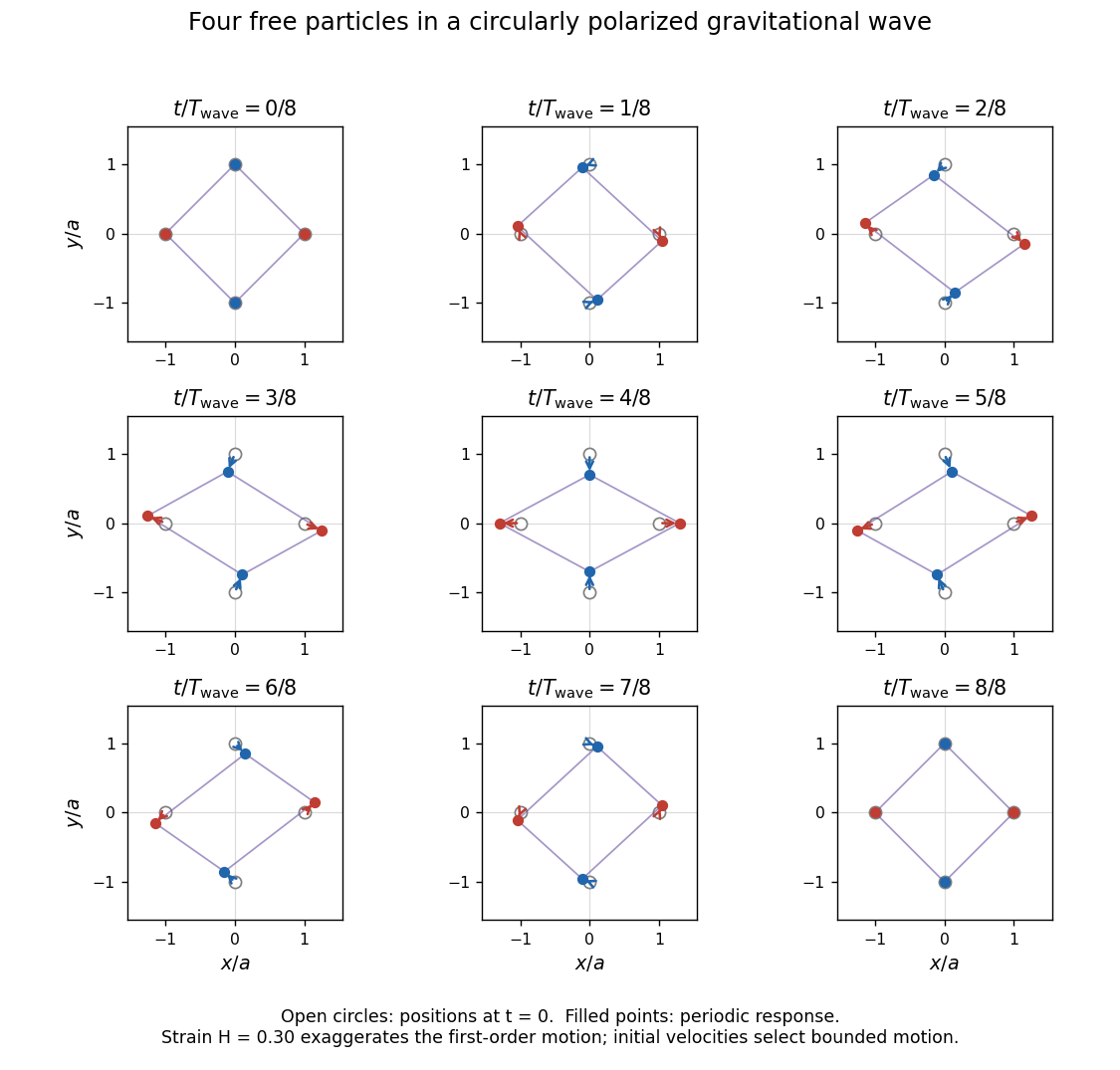
One full circularly polarized gravitational-wave cycle, with the four particles at their specified initial positions at phase zero
. Details. 
Gravitational radiation admits polarization: general relativity has two transverse tensor modes, plus polarization and cross polarization, whose relative amplitudes and phase give linear, elliptical or circular gravitational-wave polarization. Their axes transform through twice a rotation of the transverse coordinate frame, unlike the vector polarization of electromagnetic radiation. Measuring these modes is physically plausible with several differently oriented detectors; a single detector generally measures only one projected combination.
Gravitational waves can exhibit interference. In linearized gravity, overlapping strains add, so coherent contributions can enhance or cancel the measured response. Independent astrophysical sources generally have unrelated phases and average to a stochastic background rather than stable fringes. More plausible coherent paths arise when gravitational lensing sends different parts of the same signal to the detector with different delays; fringes require sufficient overlap and coherence. The relevant quadratic radiative energy flux contains the cross terms even though the leading wave equation is linear.
In a local inertial frame in vacuum, gravitational waves travel at in general relativity; there is no ordinary material index of refraction analogous to a transparent dielectric. Ordinary matter couples so weakly that laboratory prisms for gravitational waves are implausible. Propagation through a varying background gravitational field nevertheless changes ray directions and travel times, giving gravitational lensing and Shapiro time delay. In weak static coordinates , the null condition gives an effective coordinate index of refraction . This useful description depends on coordinates and does not change the local propagation speed. Thus astronomical gravitational refraction is plausible, while a substantial everyday material effect is not.
Gravitational waves also exhibit diffraction: the geometrical optics ray description fails when a propagation structure or lens delay is not large compared with the wave's wavelength or period. For a compact lens of mass , a useful dimensionless parameter is ; of order one signals potentially appreciable wave effects, with cosmological lens redshift supplying an additional factor when needed. Astrophysical gravitational lensing can therefore produce diffraction and frequency-dependent amplification. Ordinary objects are poor opaque screens for gravitational waves, so everyday slit-and-screen demonstrations are implausible despite the large wavelengths, which are about km at Hz.
The intended orbit is a freely falling timelike circular Schwarzschild geodesic. Use the Schwarzschild metric with rather than as the zeroth coordinate, and put the orbit at . Thus , , , with . The radial geodesic equation at constant isConsequently . The four-velocity normalization givesand henceHere is Schwarzschild time, the orbiting clock's proper time, the gravitational constant, the central mass, the constant areal radius, and the speed of light. The dimensionless follows the question's time-valued zeroth-coordinate convention; with the zeroth four-velocity component would be .
The condition is for a massive circular geodesic; radial stability further requires , with equality marginal. The phrase “any circular orbit” is false without free fall: a powered circular trajectory has with independently chosen . For example, at choose ; this valid accelerated circular trajectory has , instead of the displayed .
Let , , , and choose . A torque-free test gyroscope moving on a geodesic has a spin four-vector obeying parallel transport,The orthogonality condition says the temporal spin component vanishes in the body's rest frame, not necessarily in Schwarzschild coordinates. Here it givesIn addition to the radial Christoffel symbols in part (a), use and . On the equator the parallel transport equations becomeThe radial equation follows by substituting into . Eliminating gives .
Let be the invariant spin magnitude. Initially radial spin means and . The complete solution isTo interpret the orientation, convert coordinate components into the orbiting orthonormal frame. The Lorentz factor relative to a Schwarzschild static observer is , so the body's measured radial and tangential spin components areTheir squared sum is , and their angle relative to the outward radial direction decreases uniformly at rateThe differing coordinate amplitudes in must not be interpreted as a nonuniform physical spin rotation. After one orbital period the radial basis has turned by while the spin has turned by relative to it. The residual geodetic precession is in the orbital direction.
For a timelike circular Schwarzschild geodesic, the coordinate orbital period and onboard proper time per orbit areUsing and , the Schwarzschild radius and orbital areal radius are and . ThereforeThe crew accumulates about fewer seconds, or fewer minutes, per orbit. Both gravitational time dilation and kinematic time dilation contribute: a static clock at has , while the orbiting clock additionally has , where . A distant observer measures the coordinate period; comparing arrivals emitted at the same orbital phase also removes the repeated light propagation delay.
The geodetic precession per orbit isThe orbital position and four-velocity repeat after a full orbit, so the direction to distant Earth in the instantaneous rest frame repeats. The freely transported gyroscope does not: its beam axis has turned through relative to the original aiming direction. This applies to any initial in-plane spin direction by linearity of parallel transport, not only the radial initial condition used in part (b). The beam's angular diameter is , giving a half-angle of . Thus Earth lies outside the beam after one orbit; comparing the offset with the diameter would already show a miss, but the correct acceptance angle is the half-angle.
The initial radial ray must be outward from the black hole for a direct path to Earth. A precisely inward radial null geodesic falls into the black hole and cannot provide the assumed initial communication. For outgoing near-radial Schwarzschild light deflection, the angular correction is especially small. If a static observer at measures a small emission angle from the outward radial direction, its impact parameter is . The outgoing null geodesic givesRelative to flat propagation, curvature changes the small pointing angle and beam radius by the fraction . At an offset of this is only about ; the beam's radius changes by about . The exactly radial central ray has zero angular deflection. This is not the geometry of the usual scattering formula, which assumes a ray coming from infinity, passing the black hole, and returning to infinity.
Relativistic aberration also distinguishes a coordinate-radial light ray from a beam aimed radially in the moving crew's frame. Here . Successful initial aiming includes that fixed correction; the same correction applies at the repeated orbital position. More precisely, an outgoing static-radial ray initially has crew-frame angle from the radial axis. The local small-angle aberration factor about that aim is ; including the outgoing propagation factor gives . Thus the asymptotic miss is about and the beam half-angle about , with the same conclusion. The small distortion of the outward beam cannot correct the much larger accumulated geodetic precession.
On large scales the appropriate background is the spatially flat FLRW metric,Here is cosmic time, the proper time of a comoving observer; is the scale factor; and are dimensionless comoving coordinates. With this convention has units of length. A fixed comoving radial interval has instantaneous proper length . The cosmological principle assumes spatial homogeneity and cosmological isotropy on the scales where this background description applies.
The general FLRW metric instead has in its radial part, with normalized describing positive, zero or negative spatial curvature of an FLRW universe. The best simple description takes ; observations constrain spatial curvature to be small rather than proving it identically zero. The late accelerated expansion is encoded by the time dependence of , determined by the stress-energy tensor through the Friedmann equations, rather than by an additional term in the FLRW metric. Small-scale galaxies and other inhomogeneities require perturbations of this background.
For a perfect fluid in general relativity, let be rest-frame total energy density divided by , its isotropic pressure, and its four-velocity, normalized by . ThenThe contracted Bianchi identity and the Einstein field equations give stress-energy conservation, , for a constant cosmological constant. Contract with and use the normalization to obtainIn comoving coordinates and the covariant divergence is , where a dot is a cosmic time derivative and the Hubble parameter. ThereforeFor a fixed region in comoving coordinates, let be its physical volume, where is a fixed coordinate-volume integral, and let . Since ,Thus the cosmological perfect-fluid continuity equation is exactly equivalent to the adiabatic first law of thermodynamics, , for every nonzero such region. Conversely, expanding that first law of thermodynamics and dividing by recovers the same equation. No heat or particle flux crosses the comoving boundary; interacting components separately need source terms, although the total still obeys this conservation equation.
There is a sign inconsistency in the supplied formula sheet worth isolating. Its Riemann curvature tensor and Ricci tensor conventions, together with its stated metric signature, give for with constant . Its vacuum Einstein field equations with then require , whereas its printed vacuum Friedmann equation gives . For example, , and satisfy the latter but leave the former's component equal to . Changing the geometric cosmological constant term to repairs this mismatch. The conservation derivation is unaffected; below take the geometric cosmological constant to be zero and include any vacuum energy as a fluid, so no ambiguous sign enters.
Write the equation of state as . Integrating the cosmological perfect-fluid continuity equation for constant gives . With spatial flatness and the geometric cosmological constant set to zero, the Friedmann equation is .
In S1, describes vacuum energy: and is constant. Its negative pressure drives accelerated expansion, , and the expanding solution is . This is the ideal de Sitter spacetime approximation to cosmic inflation. An exactly constant vacuum component cannot end its phase unaided; a phase transition or reheating mechanism is required for the assumed change to S2.
In S2, describes an isotropic bath of ultrarelativistic particles, such as photons, with negligible rest mass relative to their energy. The number per physical volume falls as , while the energy per particle redshifts as , so . This radiation-dominated universe has on its expanding branch.
In S3, describes pressureless matter, or relativistic dust, with negligible random kinetic energy. Conserved particle number and approximately fixed rest energy give . A flat universe containing only this component is the Einstein-de Sitter universe, with . The constants are integration offsets in the individual phases; they need not represent one common start time when phases are matched.
For monotonically expanding scale factor , , so the elapsed cosmic time isThe second expression uses cosmological redshift ; the age of the universe is the limit to its earliest specified state, if that limit is finite.
An age comparison for an initial vacuum-dominated phase needs a common normalization. Match the two histories at the end of S1, with and , and give them identical subsequent S2 and S3 evolution, including transition radii and today's state. Below , the history with S1 has constant . The comparison history extends S2 backwards, so and . Starting both at , where , their early durations areThe difference is positive becauseThe common later evolution adds the same time to both histories. Thus S1 makes this matched universe older. More strongly, as , the exact S1 duration diverges logarithmically, whereas a radiation beginning has finite duration to the match. The exact de Sitter spacetime expanding patch reaches only as for its comoving observers; a finite “age since ” does not exist in this ideal model. This does not establish past geodesic completeness of the patch.
The matching assumption is essential for a finite cutoff or realistic finite period of cosmic inflation: arbitrary changes of the present Hubble parameter or transition densities prevent a universal age comparison. The literal zero-size limit in this question is instead the infinite-duration idealization just derived.
The actual large-scale expansion is well described by the Lambda-CDM model: radiation in cosmology, ordinary baryonic matter, cold dark matter and late-time dark energy coexist. A component becomes dominant through continuous changes in their density ratios, rather than every previous component disappearing at an instantaneous phase boundary. Matter pressure is small in its nonrelativistic regime, but radiation persists, and massive neutrinos interpolate between relativistic and nonrelativistic behavior.
There is also a late accelerated era, absent from a model ending permanently in S3. It is consistent with nearly constant vacuum energy, whose negative pressure eventually dominates because pressureless matter dilutes as . The scale factor then ceases to follow the pure Einstein-de Sitter universe law.
An early phase of cosmic inflation is a well-motivated model rather than a directly observed exact phase. Successful cosmic inflation must end and transfer its energy to matter and radiation through reheating; realistic models generally have slowly varying and close to, rather than exactly equal to, . Extrapolating a strictly constant to arbitrarily small is not a measurement of the universe's past duration. Finally, spatial homogeneity and cosmological isotropy apply statistically on large scales: galaxies, gravitational waves and other perturbations are absent from the exact FLRW metric, and small spatial curvature remains an observational possibility.
Articles by others on the same topic
There are currently no matching articles.