Let and choose holomorphic coordinate charts centred at and . A nonconstant holomorphic map has a local expansion , where and . Taking a local holomorphic th root of the nonvanishing factor and changing the source coordinate gives the exact local form . The integeris the ramification index of a holomorphic map. A ramification point of a holomorphic map is a source point with , equivalently where its derivative vanishes; a branch value of a holomorphic map, also called a branch point here, is the image of such a point in . These are different sets, one in the source and one in the target.
Every fiber of a function is finite: locally it is the zero set of a nonzero holomorphic function, so its points are isolated, and compactness prevents infinitely many such zeros without an accumulation point. The same argument applied to the local derivatives makes the set of ramification points of a holomorphic map finite. The open mapping theorem and compactness show that is both open and closed in the connected target , hence is surjective.
For any , the degree of a holomorphic map isTo see independence of , choose disjoint small coordinate charts about its finitely many preimages. The local form shows that nearby values have preimages counted with multiplicity in the corresponding chart. Compactness excludes additional preimages outside these charts for sufficiently nearby values: a sequence of such preimages would have a limit in . The displayed sum is therefore locally constant, hence constant on connected . Away from branch values of a holomorphic map it is the ordinary number of preimages, and is a -sheeted covering map there.
The Riemann-Hurwitz formula isor, in terms of the two genera,For its proof, choose a triangulation of a surface on containing every branch value of a holomorphic map among its vertices. Every open edge and open face has lifts, since its interior avoids branch values of a holomorphic map. The lifted cells give a finite CW complex structure on . If are the target counts and , the source counts areIndeed, at a target vertex the deficit from distinct preimages is precisely , and all nonzero contributions occur over vertices. Taking the alternating sum gives , as required. This is the Triangulation proof of the Riemann-Hurwitz formula.
Every nonidentity biholomorphism in the finite group has only finitely many fixed points, by the identity theorem on a Riemann surface and compactness. Because the group action is a faithful group action, the union of these finite sets does not exhaust . A point outside this union has trivial stabilizer subgroup, so its group orbit has points by the orbit-stabilizer theorem. The generic fiber of a function of the projection is such an group orbit, givingMore precisely, put and . Differentiation at gives a group homomorphism . It is injective: if a nonidentity finite-order germ had the form with and , then its th iterate would begin , so no positive iterate could be the identity. A germ equal to the identity gives the identity on by the identity theorem on a Riemann surface. Thus is a cyclic group, with derivative image the th roots of unity.
For completeness, an explicit local coordinate linearizing isIt has , and reindexing the sum gives . Therefore a coordinate on the local quotient space is . Other translates of a sufficiently small neighbourhood of are disjoint unless their translating element lies in , so this local quotient space is also a chart for . The local cyclic quotient of a Riemann surface consequently gives
In a cyclic group of prime order , a stabilizer subgroup has order either one or . The latter case consists exactly of points fixed by all of . Thus the fixed points each have ramification index of a holomorphic map , and every other point has index one. Applying the Riemann-Hurwitz formula with degree of a holomorphic map givesEquivalently,The count concerns fixed points upstairs. Each is its own group orbit, so their images are also distinct branch values of a holomorphic map.
For a free action of a group, every stabilizer subgroup is trivial. Hence every ramification index of a holomorphic map is one, and the projection is an unramified covering map of degree of a holomorphic map . The Riemann-Hurwitz formula reduces toThis is also the multiplicativity of Euler characteristic under a finite covering.
The dihedral group here has order . Substituting into part (d) givesIn particular, requires genus seven. A geometric construction is to start with a round solid torus about the vertical axis, then drill thin radial tunnels through its tube in the horizontal midplane, equally spaced at azimuths , . The tunnels run from the central opening to the exterior; their directions are horizontal and radial. Round all their rims in the same way, preserving the dihedral symmetry, and let be the boundary of the resulting solid.
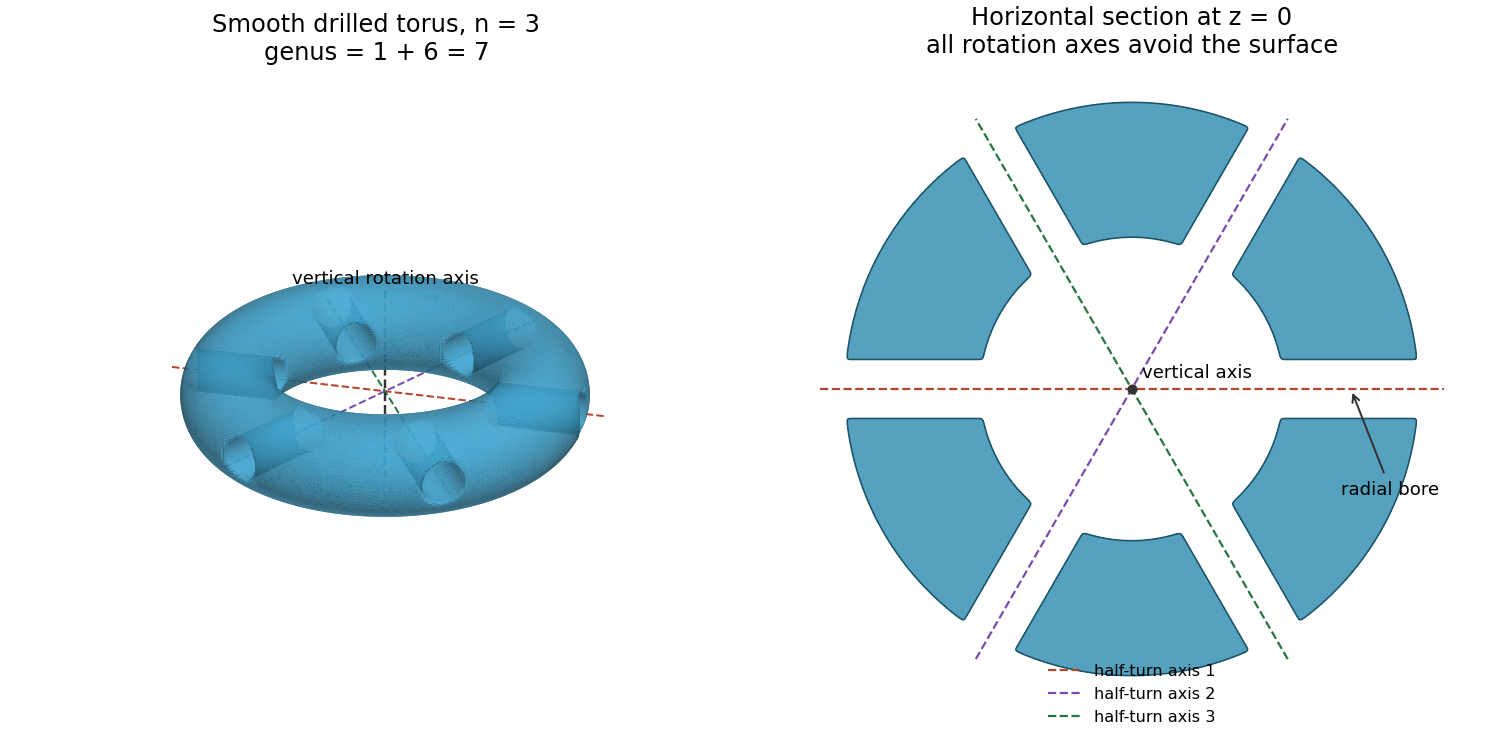
A genus-seven surface with a free dihedral action: six radial bores contain the horizontal rotation axes
. Details. 
Here is why the construction has exactly the required properties. Every nonidentity power of is a rotation in three dimensions fixing the vertical axis, which lies in the central opening and is disjoint from . Each element is a half-turn about a horizontal line at azimuth , modulo . The such lines meet the original solid torus in short radial segments. Each segment lies strictly inside one drilled tunnel, so these axes are also disjoint from . A nonidentity rotation in three dimensions fixes only its axis. Thus no nonidentity element fixes a point of , proving a free action of a group.
Rotation by permutes the tunnels, while preserves their arrangement and the original solid torus. Hence is preserved by the two generators and therefore by . The tunnels can be chosen sufficiently thin to be pairwise disjoint, and the rounding can be made group-invariant in small disjoint neighbourhoods of their rims. It neither changes the genus nor introduces an intersection with any axis.
Each tunnel removes two discs from the existing boundary and inserts the cylindrical wall of the bore. Its contribution to Euler characteristic is : the two removed discs contribute , and the inserted annulus and its boundary circles have zero Euler characteristic. The boundary remains connected and orientable, so each tunnel increases genus by one. Starting from a torus and drilling tunnels therefore gives . The construction also supplies a Riemann surface: use the complex structure associated with the induced oriented Riemannian metric. The ambient generators are isometries preserving the solid and ambient orientation of a vector space, so they preserve the induced boundary orientation and act by biholomorphisms. Part (d) then confirms that the quotient space has genus two. This is a free dihedral action on a drilled torus.
Articles by others on the same topic
There are currently no matching articles.