The equations describe the linear reduced gravity shallow water equations for a uniform upper layer over a deep, resting lower layer, or equivalently one separated internal vertical mode. The layer is shallow compared with its horizontal scales, permitting hydrostatic balance, and its horizontal velocity is independent of depth. The Boussinesq approximation retains the small density contrast through . We neglect friction, external forcing, background currents, and quadratic perturbation terms. On an equatorial beta plane, with , and the equatorial Kelvin wave branch imposes . The meridional Cauchy momentum equation then reduces exactly within this linear model to a balance between the Coriolis force and pressure gradient force.
Strictly, the printed must denote the thickness perturbation , with total thickness and . A signed oscillation around zero cannot represent the total positive layer thickness. Define . For a nonzero zonal wavenumber , the zonal Cauchy momentum equation and conservation of mass giveOn the eastward branch , the wave polarization is . Meridional geostrophic balance givesThe branch instead grows as and is excluded by decay away from the equator. Matching the paper's Gaussian function therefore givesThe usual equatorial deformation radius is , with the envelope written . Thus the printed exponent uses . Calling that width a deformation radius is a convention; using the standard radius without the factor would fail the printed meridional equation.
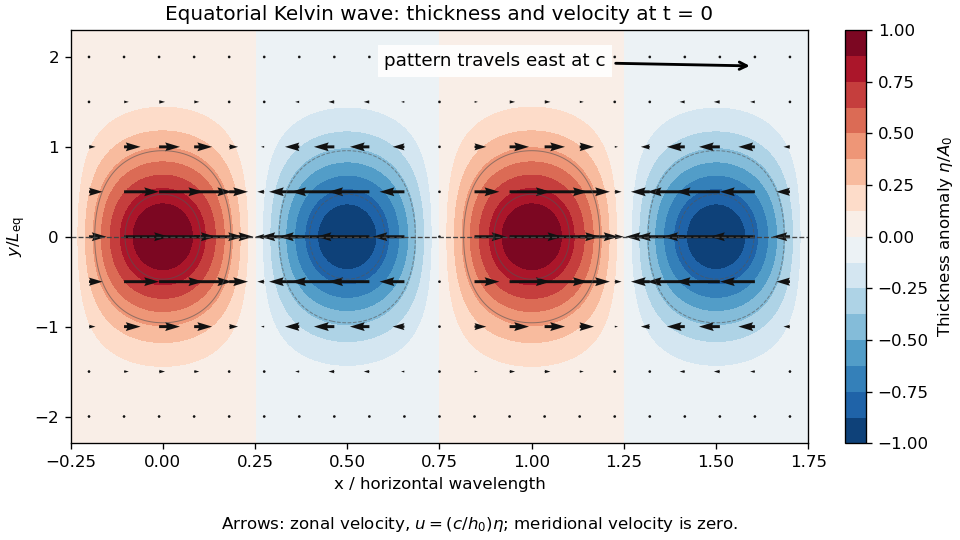
Equatorial Kelvin-wave thickness anomaly and zonal velocity at one instant, using the paper's Gaussian-width convention
. Details. 
At an instant, alternating positive and negative thickness anomalies have their largest magnitudes on the equator and decay symmetrically away from it. Eastward arrows occupy the positive anomalies, westward arrows the negative anomalies; the velocity vanishes at the nodes and weakens away from the equator. The whole pattern travels eastward at speed . Meridionally, is geostrophic balance. For a positive anomaly north of the equator, the northward pressure gradient force balances the southward Coriolis force; both directions reverse south of the equator. Zonally, and : the zonal pressure gradient force accelerates the flow, so it is not in zonal geostrophic balance. On the equator the meridional terms both vanish smoothly.
Articles by others on the same topic
There are currently no matching articles.