Let be a diffeomorphism between intervals, which may be unbounded. For a nonnegative Lebesgue measurable function on , Lebesgue substitution on an interval givesallowing the value infinity. The same identity applied to shows that is Lebesgue integrable exactly when the transformed integrand is integrable; in that case the displayed formula holds for signed or complex as well. The absolute value on the derivative makes the formula valid for both increasing and decreasing substitutions. Finite endpoints can be omitted without changing a Lebesgue integral, because individual points are null sets.
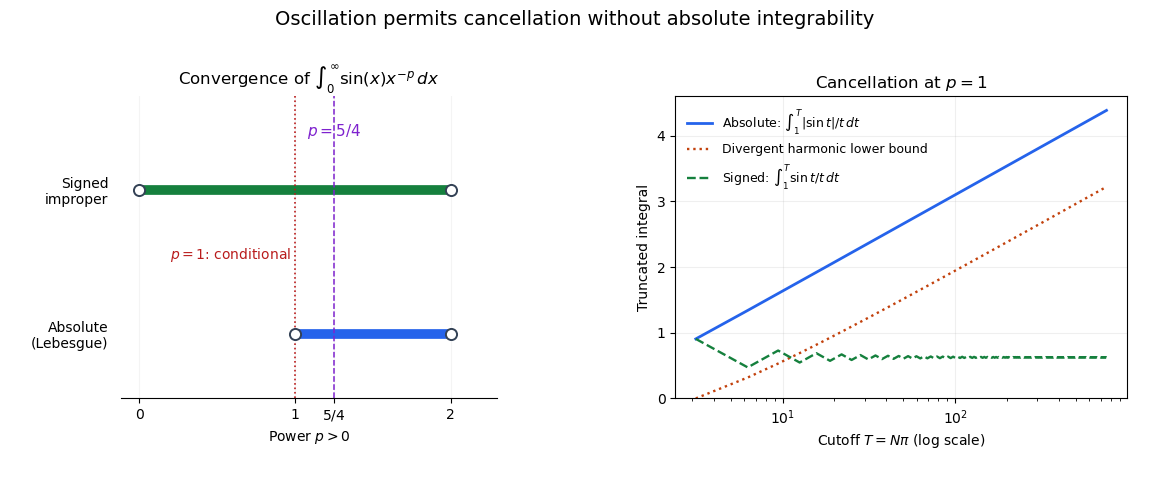
Both functions are continuous on the positive domains in question, so they are measurable. For the first function, the decreasing substitution and giveFor every integer ,Summing this lower bound gives a divergent harmonic series. Thus is not Lebesgue integrable on .
For the second function, on and everywhere giveTherefore is Lebesgue integrable on . The sine power kernel integrability threshold is : one endpoint requires , and the other requires . The signed improper integral for does converge by the Dirichlet test for improper integrals, but conditional improper convergence does not give a finite integral of .

The monotone convergence theorem states that, for nonnegative measurable on a Lebesgue measurable set with almost everywhere,allowing infinity. Fatou's lemma states that, for nonnegative measurable ,Now write . A pointwise limit superior of measurable functions is measurable, and it agrees with off the exceptional null set. By completeness of Lebesgue measure, assigning any values on that null set preserves measurability. Therefore is measurable. Since almost everywhere, Fatou's lemma givesThus is finite almost everywhere and is a Lebesgue integrable function. This is an almost-everywhere limit under a uniform L1 bound. The argument proves integrability of the limit, not convergence in L1 space.
Let . These are nonnegative measurable functions with . The monotone convergence theorem and linearity of the finite sum giveHence almost everywhere: if on a set of positive measure, the integral would exceed every finite constant. Also each is finite almost everywhere, since its absolute integral is finite. Outside the union of these countably many null sets, all terms are real andThus the signed series converges absolutely almost everywhere, as asserted by summable L1 norms imply almost-everywhere absolute convergence. Removing the common null set avoids any undefined in signed partial sums.
Let on the full-measure set where part (A) gives absolute convergence, and set on its null complement. After similarly replacing the individual terms by zero on that common null set, the partial sums are finite measurable functions and converge to . Hence is a Lebesgue measurable function. The triangle inequality givesalmost everywhere. Part (A) proved integrable, soTherefore the summed function is Lebesgue integrable. Its values on the exceptional null set do not affect the integral. This is the integrability step in integration of a series with summable L1 norms.
Let , using the finite representatives from part (B). Then almost everywhere, and , where is integrable by part (A). The dominated convergence theorem givesThe numerical series on the right converges absolutely because and the sum of these bounds is finite. Moreover,Thus integration of a series with summable L1 norms also yields convergence of the partial sums in L1 norm.
Use the power series of the exponential function:Each term is a Lebesgue integrable function, andThe sum of these nonnegative integrals is at most . Applying integration of a series with summable L1 norms, just proved in part (ii), therefore justifies exchanging the series and the integral:The absolute-integral bound is the justification; pointwise convergence of the exponential series alone would not suffice.
Articles by others on the same topic
There are currently no matching articles.