Let be a diffeomorphism between intervals, which may be unbounded. For a nonnegative Lebesgue measurable function on , Lebesgue substitution on an interval givesallowing the value infinity. The same identity applied to shows that is Lebesgue integrable exactly when the transformed integrand is integrable; in that case the displayed formula holds for signed or complex as well. The absolute value on the derivative makes the formula valid for both increasing and decreasing substitutions. Finite endpoints can be omitted without changing a Lebesgue integral, because individual points are null sets.
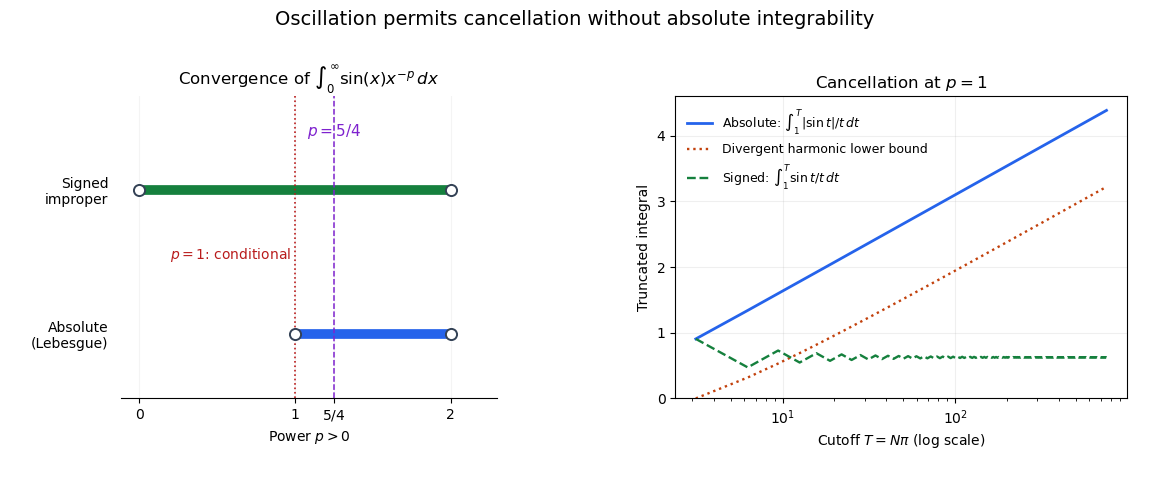
Both functions are continuous on the positive domains in question, so they are measurable. For the first function, the decreasing substitution and giveFor every integer ,Summing this lower bound gives a divergent harmonic series. Thus is not Lebesgue integrable on .
For the second function, on and everywhere giveTherefore is Lebesgue integrable on . The sine power kernel integrability threshold is : one endpoint requires , and the other requires . The signed improper integral for does converge by the Dirichlet test for improper integrals, but conditional improper convergence does not give a finite integral of .

Articles by others on the same topic
There are currently no matching articles.