Let be an affine scheme, and let be an open cover. Write each complement as a Zariski closed subset for an ideal . The intersection rule for Zariski closed subsets givesA proper ideal lies in a maximal ideal, which is a prime ideal; consequently forces . Thus . By the definition of a sum of ideals, this membership is witnessed by finitely many elements:Hence , so , and therefore . If is the zero ring, is empty and the empty subcover suffices. This provesThe proof uses only complements, the intersection rule for Zariski closed subsets, and the finite expression of an element in a sum of ideals.
The quotient. Evaluation , , is a surjective ring homomorphism whose kernel of a ring homomorphism is . Indeed, division by this monic polynomial leaves a remainder , and for forces . Taking the further quotient ring modulo gives the explicit isomorphism
All fibers, including the generic fiber. For a point with residue field , its scheme-theoretic fiber isAt the generic point , the residue field is , and is an irreducible polynomial over , so . For a closed point the residue field is . The permitted criterion for a square root of gives three cases. If , choose with ; the two roots are distinct, so the Chinese remainder theorem gives . If , the quadratic has no root and is an irreducible polynomial, giving the finite field . Finally, in characteristic two, ; setting gives the dual numbers. ThusThe split scheme-theoretic fiber has two closed points, represented by and . The inert scheme-theoretic fiber has one closed point, represented by . The scheme-theoretic fiber over has one closed point, represented by , but is a nonreduced scheme: its nonzero element is nilpotent. These descriptions retain the residue fields and the nilpotent structure, which a count of points alone would lose.
The topology. The printed PDF says that the nonempty proper Zariski closed subsets are finite subsets of . Its points are prime ideals, so the intended set is .
Put . Since is a principal ideal domain, every nonzero prime ideal is a maximal ideal. Each such prime ideal contains a nonzero Gaussian integer , and therefore contains the positive integer . Its contraction to is consequently a nonzero prime ideal , so the scheme-theoretic fibers just computed list all the closed points of . The sole remaining point is the generic point .
Every proper Zariski closed subset is with : if its defining ideal were zero, it would be all of . A nonzero nonunit has a finite unique factorizationHere the are pairwise nonassociate prime elements. Conversely, any finite set of nonzero prime ideals equals ; the empty set is . ThereforeIn particular, the closure of the generic point is , and every nonempty open subset contains that generic point and all but finitely many closed points.
A nonidentity automorphism. Complex conjugationis a ring automorphism fixing . It induces the automorphism over . Since , this is not the identity morphism of schemes. On the generic fiber it is the nontrivial field automorphism of . On a split scheme-theoretic fiber it swaps the two closed points, since maps to . On an inert scheme-theoretic fiber it fixes the only point but induces the nonidentity finite-field Frobenius automorphism on its residue field, because . On the scheme-theoretic fiber over it is the identity on the entire scheme: in , so is fixed. Thus
The immersions and gluing. For , the prime ideals of the localization are and . Inverting gives , sois an open immersion sending the generic point to the generic point. For , , and take to be the identity. Identify each pair of these open subschemes using the identity of . The identities compose to the identity on every triple overlap, so gluing of schemes along open subschemes applies. No finiteness of the family is required.
The resulting scheme has one common generic point and a distinct closed point for every positive prime number . Its affine open subschemes , for , intersect pairwise in . A subset is open precisely when its intersection with every is open. In the two-point topological space , the open subsets are , and . Consequentlywhere is any subset of the positive prime numbers, including the empty subset.
The canonical morphism. The ring homomorphisms give morphisms of schemes agreeing on the overlaps, hence a morphism of schemes . By uniqueness of the structure morphism, this is the required map. Contraction of prime ideals givesThese are all points of , each exactly once, so is a bijection. It is continuous because its restrictions to the open cover are continuous; explicitly, every nonempty open subset of is the complement of a finite collection of closed points, whose inverse image is one of the .
Sections on every open. For any , the sheaf gluing axiom on the cover of by and the with identifieswhere the intersection over the empty set is . Indeed, a section on is an element of ; restrictions to every overlap are its inclusion into . Compatibility means that all these elements are the same rational number. In lowest terms , this rational number lies in the intersection exactly when no prime number in divides . Equivalently, this is the integer localization at a set of primes obtained by inverting all positive prime numbers outside .
Now let be nonempty and open. Its finite complement consists of ; put , with for an empty complement. Then andThe equality follows by the denominator criterion above. The map is this same equality of subrings of , so it is a ring isomorphism. Over the empty open subset both rings of sections are the zero ring. These identifications respect every restriction map. Thus the precise comparison of structure sheaves isHere “over every open set” refers to an open subset of the target and its inverse image. The preceding intersection formula additionally describes the sections on every open subset of , including ones whose images are not open in the target.
Topology and finiteness. The singleton is open in , but is not open in : a nonempty open subset there contains all but finitely many of the infinitely many closed points. Therefore is not a homeomorphism, despite being a continuous bijection and giving the indicated isomorphism of structure sheaves after direct image.
The open cover of has no finite subcover, because belongs only to . Thus is not a quasi-compact scheme, and part (a) rules out an affine scheme. Each is a Noetherian ring, being a localization of the Noetherian ring . Hence the form an affine open cover by spectra of Noetherian rings, proving that is a locally Noetherian scheme. A Noetherian scheme is a quasi-compact scheme, so
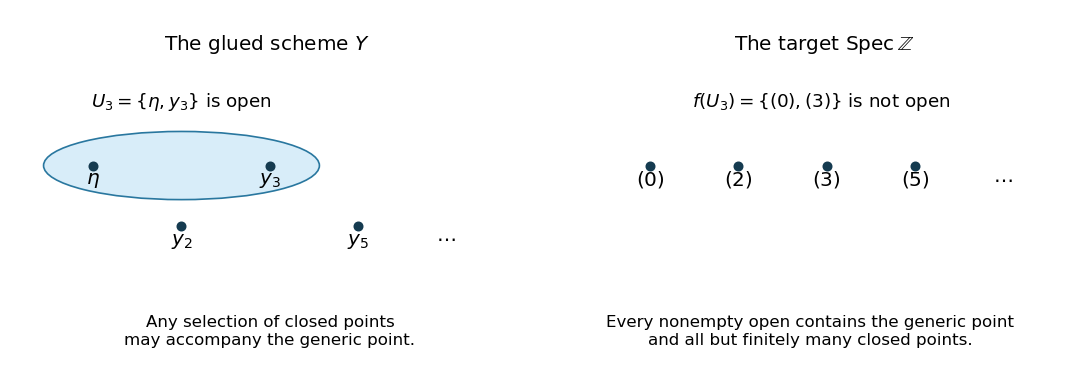
Gluing the local spectra retains every closed point but permits more open subsets
. Details. 
Articles by others on the same topic
There are currently no matching articles.