The two real branches start at , have zero initial slope, and approach the lines from outside the populated parallel-velocity region. The original plot solves the degenerate-plasma dielectric response numerically; the shaded wedge shows where particles with resonant parallel velocities exist.
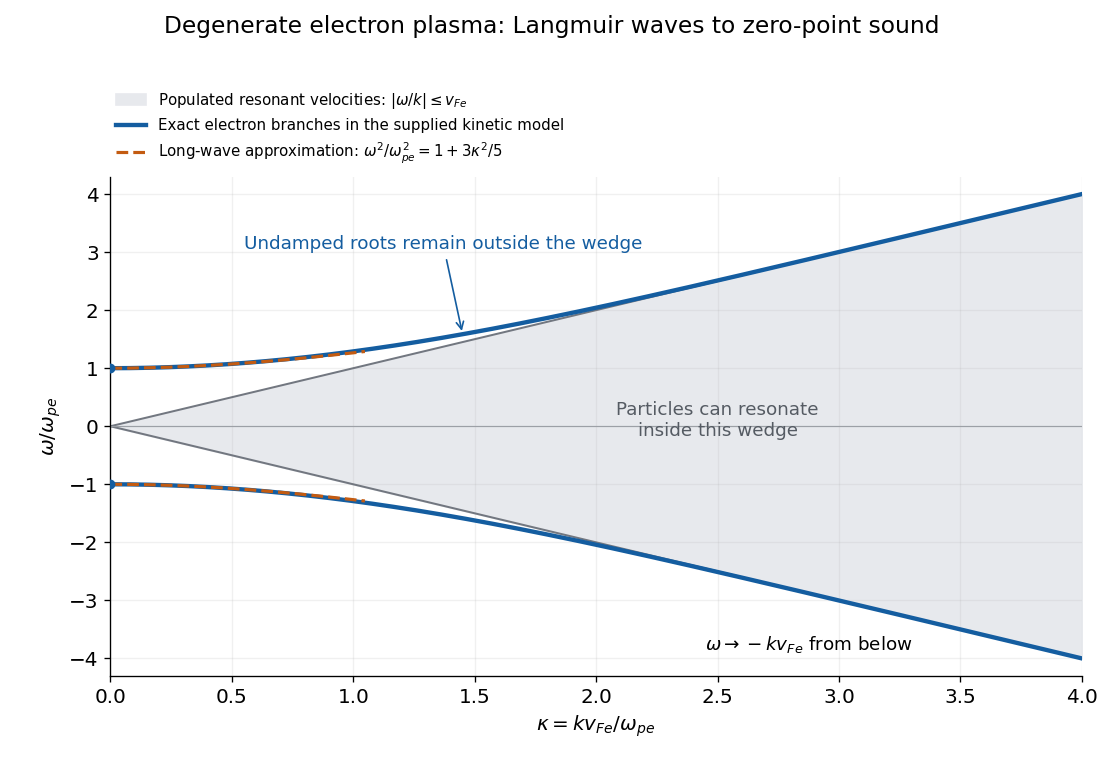

The distinction from a nondegenerate gas with a Maxwellian Maxwell-Boltzmann velocity distribution is its tail. A Maxwellian has resonant particles at every finite phase velocity. Its long-wavelength Langmuir waves have exponentially weak Landau damping, but at shorter wavelengths that damping becomes strong. The ideal degenerate cutoff instead permits this undamped branch to persist continuously into degenerate-plasma zero-point sound. The coefficient in c is also different from the classical thermal dispersive coefficient.
A natural additional branch is a degenerate ion-acoustic wave. For singly charged ions with equal electron and ion number densities, degenerate electron pressure supplies a restoring force while ion mass supplies inertia. The electron equation of state has , suggesting, at long wavelengths,Both species are degenerate here, so . The hierarchy explains the damping: there are no resonant ions, but there are resonant electrons inside their parallel marginal distribution. That electron marginal distribution has a small nonzero slope at , even though the full three-dimensional occupation is constant inside the Fermi sphere. One therefore expects weak electron Landau damping, of relative order , rather than exact absence of damping. Ion degeneracy pressure adds a relatively small correction to . This reasoning concerns an electrostatic ion-acoustic wave; transverse or magnetized branches require additional field dynamics or a background magnetic field.
Articles by others on the same topic
There are currently no matching articles.