Source extract: users.physics.ox.ac.uk/~Foot/C2/pdf/C22005Q5.pdf
The year is attributed from the preserved Oxford support-page record; it is not printed on the held page.
TODO: The remainder of this historical paper is not held. Only the supplied question material is covered.
Treat and as an isolated ground-state hyperfine qubit. Their transition angular frequency is . The radiofrequency magnetic field couples them through an allowed magnetic dipole transition. After choosing its phase reference, take the two-level laboratory Hamiltonian operator to bewhere are Pauli operators. Here is defined by the on-resonance rotating-frame off-diagonal matrix element .
Use a quantum rotating frame and the rotating-wave approximation, valid for , with Rabi detuning . Ignoring off-resonant coupling to other levels givesAt resonance , the unitary time evolution isThus the Born rule gives coherent Rabi oscillations,The stated amplitudes are in the rotating frame; the laboratory carrier phases are tracked by the drive reference.
These logical states are orthogonal, individually resolvable hyperfine levels in the same electronic ground state. They avoid fast optical decay, can be coherently coupled by radiofrequency control, and have a state-selective optical readout through . The excited level is useful for fluorescence detection rather than for the storage superposition in this model. Long lifetimes alone do not guarantee a useful qubit: control isolation and adequate quantum coherence are also required.
A resonant Rabi pi pulse satisfies . The supplied therefore givesThe ideal rotating-frame operation is , a Pauli X gate up to global phase.
Both logical states belong to the electronic ground level. A fast electric dipole transition between them is forbidden, and spontaneous radiative relaxation at a hyperfine radiofrequency is weak. The optical readout field is off during the coherent pulse. Neglecting relaxation is therefore consistent with a population lifetime much longer than . Magnetic noise, collisions and technical dephasing are additional limitations; the ideal coherent calculation assumes their effects are small over this interval.
At detuning , define . The same two-level Hamiltonian operator givesFor an accurate fixed-duration rotation, the detuning must be small compared with the Rabi angular frequency. Writing ,a fractional mismatch much smaller than relative to the carrier. This is an accuracy scale, not an assertion that a particular nonzero detuning gives a perfect gate.
The small-detuning error of a Rabi pi pulse quantifies a chosen tolerance. For an initial and the resonant pulse duration,A population-transfer error at most consequently requires approximately ; for example, about for one percent error. Full gate calibration also includes pulse area and drive phase, beyond this population-transfer criterion.
In the ideal state-selective fluorescence detection model, driving the optical transition produces a bright record only for , while is dark. A sufficiently discriminating pulse therefore measures the basis . The optical cycle is assumed to return population to the appropriate logical state without leakage. Ignoring the recorded outcome removes the off-diagonal quantum coherence between and .
Take equally spaced measurements at , including the final time. Between checks the resonant drive rotates through angle . The probability of changing basis state in one interval isAfter each ideal projective measurement, the populations therefore follow the symmetric two-state Markov chainThe population difference is multiplied by at each step. Starting in , the nonselective two-level Zeno dynamics givesFor , the exact final population is , while the requested large- estimate is , about four percent. Thus the transition that an uninterrupted pi pulse would complete is strongly inhibited.
If “leaving” instead means departing from at least once in the complete measurement record, use the repeated projective-measurement survival probability. The probability that every check returns isIt has the same leading estimate , but is not exactly the final population: a trajectory can leave and subsequently return. Keeping these events separate also distinguishes postselected records from an experiment that measures only final populations.
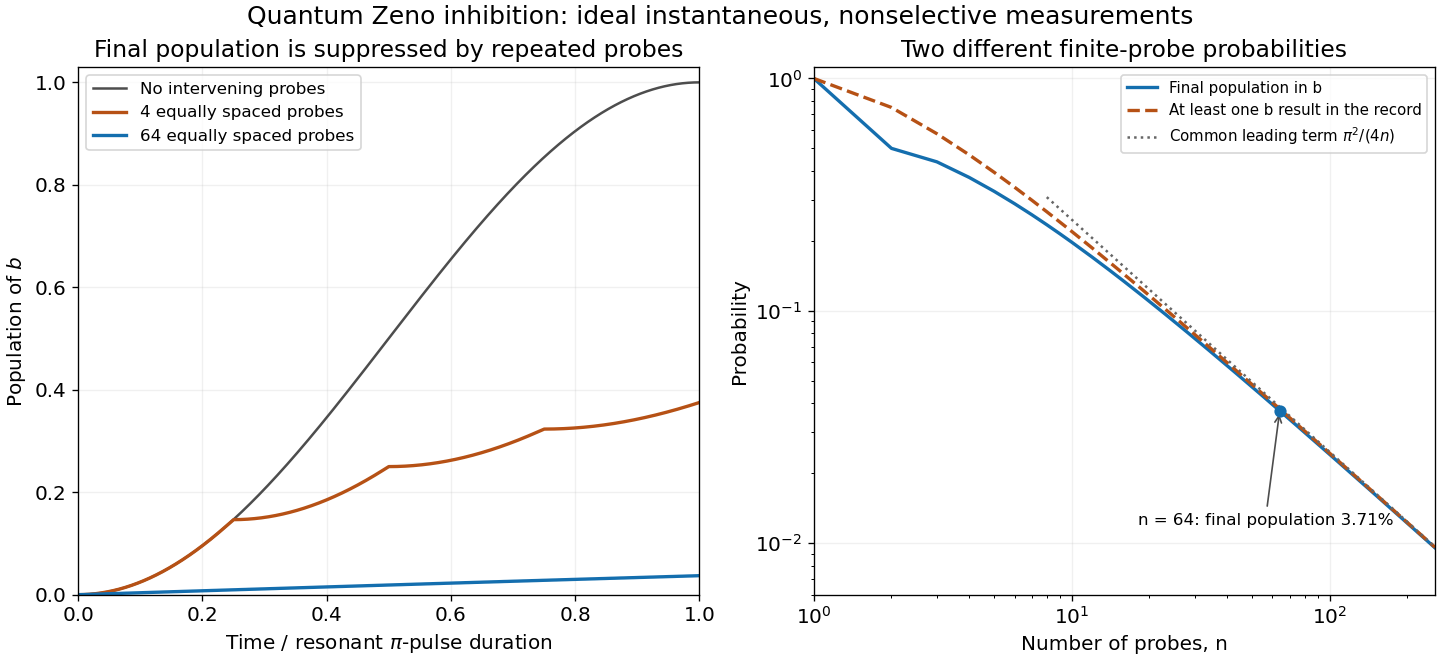
Rabi transfer inhibited by repeated measurements, with final population and all-check departure distinguished
. Original ideal two-level calculations, not historical data. Probe times include the end of the pi pulse. The first panel shows ensemble populations between nonselective probes; the second compares exact final population, departure at any recorded check, and their common large-n estimate. Details.
The mechanism is the quadratic short-time quantum survival probability: each short interval has transition probability of order , so checks leave only an order- total transition probability. The quantum Zeno effect here requires effective, sufficiently fast measurements; a finite-duration optical probe is a physical interaction whose imperfections must be included when comparing with data.
The beryllium-ion quantum Zeno experiment of 1990 used the same ground-state transition and a finite-duration optical probing sequence, followed by a calibrated ensemble fluorescence readout. Its measured final populations motivate the nonselective model; the instantaneous projections here idealize those physical pulses.
Articles by others on the same topic
There are currently no matching articles.