For a paraxial Gaussian beam, choose the complex beam parameter withHere is the wavefront radius and the intensity radius. The ABCD law isFor a real, lossless round-trip ray transfer matrix in free space, . A reproducing cavity mode requires , henceExcept for a scalar identity matrix, a finite physical solution requires a complex-conjugate root pair, one with positive imaginary part. The generic strict stability condition is thereforeEquivalently, the ray eigenvalues are distinct unit-modulus numbers , so repeated round trips do not cause unbounded ray excursions. Adequate mirror apertures and longitudinal resonance are also needed for a low-loss resonant mode.
The strict inequality has a degenerate exception relevant to this paper. If , then for every physical even though . A symmetric confocal resonator has exactly this matrix and supports Gaussian modes; it is not excluded as a physical cavity. Thus the printed strict condition should be understood as the generic, nondegenerate stability criterion, not a universal necessary condition covering the confocal case in c.
Use the unfolded propagation convention after reflection. Free-space propagation and a concave spherical mirror have matricesThe mirror is equivalent in this paraxial convention to a thin lens of focal length . The excursion from the reference plane to mirror 1 and back isLikewise . Multiplying , or using cyclic invariance of the trace to move the reference plane, givesConsequently the strict criterion of a isThe trace is independent of , as a change of reference plane only conjugates the round-trip matrix. For the concrete confocal counterexample , , each excursion is and its square is . This gives and the degenerate boundary exception already explained.
Let , so each mirror in the symmetric confocal optical resonator has radius . At mirror 1, an incident beam whose waist is at the centre has , with distances measured along its incoming direction. Reflection givesAfter propagating the distance back to the centre, its parameter is purely imaginary. Thus the reflected waist is also at the cavity centre andThe incident and reflected waist radii need not agree. With axial position measured from the centre, their radii obeyAt either mirror, and the two spot sizes agree, as reflection requires. Between the mirrors they generally have different waists while still reproducing themselves after a full round trip.
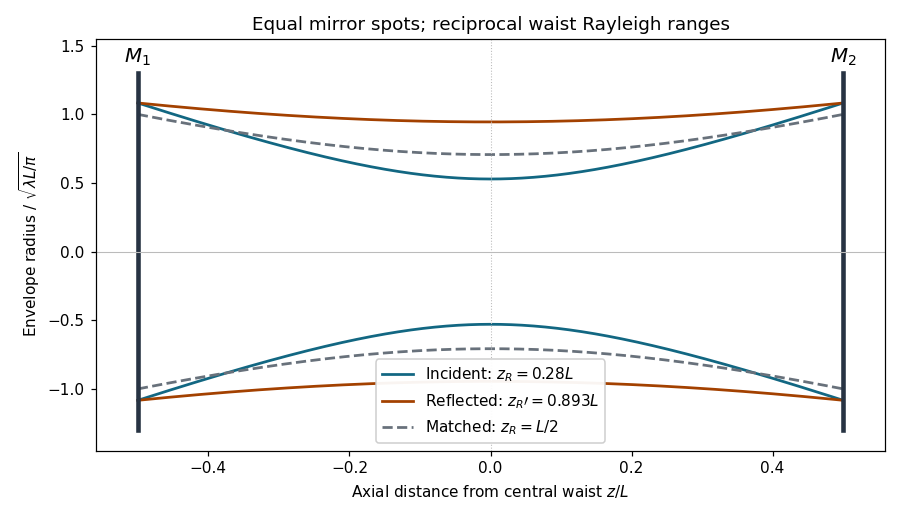

Equal waist sizes imply equal positive Rayleigh ranges, so c gives . Since , the matched radii areThese are radii; the corresponding spot diameters are twice these values. One practical disadvantage is the transverse-mode degeneracy of the exact confocal geometry: mode frequencies coincide in families, making clean selection of a single transverse mode more difficult. Its condition also lies at the strict-stability boundary. For example, perturbing the two radii in opposite directions, and , gives for , an unstable perturbation. This does not mean that all perturbations, or the ideal confocal resonator itself, are unstable.
Articles by others on the same topic
There are currently no matching articles.