Write and . The ensemble is the mixture , rather than a coherent superposition of the two phases. The ZZZ probabilities stay unchanged. Reversing the relative phase interchanges the allowed parity sector in every equatorial basis, so for XXY, XYX and YXX,In YYY the quantum prediction is the opposite:For a concrete continuation of the ideal local analysis, apply the same phase-flip event to a predetermined local assignment: it reverses X and Y at the affected photon. All three mixed-basis products and the YYY product then reverse together. With unbiased marginals in each parity sector this shared-error local model predicts negative-product YYY outcomes at each and positive-product outcomes at each. The histograms compare this specified model with the quantum result.
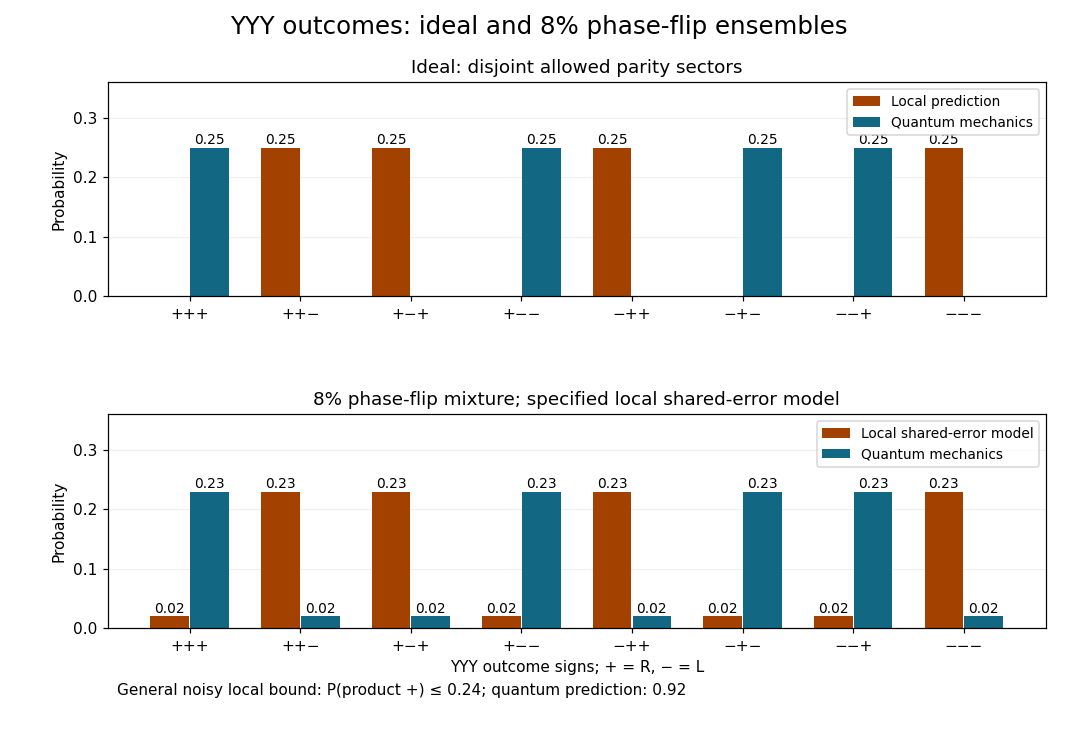

Imperfect mixed-basis statistics alone do not force that particular local histogram. A model-independent constraint follows because a positive YYY product requires at least one of the three ideal mixed-product constraints to fail. Each fails with probability , so the union bound givesEquivalently, local assignments satisfy , whereas this noisy quantum state gives . Thus the violation survives the specified phase error without assuming a unique noisy local histogram or independent errors in the three measurement contexts.
Articles by others on the same topic
There are currently no matching articles.