Use , . Choose the eigenstate phasesThe inverse relations are and . The X states are linearly polarized at and to horizontal, while the Y states have equal orthogonal amplitudes in quadrature and hence opposite circular polarizations. We define R as the state; descriptions as clockwise or anticlockwise must specify the observation direction and time convention.
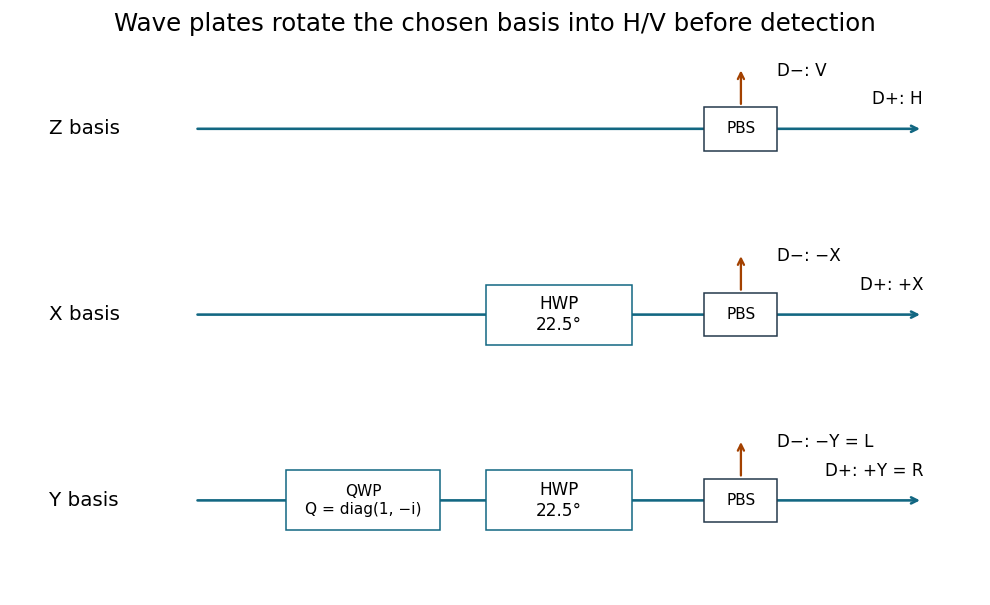
A polarizing beam splitter and two single-photon detectors directly measure Z, routing H and V to separate detectors. For X, place a half-wave plate with its axis at before that splitter; it implements a Hadamard transformation up to a global phase. For Y, first apply a quarter-wave retardance in the H/V axes and then the same half-wave plate. The total analyzer transformation is , with and . The physical fast/slow-axis assignment is selected to realize this stated retardance.

In ZZZ order, the only nonzero amplitudes are those of HHH and VVV. ThusFor an equatorial outcome , use the X and Y eigenvectors in a. For a product basis containing Y measurements, the bra acting on VVV contributes , while that acting on HHH contributes . Hence the amplitude of outcome in the supplied state isEach of XXY, XYX and YXX has , giving . In each of the three respective product bases,The eigenvector in each position belongs to the observable named in that position. All four outcomes with product have probability ; the four with have probability zero. This also specifies all eight probabilities in all three bases, and all single-site equatorial marginals are unbiased.
In a local hidden-variable description, assign predetermined values to the two possible measurements at photon . The perfect correlations of b requireMultiplying these identities cancels each squared X value and gives . Thus local realism predicts only the YYY outcomes and . Combining this parity rule with the measured unbiased single-Y marginals forces all four frequencies to be : four weights subject to normalization and the three zero-mean conditions are uniquely uniform.
Quantum mechanics instead has in the amplitude formula of b, giving . ThereforeQuantum mechanics predicts each positive-product outcome with probability and every negative-product outcome with probability zero. The local and quantum allowed sets are disjoint.
This is the GHZ theorem: in the ideal case the contradiction follows from deterministic product constraints, an all-versus-nothing argument. A usual two-party Bell-state test instead violates a statistical Bell inequality assembled from several settings. Both require appropriate locality and measurement-choice assumptions and careful treatment of experimental imperfections; the distinction is the deterministic form of the ideal three-party argument.
Write and . The ensemble is the mixture , rather than a coherent superposition of the two phases. The ZZZ probabilities stay unchanged. Reversing the relative phase interchanges the allowed parity sector in every equatorial basis, so for XXY, XYX and YXX,In YYY the quantum prediction is the opposite:For a concrete continuation of the ideal local analysis, apply the same phase-flip event to a predetermined local assignment: it reverses X and Y at the affected photon. All three mixed-basis products and the YYY product then reverse together. With unbiased marginals in each parity sector this shared-error local model predicts negative-product YYY outcomes at each and positive-product outcomes at each. The histograms compare this specified model with the quantum result.
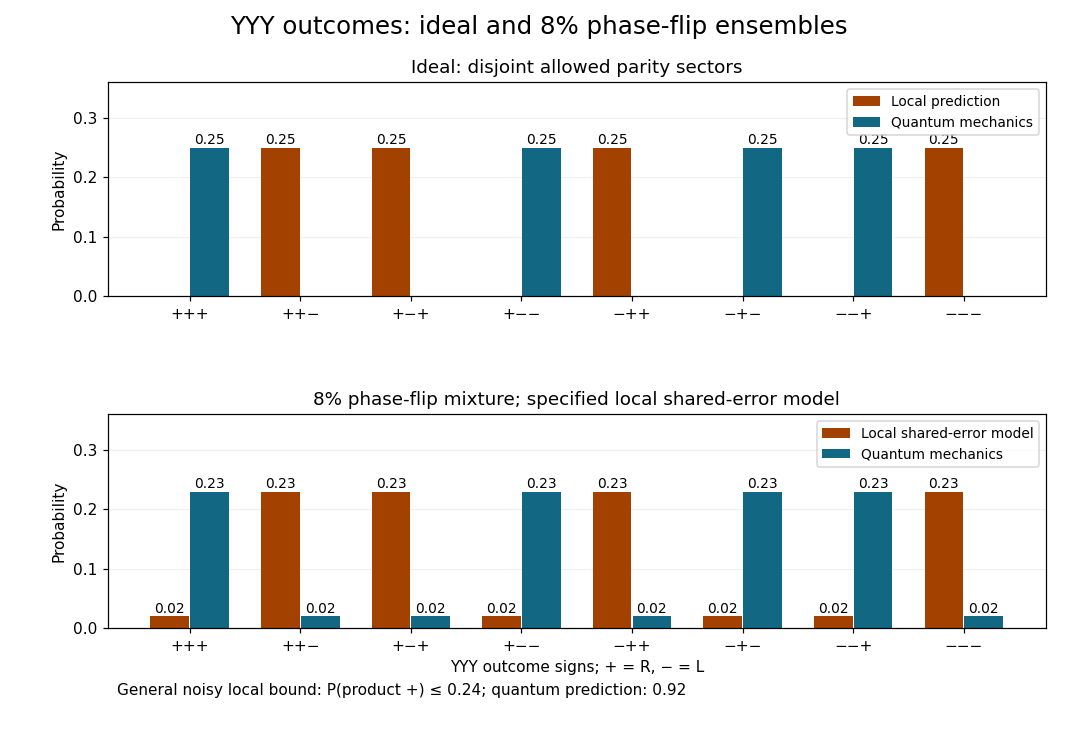

Imperfect mixed-basis statistics alone do not force that particular local histogram. A model-independent constraint follows because a positive YYY product requires at least one of the three ideal mixed-product constraints to fail. Each fails with probability , so the union bound givesEquivalently, local assignments satisfy , whereas this noisy quantum state gives . Thus the violation survives the specified phase error without assuming a unique noisy local histogram or independent errors in the three measurement contexts.
Articles by others on the same topic
There are currently no matching articles.