Use the source's north-pole assignment . Fix the ordered basis as and use the standard Pauli matrices in that order, soA pure state has : examples are at the north pole and at . An incoherent mixed statehas inside the Bloch sphere. At it is the origin, distinct from an equatorial pure state despite equal populations. The distinction is the off-diagonal quantum coherence of the density matrix.
For the stated Hamiltonian operator, put and . The Bloch vector obeysThus it rotates right-handedly about the fixed axis , preserving its length and its projection on that axis. For example, on resonance , a north-pole Bloch vector follows and reaches the south pole at .
Take , with the field phase chosen accordingly. The Hadamard gate is . Align the axis with and rotate through :The factor is an irrelevant common global phase. This realizes the whole quantum gate, rather than merely its action on one input quantum state.
There is a basis-ordering convention to make explicit: this is the Hadamard gate matrix in the ordered basis chosen in part (a). If instead its definition is the usual ket rules and , its matrix in our order is . For that definition choose . Both conventions use the same pulse duration; the sign of the Rabi detuning selects the desired axis.
At resonance, the Hamiltonian operator becomes . ThereforeIt gives the requested positive rotation about the x-axis. In the ordered basis , becomes , whose Bloch vector is .
A resonant Rabi pi pulse givesIt swaps and with a common global phase, implementing the Pauli gate , or NOT. Its Bloch sphere action is a half-turn about the -axis.
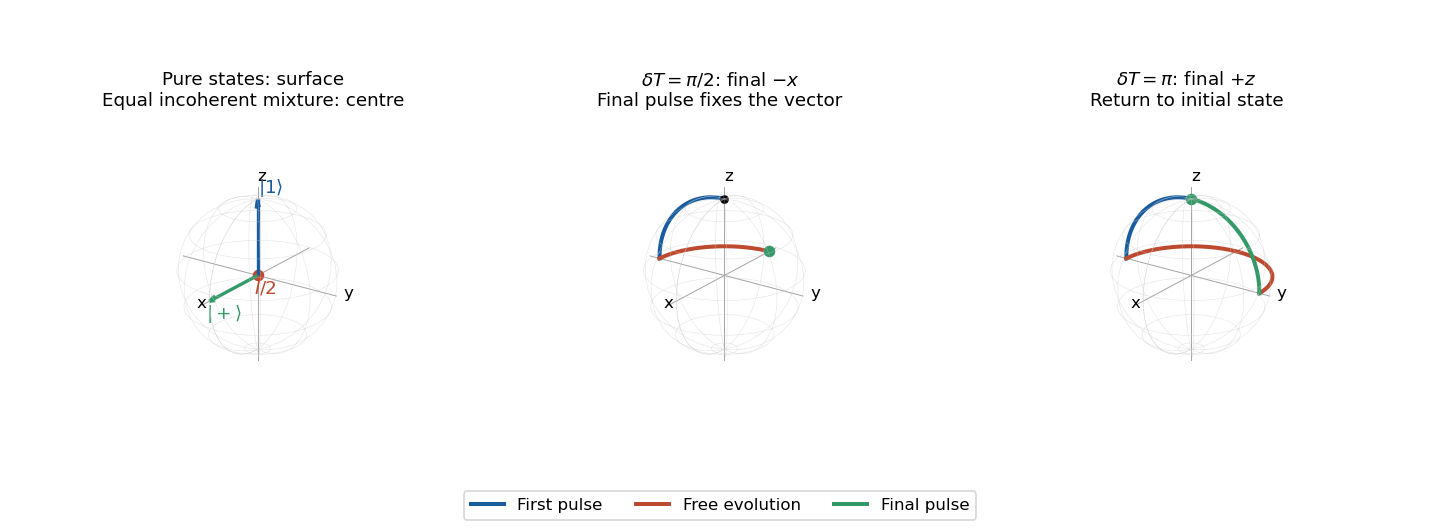
Keep the Pauli matrix and north-pole conventions of part (a), and neglect Rabi detuning during each short pulse. Write and . During the first pulse the Bloch vector is for . During free evolution,because the Hamiltonian operator generates . During the final pulse it isThese formulas specify every arc in the two Bloch sphere sketches. For the path is north , and the last pulse leaves fixed. For the path is north north.
To test the complete quantum gate, multiply its unitary operators:It is proportional to the Hadamard gate when , hence the shortest positive waiting time isMore generally . With the alternative conventional ket definition specified in part (b)(i), the required matrix is , so and . The distinction concerns which basis order defines the named Hadamard gate; the evolution and the return population do not depend on that naming choice. Finally , so the actual return population isThe printed plus sign is inconsistent with the two identical pulses. At , , so becomes and ; the printed expression gives one. This counterexample is independent of Bloch sphere labeling. A plus sign would describe the complementary population , or the return population with an opposite-sign final pulse. That changed sequence also changes the gate question and must not be silently substituted.
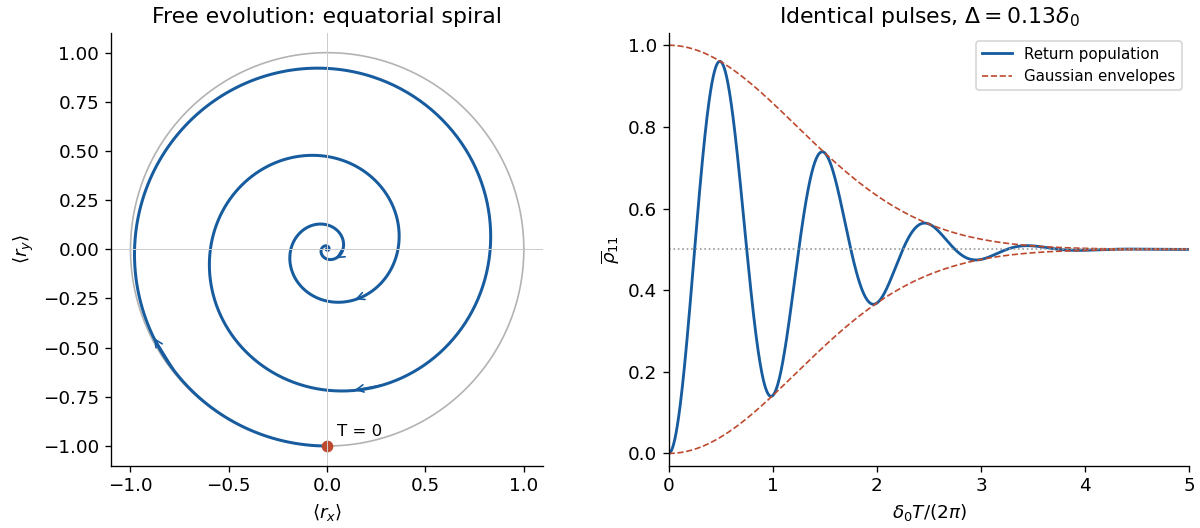
Interpret the unspecified Gaussian width as the standard deviation, soThe characteristic function of this Gaussian distribution isAverage the free-evolution Bloch vectors from part (c):It starts at and spirals towards the origin in the equatorial plane, with period and shrinking length . Individual pure states retain unit-length Bloch vectors; only ensemble averaging produces the apparent loss of quantum coherence.
After the final pulse, the corrected return population isThe oscillations lie between , start at zero, and tend to . The upper envelope has no implication of exponential energy relaxation: this is static inhomogeneous dephasing. If instead the intended Gaussian convention was , every envelope above becomes . The printed-plus-sign convention would give the complementary fringe.


An ideal instantaneous NOT about reverses each atom's accumulated phase relative to its subsequent free precession. Algebraically, , so for a static Rabi detuning and ,The entire Ramsey interferometry sequence is consequently , up to the additional common global phase if NOT is implemented as . ThusThis spin echo restores the initial population even for the distribution of static Rabi detunings in part (d). It removes reversible inhomogeneous dephasing; fluctuating Rabi detuning, finite pulse errors and irreversible loss of quantum coherence need not refocus. With an opposite final pulse, the return population would instead be zero; this distinguishes that alternative from the sequence actually specified.
Articles by others on the same topic
There are currently no matching articles.