A base of a root system is a vector-space basis of the ambient Euclidean space such that every root is an integer combination of its elements with all coefficients nonnegative or all nonpositive. The corresponding nonzero nonnegative combinations are the positive roots.
If distinct had positive inner product, the allowed root-difference fact would make a root. Its simple-root coefficients have opposite signs, contradicting the definition. Hence distinct simple roots have nonpositive inner product.
For a positive root which is not simple, the identity gives a simple root with and . The allowed fact makes a root. Its coefficients remain nonnegative, and it is nonzero because is not simple. It has smaller height . Induction expresses it as a sum of simple roots with each partial sum a root; appending gives the required expression for .
Finally, reflection in a simple root changes only that root's coefficient:For positive , at least one other simple coefficient is positive: in a reduced root system the only positive root on the line of is itself. That other coefficient is unchanged. The reflected vector is a root, so its coefficients cannot all be nonpositive and must all be nonnegative. Thus preserves all positive roots except , which it sends to .
Use the column-coroot convention , consistent with the printed matrix and the stated shorter first root. It givesThe root string through in the direction contains . Reflecting in gives . Together with and their negatives these giveThere are no further roots. Indeed the simple reflections act on coefficient pairs by and ; the displayed twelve-element set is closed under both. Every positive nonsimple root can be reflected to a positive root of smaller height: choose a simple root with positive inner product as in (a), and its positive integral Cartan pairing decreases height. Repetition reaches a simple root, so every root lies in an orbit already contained in the list. This is the G2 root system.
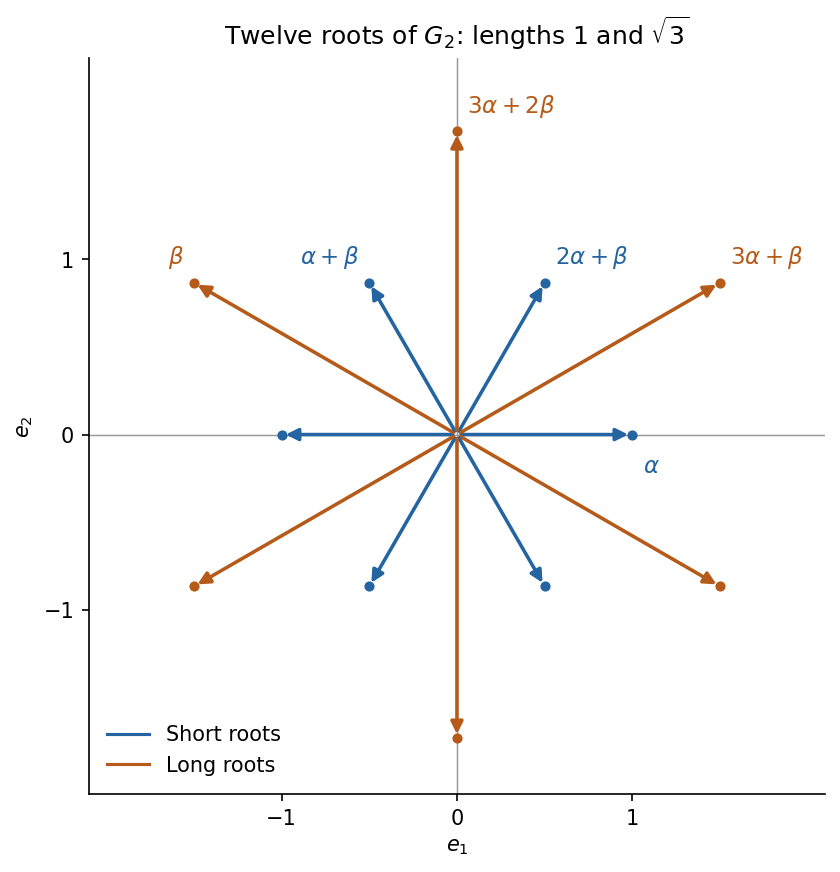
The twelve roots of G2 with the shorter simple root horizontal
. Details. 
Articles by others on the same topic
There are currently no matching articles.