Source: Mathematics release, bundle
Part C 2007 11.pdf, pages 309–312. This combined paper was sat on 8 June 2010, 2.30–5.30pm, for Mathematics, Mathematics and Computer Science, and Mathematics and Philosophy Part C.Bounded exact-paper availability checks found no matching answer advertisement. The department's general even-year policy states coverage back to at least 2016 and does not itself establish 2010 coverage. Both printed sections, all thirteen source leaves, and their unnumbered requests are answered below.
We prove Lie's theorem in the required form by induction on . If , any nonzero vector works. Otherwise solvability gives , so choose a codimension-one ideal and . By induction there are and a linear functional with for all .
Let . Choose the cyclic basis up to its first linear dependence. The commutator identity , with , proves inductively thatHence is invariant under and , and every has trace on . In particular implies . Characteristic zero gives .
The simultaneous weight space is nonzero and stable under , becauseOver , the restriction of to this nonzero finite-dimensional space has an eigenvector. That vector is an eigenvector of both and every , hence of every element of .
Let be the quotient map. A full flag of ideals in lifts by inverse images to a flag from to , with dimensions increasing by one. Prepending supplies the required full flag in . Thus supersolubility lifts across a one-dimensional ideal.
Over , a nonzero soluble has a one-dimensional ideal: apply part (a) to its adjoint image acting on . A common eigenvector spans an adjoint-invariant line, which is an ideal. The quotient is soluble and has smaller dimension, so induction and the lifting result give a full flag of ideals. Therefore a soluble complex Lie algebra is supersoluble.
Conversely this implication needs no field restriction. If has a full flag, its first nonzero ideal is one-dimensional and abelian, and has a full flag. By induction is soluble, so some term of the derived series of lies in ; its next derived term is zero. Hence
Let be the two-dimensional affine Lie algebra with basis and bracket , and putBoth factors have zero centre, so . The line in the second factor is an ideal, making PSS. But its quotient onto the nonabelian simple algebra is not soluble. A quotient of a soluble algebra would be soluble, so is not soluble.
If is abelian and nonzero, . Otherwise choose such that is an ideal. For each writeThe coefficient is uniquely defined and linear. The Jacobi identity givesso . If , then .
If , the same equation says for all . Hence . Since is not central, its centralizer is proper. Thus in both casesNo algebraic closure or characteristic restriction was used.
Choose a basis with . The representation matrices areThe one-dimensional modules have characters . If they coincide, these modules are isomorphic and the first alternative holds.
Otherwise choose with , where . Replacing by makes the upper-right entry of zero. The representation identity on commutators now gives, for every ,Iteration yields . Nilpotence of implies for sufficiently large , by its lower central series. Since , it follows that for all . The new line is therefore a submodule, andThe argument works over the stated arbitrary field, including positive characteristic.
The flag makes every composition factor one-dimensional, described by a character . The Jordan–Hölder theorem for modules for finite-length modules says that the multiset of simple composition factors is independent of the chosen composition series.
Here is a construction valid over every . For , every generalized eigenspace of is an -submodule. Indeed is nilpotent on , say of exponent , andIf is killed by , take . Terms with vanish by adjoint nilpotence, and all other terms kill . This proves invariance of the generalized eigenspace.
The flag also makes the characteristic polynomial of every split over . Whenever two composition characters differ, choose an on which they differ and split the module into the distinct generalized eigenspaces of . Repeat within each summand until all its composition factors have the same character. Every nontrivial split lowers dimensions, so the process terminates. Finally combine summands carrying the same character. Jordan–Hölder ensures that the resulting distinct blocks have distinct factor types, givingThis recursive method does not assume that a single element separates every character, which could fail over a finite field.
Writing matrices in blocks, the defining relation givesThe trace is automatically zero. The relation is linear, and if , , thenThus is closed under the commutator and is a Lie subalgebra of .
Its diagonal subalgebra isPut , . Since , the required block decomposition isThe four lines have respective characters , , , . They are distinct and nonzero because . The two-dimensional summand has two trivial composition factors. These five submodules therefore have exactly the factor-grouping properties of part (b). Their dimensions sum to , the dimension obtained from four free entries in and one each in the skew-symmetric blocks .
A reduced crystallographic root system is a finite spanning subset of a real Euclidean vector space, excluding zero, such that , each reflection preserves , and all Cartan integers are integers. A base is a vector-space basis in which each root has integer coordinates either all nonnegative or all nonpositive. The Weyl group is generated by the root reflections.
For nonparallel roots put and . Then is an integer strictly below and at least zero. ThereforeIf , the positive integers have product or , so at least one is one. If , reflection gives and hence its negative. If , reflection directly gives . This proves the positive-inner-product assertion.
To prove that an -string has no gaps, suppose consecutive occurring integer positions in had . If , apply the previous result to and to obtain the missing root at . Thus this inner product must be nonnegative. Similarly the absence of a root at forces . But the latter inner product exceeds the former by , impossible. Thus every intermediate integer position occurs.
Write the complete finite string as . Reflection maps position to , so it interchanges the two endpoints. HenceHere are the maximal endpoint distances, not arbitrary shorter distances mentioned in the existence assertion.
Use the Cartan-matrix convention . The displayed matrix is realized bywith the standard orthonormal coordinates. Closure under the two simple reflections givesThe positive roots are . Conversely the standard fact that every root is Weyl-conjugate to a simple root, or successive height reduction by simple reflections, shows these two reflection orbits exhaust the roots. This is the rank-two system , also called after exchanging the length convention. With a transposed Cartan-matrix convention, interchange which simple-root label is short; the geometric system and Weyl group are unchanged.
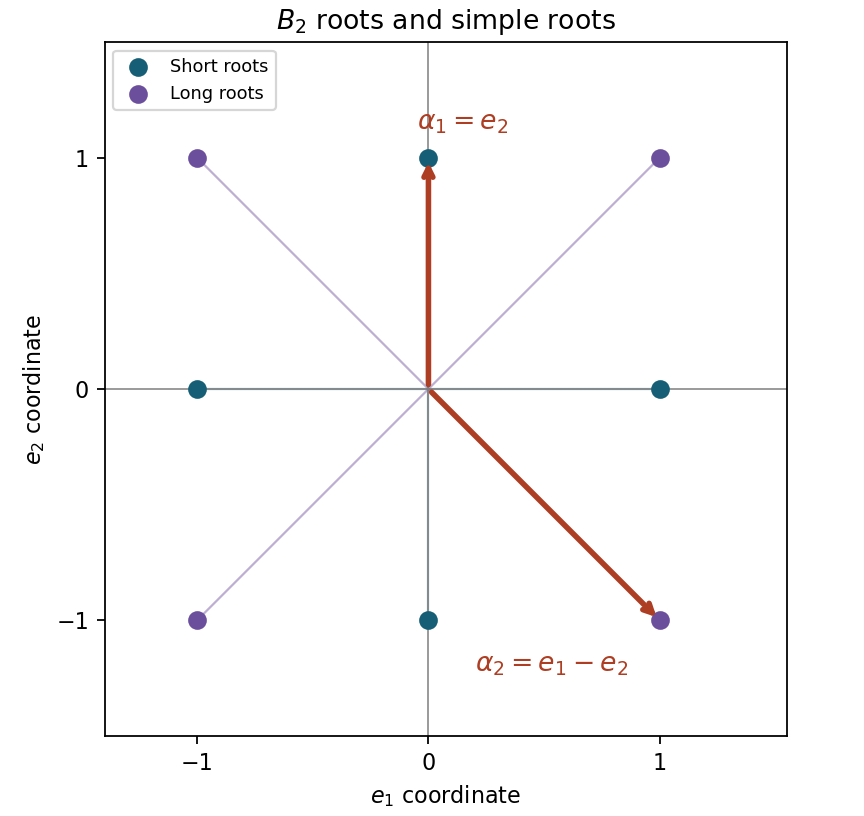
Rank-two root system with its chosen simple roots
. Details. 
The reflection in flips the second coordinate, while the reflection in swaps the two coordinates. These generate all eight signed permutation matrices in two coordinates. Thuswhere means the symmetry group of a square.
For a Young diagram cell , its hook length is one plus the number of cells to its right and below. The hook-length formula isApplying it to the two shapes givesThe shapes here require .
A hook tabloid remembers its first-row set and the ordered singleton entries below it. The proposed map keeps that first-row set and merges the remaining entries into one unordered row. Thus it is well-defined on tabloids. Permuting entries before merging gives the same tabloid as merging before permuting, so it is a module homomorphism. Every target tabloid is reached by putting its second-row entries, in any order, into the singleton rows. Therefore it is surjective.
For , the strictly dominating partitions of are exactly . Indeed dominance forces the first part to be at least , and the possibilities for the remaining sum give precisely those shapes or itself.
In characteristic zero, Maschke's theorem makes the permutation module semisimple, and Young's rule gives one copy of and only strictly dominating additional shapes. The trivial multiplicity is one, since a transitive permutation module has a one-dimensional invariant space. For the standard representation , Frobenius reciprocity identifies its multiplicity with the dimension of fixed vectors under the row stabilizer . In its realization , those fixed vectors have the form with , a two-dimensional space. Thus its multiplicity is two.
Finally . Subtracting the dimensions of one , one trivial module and two standard modules leaves , exactly one . ThereforeThe additional multiplicities are respectively. If the printed weak summation index is read literally alongside its separate , then ; the total multiplicity of is one.
A tabloid is the row-equivalence class of a tableau filled bijectively with : order inside each row is forgotten, but the rows remain distinguished. The permutation module has these tabloids as an -basis, with permuting their entries. Let be the column stabilizer of and defineThe Specht module is the submodule spanned by all polytabloids .
If a module homomorphism is nonzero on , it is nonzero on some spanning . Equivariance gives , so . The allowed criterion yields .
In characteristic zero, Maschke's theorem gives an equivariant projection . If , compose that projection with the isomorphism and the inclusion into . The preceding argument gives . Reversing the roles gives , so antisymmetry of dominance givesFor a map defined only on a Specht module in arbitrary characteristic, dominance need not hold. Take , , and . The first Specht module is the one-dimensional span ofThe transposition fixes , so this is the trivial module. The one-row permutation module is also trivial and one-dimensional. Sending to its single tabloid is a nonzero equivariant map, yet . In this characteristic such a map need not extend to the surrounding permutation module; that is exactly where the earlier proof ceases to apply.
Let be the permutation character of . Young's rule gives , with integer Kostka multiplicities. This dominance-triangular system has diagonal entries one, so recursive subtraction expresses every irreducible character as an integer linear combination of permutation characters. The latter count fixed tabloids, proving that all are integers.
For a -cycle, the Murnaghan–Nakayama rule reduces towhere height is the number of occupied rows minus one, and is the degree of the remaining Specht character at the identity. In particular a full -cycle has character zero unless is a hook, in which case the value is .
There is more than one solution: the trivial representation has character everywhere and the sign representation has character everywhere. ThusIn fact they are the only ones. The full-cycle formula in the preceding discussion forces any candidate to be a hook . For , the standard character is the number of fixed points minus one, so it vanishes on cycle type ; its sign twist does too. For , the hook representation is the exterior square of the standard representation and has character . At cycle type both standard-character values are one, so this character is zero. Its sign twist also vanishes there. Only remain.
Irreducible character orthogonality gives . Under the proposed vanishing condition, only the identity contributes, soBut is an integer dimension and is not a square. Thus no such partition exists.
The full-cycle formula says that precisely the nonhook shapes have zero value on a 6-cycle. These are .
Use the standard two-row permutation-character rule . A transposition has four fixed points, so . It fixes two-subsets, giving . It fixes three-subsets, giving .
Conjugating a partition tensors its character with the sign character. Hence the values on a transposition for the conjugate shapes are and . The shape is self-conjugate, so its character equals its own sign twist and is zero on every odd permutation. The complete candidate table is therefore:
| Shape | Value on a transposition |
|---|---|
Thus the unique answer is
First prove the unlettered common-eigenvector assertion, in the stronger form that some nonzero vector is killed by every operator in . This is the linear form of Engel's theorem.
Induct on , with the zero algebra immediate. If , the operator on is nilpotent: left and right multiplication commute, and every term in contains a power of at least . This argument works in every characteristic.
For a proper Lie subalgebra , its action on by brackets is therefore by nilpotent operators. The image of this action has dimension at most , so induction gives a nonzero class killed by . Thus the normalizer strictly contains . Choose maximal proper. Its normalizer must be , so is an ideal. Moreover has dimension one, since otherwise any one-dimensional subalgebra of the quotient would lift to an intermediate proper subalgebra.
Induction applied to acting on makes nonzero. This space is -invariant: for , . Choose complementing in . Its restriction to the nonzero space is nilpotent and has a nonzero kernel. A vector in this kernel is killed by and , hence by all of . This proves the preliminary assertion, with every common eigenvalue equal to zero.
Now apply it to the adjoint action of on itself. If , its common zero space is the center , which is therefore nonzero. Every induced adjoint map on remains nilpotent. Induction on dimension makes that quotient nilpotent. A central extension of a nilpotent Lie algebra is nilpotent: if its lower central series vanishes after projection, the next term lies in the center and the following term is zero. Hence is nilpotent. The zero algebra is immediate.
Every subalgebra of a nilpotent Lie algebra is nilpotent, since its lower central series is contained term by term in the ambient lower central series.
Conversely, if were not nilpotent, part (a) would give for which is not nilpotent. Over an algebraically closed field, such an endomorphism has a nonzero eigenvalue and eigenvector . The vectors are independent because while . Their span is a two-dimensional subalgebra, and its lower central series is at every stage after the first. It is therefore not nilpotent, a contradiction. Thus
Polarizing givesLet . Antisymmetry and this identity give and . The Jacobi identity therefore gives . Since the characteristic is not three, for every triple. ConsequentlyNo division by two was used, so the proof also applies in characteristic two with the usual alternating definition of a Lie bracket.
The Killing form is . Write , , . Since , cyclicity of trace givesIf , and , invariance gives , because . Thus is an ideal. For , the restrictions of their adjoint maps to are the adjoint maps of , and their induced maps on vanish. Block traces therefore give .
If is an Abelian ideal, maps into and vanishes on for . In a basis starting with it has zero diagonal blocks, hence trace zero. Therefore every Abelian ideal lies in .
Cartan criterion for semisimplicity says that a finite-dimensional complex Lie algebra is semisimple exactly when its Killing form is nondegenerate. To see why nondegeneracy implies semisimplicity, any nonzero solvable ideal has a last nonzero derived term which is an Abelian ideal of . The previous paragraph would put it in the radical of the Killing form, a contradiction.
If is a semisimple ideal of , the restriction is nondegenerate. Put . This is an ideal of by the argument above, and nondegeneracy on gives and . One way to check the latter is to restrict the pairing map : its restriction to is an isomorphism, so every vector of can be adjusted by an element of to lie in its kernel . Since both are ideals, . HenceApply this to the supplied extension by the derivation. If , it is . Otherwise and are one-dimensional, and projection is an isomorphism. Choose its vector with -component , writing it as for . Because , for every one has . ThusThis also handles the sign in the extension bracket explicitly.
A base of a root system is a vector-space basis of the ambient Euclidean space such that every root is an integer combination of its elements with all coefficients nonnegative or all nonpositive. The corresponding nonzero nonnegative combinations are the positive roots.
If distinct had positive inner product, the allowed root-difference fact would make a root. Its simple-root coefficients have opposite signs, contradicting the definition. Hence distinct simple roots have nonpositive inner product.
For a positive root which is not simple, the identity gives a simple root with and . The allowed fact makes a root. Its coefficients remain nonnegative, and it is nonzero because is not simple. It has smaller height . Induction expresses it as a sum of simple roots with each partial sum a root; appending gives the required expression for .
Finally, reflection in a simple root changes only that root's coefficient:For positive , at least one other simple coefficient is positive: in a reduced root system the only positive root on the line of is itself. That other coefficient is unchanged. The reflected vector is a root, so its coefficients cannot all be nonpositive and must all be nonnegative. Thus preserves all positive roots except , which it sends to .
Use the column-coroot convention , consistent with the printed matrix and the stated shorter first root. It givesThe root string through in the direction contains . Reflecting in gives . Together with and their negatives these giveThere are no further roots. Indeed the simple reflections act on coefficient pairs by and ; the displayed twelve-element set is closed under both. Every positive nonsimple root can be reflected to a positive root of smaller height: choose a simple root with positive inner product as in (a), and its positive integral Cartan pairing decreases height. Repetition reaches a simple root, so every root lies in an orbit already contained in the list. This is the G2 root system.
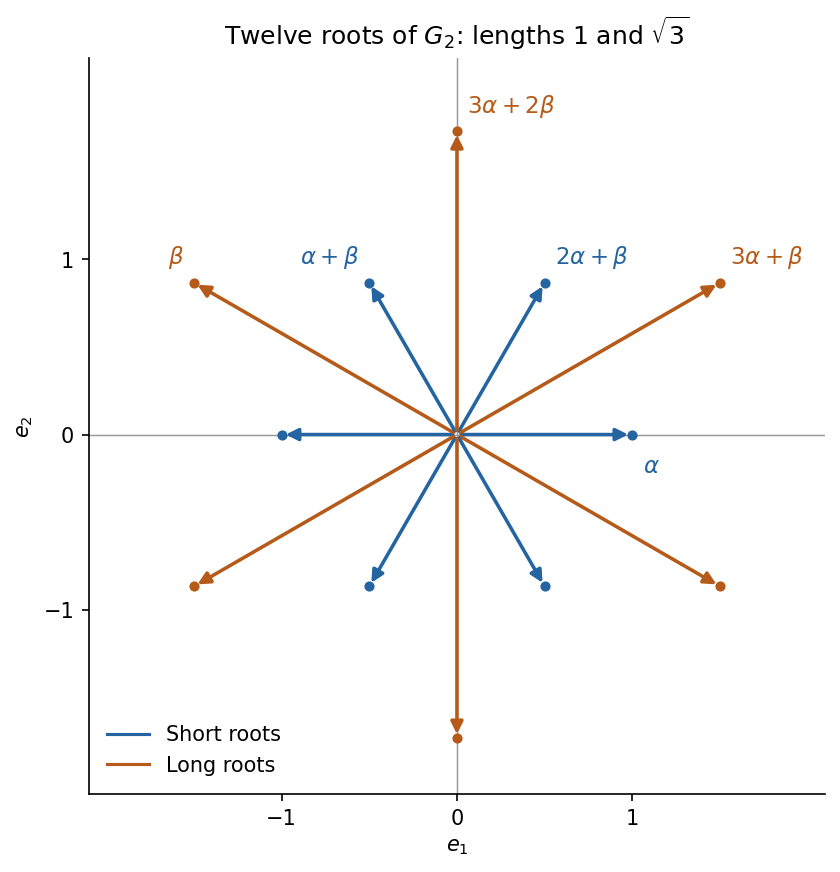
The twelve roots of G2 with the shorter simple root horizontal
. Details. 
The Young diagram is . The hook length of a box iscounting the box itself, the boxes to its right in the same row, and the boxes below it in the same column. The hook-length formula isThe first implication in the equivalence is immediate: if every hook length is odd, no hook can have length two.
Assume no hook has length two. The last row has length one, since otherwise its penultimate box has hook length two. If two adjacent row lengths are equal, take the last two rows in the maximal block of that length; the last box in the upper of those two rows has hook length two. Thus all row lengths are distinct. If a gap were at least two, the penultimate box in row would again have hook length two, since there would be no boxes below it. Therefore every successive gap equals one and the final part equals one, proving (2) implies (3).
The final condition makes . Its column lengths are the same staircase, sowhich is odd. This proves (3) implies (1) and completes the equivalence. Such a partition exists exactly at the triangular numbersThe hook formula gives , since its denominator is odd. Thus divides . Conversely implies . The product is an integer, so its valuation is zero and all its hooks are odd. By the equivalence is a staircase; its size uniquely determines its length, so .
For the character assertion, every removable rim hook has length equal to some hook length of the diagram. Here is a direct justification. If a border strip occupies rows through , connectedness and absence of a two-by-two block make adjacent strips of boxes overlap in exactly one column. Hence for , so its size is . The column has height , giving exactly . Therefore every removable rim hook of the staircase has odd length.
A fixed-point-free permutation of power-of-two order has only even cycles. Apply the Murnaghan–Nakayama rule starting with any cycle. It would require removal of a rim hook of that even length, but none exists. The sum is empty, soFinally suppose has distinct parts and is not . It cannot be another staircase of the same size. Thus some gap between successive rows is at least two, or the last row has length at least two; in either case a horizontal rim domino is removable. No vertical rim domino is removable, since that would require two equal adjacent row lengths. Murnaghan-Nakayama on a transposition consequently gives a nonempty sumall signs being positive and all tableau counts positive. Thus the character is nonzero at every transposition, proving the requested existence.
For a tableau , let be its column stabilizer and its polytabloid. The Specht module is the span of all such polytabloids inside the tabloid permutation module.
A tabloid with second row of size is determined by that subset, so . The two-row hook formula givesAt this provesBy Maschke's theorem, characteristic-zero permutation modules are completely reducible, so their Specht submodules are summands. The nonzero sum of all three-subset tabloids is fixed by every permutation; its span is a copy of the trivial module .
A permutation sends to , to and to . Relabeling the summation indices givesLinearity therefore proves both maps are module homomorphisms. The map denoted in the second displayed source formula is .
For the standard tableau with second row , the first entries in the top row are , so its nontrivial columns are and . HenceIn the coefficient of is one: among those four pairs only is contained in , since . Thus the image is nonzero. Its restriction to the characteristic-zero simple module has zero kernel, giving the requested isomorphic submodule.
For , choose the standard tableau with lower entry two and top-left entry one. Its polytabloid is . Each three-subset containing occurs twice in , once for each choice of its other two entries as the intermediate . Consequently the coefficient of in is two. This is nonzero in characteristic zero. Simplicity again makes the restriction injective, giving a copy of .
The four constructed submodules have the distinct shapes , , and , so they are pairwise nonisomorphic irreducible characteristic-zero modules. Complete reducibility therefore makes their sum direct. The given decomposition of and the dimension identity in (a) show their dimensions sum to . Their direct sum is consequently the whole module:
Use the standard invariant tabloid bilinear form, with the tabloid basis orthonormal. Each permutation acts by an orthogonal matrix, so . Inversion permutes and preserves its signs. ThereforeThe James submodule theorem states that for any submodule , either or . Use the allowed fact . The coefficient of in is one, so the displayed adjoint identity gives . If is not orthogonal to , some and some tableau have . Hence , and its permutation translates span . This proves the theorem.
Let . Every proper submodule of lies in by the theorem. If the restricted form is nonzero, is proper, hence is the unique maximal submodule andIn the stronger nondegenerate case specified in the question, , so itself is simple. The nonzero-form version also covers the possibly degenerate case needed in the final calculation.
For shape , identify with with basis . Its Specht module is the augmentation subspace , spanned freely by , . Its Gram matrix is , with diagonal entries two and off-diagonal entries one. Equivalently, in is the span of . This vector belongs to exactly when . Thus the restricted radical has dimension one if and zero otherwise, givingFor this quotient is nonzero and simple by the theorem. In the small exceptional case , the canonical radical quotient is zero, as the same dimension formula states; it is then not a nonzero simple module. This qualification distinguishes the numerical formula from the nonzero-form hypothesis.
Source: Mathematics release. This five-page Mathematics Part C paper is dated 2 June 2008. Bundle
Part C 2007 11.pdf, pages 112–116.Bounded exact-paper checks found no matching advertisement of worked answers. Both printed halves and all question parts, including the common definition before (1)(a), are covered. Full editable source statements remain in the private archive.
Define and , where brackets of subspaces mean their linear span. Each term is an ideal. Inductively, if is an ideal, the Jacobi identity givesso is an ideal as well. Also . Nilpotence means that this descending series eventually reaches zero; class means with for nonzero .
Because and the lower central series terminates, choose with but . Take . Then . Thus belongs to the idealizer and not to , proving .
Start with and set . Every term lies in , and , so the sequence eventually vanishes. Choose its last nonzero term . Then , hence . Therefore .
Induct on , proving the claim for all simultaneously. The case is the definition . If it holds for , Jacobi givesBoth uses of the induction hypothesis have first index , so the induction is valid. Thus for all positive indices.
Let and write for its own lower central series. Part (c) proves inductively that : it holds at , and . If has class less than , then , so . Consequently , with the zero algebra understood to have class zero.
The Killing form is . Symmetry follows from . Since , cyclicity of trace gives the invariance identityIf and , then , so the right side is zero. Hence for every , proving that .
For , use a basis of followed by a complementary basis of . Because , the matrix of has blocks . Multiplying two such matrices showsThe restriction statement has both arguments in ; it does not identify the two forms for arbitrary elements of outside .
Now use the ordered basis in the question for a central ideal . The images of the in the quotient have adjoint matrix , so the -coordinate block of their images is ; arbitrary -components form . Each is central, so its image under every adjoint map is zero. Thus the matrix is exactly . Products have top-left block and zero bottom-right block. Taking traces givesFinally, a nonzero finite-dimensional nilpotent Lie algebra has nonzero centre by (1)(b). Induct on its dimension: the Killing form descends to the quotient by its centre, which is again nilpotent of smaller dimension, and is therefore zero by induction. The zero algebra starts the induction. Apply this to the nilpotent ideal and then use the restriction identity to obtain . This avoids the false general claim that the product of two nilpotent linear maps must be nilpotent.
By irreducible traceless matrix Lie algebra is semisimple, let be the solvable radical. Lie's theorem triangularizes its action, with finitely many diagonal characters , and supplies a nonzero common eigenspace for one of them. For , conjugation by preserves and gives an equivalent representation of it. Thus the multiset of characters is constant. Each character varies continuously in and has values in that finite set of characters, so it is individually constant. Differentiating at zero gives for all .
Choose a common eigenspace . For ,Thus is -invariant, so irreducibility makes it all of . Every element of acts as a scalar. Its trace is zero because , so that scalar is zero. Faithfulness of the matrix inclusion gives . Hence .
One sufficient diagonal-matrix condition for simplicity is that contain all traceless diagonal matrices. Indeed invariance under their adjoint actions then decomposes into that diagonal algebra and some matrix-unit spaces . Put a directed edge when . Irreducibility makes the directed graph strongly connected; otherwise a terminal component spans a proper invariant coordinate subspace. Bracketing matrix units along a simple directed path supplies the matrix unit between its endpoints. Strong connectivity therefore supplies every off-diagonal matrix unit, so , which is simple. The mere existence of a diagonal matrix with distinct diagonal entries would not be a sufficient condition.
For the specified construction, has dimension two. Its diagonal adjoint action and the twelve distinct nonzero weights give a direct sum , of dimension fourteen. The stated bracket condition and the weight-vector relations make it a Lie algebra. A subspace invariant under it is invariant under all the and hence their associative algebra, so it acts irreducibly on . The preceding result makes it semisimple.
Use prime-dimensional faithful irreducible module forces simplicity. To see this, decompose the algebra into simple ideals. Complete reducibility for one ideal and commutation with the others make its isotypic component invariant under the whole algebra, hence all of the representation. Writing that component as and repeating produces a tensor product of irreducibles for the simple ideals. Faithfulness makes every factor nontrivial, of dimension at least two. Their dimensions multiply to seven, so only one factor is possible. Thus the constructed is simple.
The diagonal algebra is toral, and its centralizer inside is just , since no has zero weight. A maximal toral subalgebra containing lies in that centralizer, so equals ; it is a Cartan subalgebra. Thus the rank is two and the twelve weights are the roots. Pair them as . The opposite-root brackets have weight zero and belong to . For distinct , the sum cannot be zero, and the supplied root-bracket result says their bracket is nonzero exactly when is a root. This is equivalent to being a root, proving the requested equivalence for the paired brackets.
Among rank-two simple root systems, have respectively six, eight and twelve roots. ThereforeChoose simple roots short and long. In , and are roots. Renumber with , , and , retaining opposite partners in the other six positions. Root spaces are one dimensional, and the allowed bracket equality gives
Use the convention . For a finite reduced crystallographic root system, diagonal entries are two and off-diagonal entries belong to , with . Transposing this convention merely transposes the Cartan matrix.
The -string through has the consecutive roots , where and . For distinct simple roots , the negative step is absent, so and .
The matrix determines each simple reflection on the simple-root basis:It therefore determines their generated Weyl group as linear transformations. Every root is in the Weyl orbit of a simple root. For a positive nonsimple root , some is positive because . Its reflection subtracts a positive integer multiple of and lowers height. It stays positive unless the root is simple, since the other simple-root coefficients are unchanged and at least one is positive. Induction on height reaches a simple root; negative roots follow by sign. Hence , which is completely reconstructed by those reflection matrices. This determines the system up to root-system isomorphism, rather than fixing an absolute length scale; irreducible components may be rescaled.
For positive roots for a chain Cartan matrix, symmetry and adjacency imply all simple roots have equal length; normalize their squared lengths to two. Adjacent inner products are minus one and all others zero. Since every root is Weyl-conjugate to a simple root, every root also has squared length two. Write a positive root as with nonnegative integers , and set . ThenThere must be exactly two nonzero integer differences, one and one . Nonnegativity and the two zero endpoint values imply that the coefficients are one on one consecutive interval and zero elsewhere.
Conversely a single simple root is a root. If is a root and , its pairing with is minus one. Reflecting in therefore adds that simple root, making the next longer interval a root. Induction constructs every interval. Thus
Use the convention that insertion returns the insertion tableau first and the recording tableau second. Successive row insertions of giveFor example inserting five bumps six to the second row, and the final insertion of two bumps four from the first row and six from the second, creating the third row. The newly created boxes at these steps receive recording labels six and seven respectively.
The deletion input is this pair with the two tableaux interchanged. The symmetry property of RSK therefore gives the inverse permutation. One can also reverse-insert the boxes in descending recording-label order. The result isIndeed the displayed second row lists the positions of one through seven in the original permutation.
Let be the number of standard tableaux of shape . First the associated polytabloids are linearly independent. Order tabloids lexicographically by reading each row after sorting its entries. For a column-increasing tableau , the term in has coefficient one; every other tabloid term has larger row word. To see this, take the first row changed by a nontrivial column permutation. Earlier rows are fixed entry by entry, since each entry belongs to one original column. The changed row can only receive entries from lower positions of those increasing columns, so after sorting it is lexicographically larger. In a linear relation between standard polytabloids, choose the smallest row word with a nonzero coefficient. Its own tabloid coefficient cannot be cancelled by a larger standard polytabloid, a contradiction. Thus .
Work first over . The RSK bijection between permutations and pairs of standard tableaux of the same shape gives . The assumed pairwise nonisomorphic irreducible Specht modules, and the decomposition of the regular representation with irreducible multiplicities equal to their dimensions, give . Combining the two inequalities forces equality term by term: . Hence the independent standard polytabloids are a basis.
The same conclusion holds over every characteristic-zero field. All polytabloid coordinates in the tabloid basis are integers, so the ranks of their coordinate matrices are the same over any characteristic-zero field as over . In particular the dimension equality and independence transfer without requiring an embedding of the whole field into .
The equality exhausts the dimension of the regular representation. There is no room for another irreducible constituent, since it would contribute its positive squared dimension. ThusEach has the standard-polytabloid basis just proved. The usual split characteristic-zero statement follows over any characteristic-zero field because these integral Specht models remain irreducible after extension to an algebraic closure and already exhaust all dimensions there. In the literal wording of the source, polytabloids themselves are vectors; it is the Specht modules with those bases that form the family of representations.
If the cycle partition contains a part , the Murnaghan–Nakayama rule isA border strip is a connected skew Young diagram with no block; its height is its number of occupied rows minus one. The remaining boxes must be a partition diagram. The recursion starts with character one for the empty diagram at the empty cycle type, and an empty sum is zero. Repeated removal for all cycle lengths computes the character value.
Write the hook cycle partition as , . At the identity, the representation dimension is : a standard tableau of shape is determined by the entry in its top-right box, any one of .
For , the only removable border strip of length is the vertical bottom strip. Its height is , and the remaining hook has size and dimension . A strip of length would leave the top-left box but disconnect the removed top-right box from the removed column, so none exists and the value is zero. For , the whole hook is a border strip of height and contributes . These cases combine asIn particular the formula includes zero at and the full-cycle sign at .
Articles were limited to the first 100 out of 173 total.
Articles by others on the same topic
There are currently no matching articles.