First prove the unlettered common-eigenvector assertion, in the stronger form that some nonzero vector is killed by every operator in . This is the linear form of Engel's theorem.
Induct on , with the zero algebra immediate. If , the operator on is nilpotent: left and right multiplication commute, and every term in contains a power of at least . This argument works in every characteristic.
For a proper Lie subalgebra , its action on by brackets is therefore by nilpotent operators. The image of this action has dimension at most , so induction gives a nonzero class killed by . Thus the normalizer strictly contains . Choose maximal proper. Its normalizer must be , so is an ideal. Moreover has dimension one, since otherwise any one-dimensional subalgebra of the quotient would lift to an intermediate proper subalgebra.
Induction applied to acting on makes nonzero. This space is -invariant: for , . Choose complementing in . Its restriction to the nonzero space is nilpotent and has a nonzero kernel. A vector in this kernel is killed by and , hence by all of . This proves the preliminary assertion, with every common eigenvalue equal to zero.
Now apply it to the adjoint action of on itself. If , its common zero space is the center , which is therefore nonzero. Every induced adjoint map on remains nilpotent. Induction on dimension makes that quotient nilpotent. A central extension of a nilpotent Lie algebra is nilpotent: if its lower central series vanishes after projection, the next term lies in the center and the following term is zero. Hence is nilpotent. The zero algebra is immediate.
Every subalgebra of a nilpotent Lie algebra is nilpotent, since its lower central series is contained term by term in the ambient lower central series.
Conversely, if were not nilpotent, part (a) would give for which is not nilpotent. Over an algebraically closed field, such an endomorphism has a nonzero eigenvalue and eigenvector . The vectors are independent because while . Their span is a two-dimensional subalgebra, and its lower central series is at every stage after the first. It is therefore not nilpotent, a contradiction. Thus
Polarizing givesLet . Antisymmetry and this identity give and . The Jacobi identity therefore gives . Since the characteristic is not three, for every triple. ConsequentlyNo division by two was used, so the proof also applies in characteristic two with the usual alternating definition of a Lie bracket.
The Killing form is . Write , , . Since , cyclicity of trace givesIf , and , invariance gives , because . Thus is an ideal. For , the restrictions of their adjoint maps to are the adjoint maps of , and their induced maps on vanish. Block traces therefore give .
If is an Abelian ideal, maps into and vanishes on for . In a basis starting with it has zero diagonal blocks, hence trace zero. Therefore every Abelian ideal lies in .
Cartan criterion for semisimplicity says that a finite-dimensional complex Lie algebra is semisimple exactly when its Killing form is nondegenerate. To see why nondegeneracy implies semisimplicity, any nonzero solvable ideal has a last nonzero derived term which is an Abelian ideal of . The previous paragraph would put it in the radical of the Killing form, a contradiction.
If is a semisimple ideal of , the restriction is nondegenerate. Put . This is an ideal of by the argument above, and nondegeneracy on gives and . One way to check the latter is to restrict the pairing map : its restriction to is an isomorphism, so every vector of can be adjusted by an element of to lie in its kernel . Since both are ideals, . HenceApply this to the supplied extension by the derivation. If , it is . Otherwise and are one-dimensional, and projection is an isomorphism. Choose its vector with -component , writing it as for . Because , for every one has . ThusThis also handles the sign in the extension bracket explicitly.
A base of a root system is a vector-space basis of the ambient Euclidean space such that every root is an integer combination of its elements with all coefficients nonnegative or all nonpositive. The corresponding nonzero nonnegative combinations are the positive roots.
If distinct had positive inner product, the allowed root-difference fact would make a root. Its simple-root coefficients have opposite signs, contradicting the definition. Hence distinct simple roots have nonpositive inner product.
For a positive root which is not simple, the identity gives a simple root with and . The allowed fact makes a root. Its coefficients remain nonnegative, and it is nonzero because is not simple. It has smaller height . Induction expresses it as a sum of simple roots with each partial sum a root; appending gives the required expression for .
Finally, reflection in a simple root changes only that root's coefficient:For positive , at least one other simple coefficient is positive: in a reduced root system the only positive root on the line of is itself. That other coefficient is unchanged. The reflected vector is a root, so its coefficients cannot all be nonpositive and must all be nonnegative. Thus preserves all positive roots except , which it sends to .
Use the column-coroot convention , consistent with the printed matrix and the stated shorter first root. It givesThe root string through in the direction contains . Reflecting in gives . Together with and their negatives these giveThere are no further roots. Indeed the simple reflections act on coefficient pairs by and ; the displayed twelve-element set is closed under both. Every positive nonsimple root can be reflected to a positive root of smaller height: choose a simple root with positive inner product as in (a), and its positive integral Cartan pairing decreases height. Repetition reaches a simple root, so every root lies in an orbit already contained in the list. This is the G2 root system.
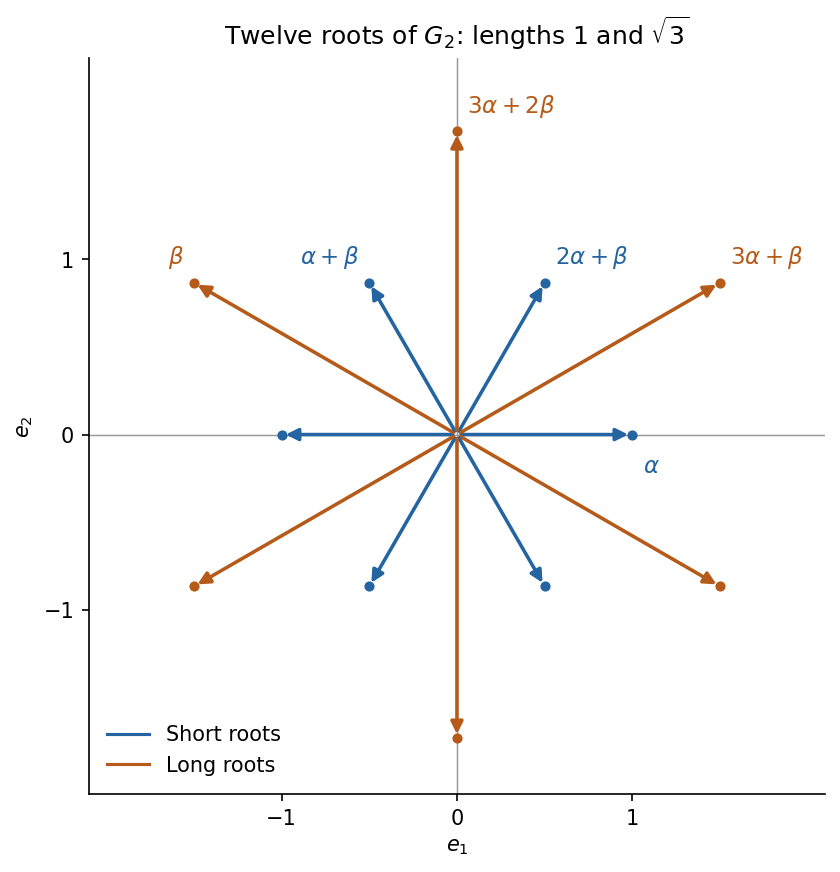
The twelve roots of G2 with the shorter simple root horizontal
. Details. 
Articles by others on the same topic
There are currently no matching articles.