The fluorite structure consists of a face-centered cubic lattice of calcium sites with all eight tetrahedral interstitial sites occupied by fluoride. In fractional coordinates of the conventional cubic unit cell, the calcium basis is , and fluoride occupies all combinations with . The projection therefore superposes two fluoride sites at each quarter-coordinate position. Labels in the original diagram give fractional depth along ; periodic boundary sites are displayed on both edges.
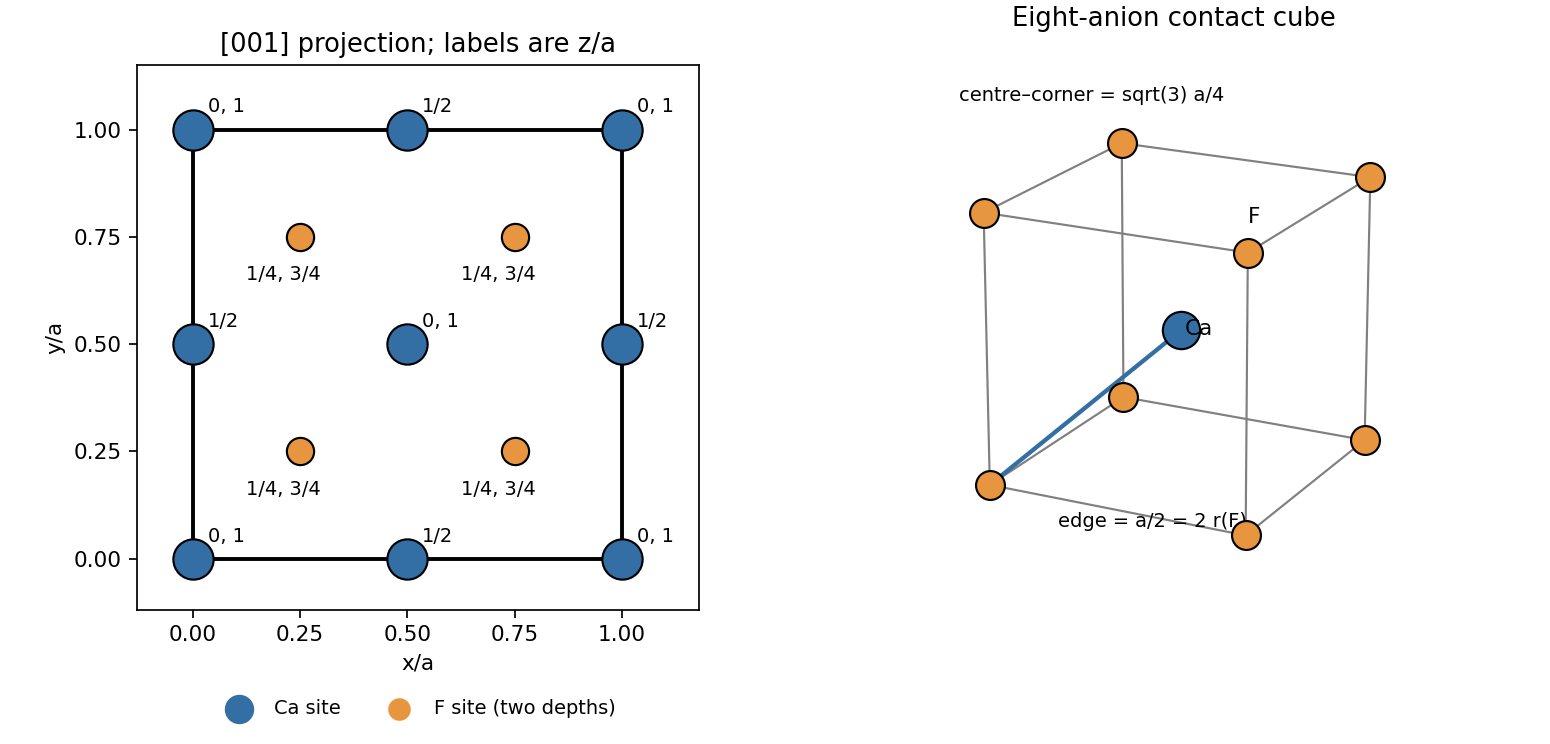
Original fluorite projection along the cubic z axis with fractional depths and the limiting anion-contact geometry
. Details. 
Counting shared sites gives calcium sites and eight interior fluoride sites: four formula units per conventional cell.
Each calcium cation has eight fluoride neighbours at the vertices of a cube: cubic coordination. Each fluoride anion has four calcium neighbours in tetrahedral coordination. Both unlike-neighbour Euclidean distances are , with the conventional cubic lattice parameter.
Apply the Goldschmidt packing principle at its limiting eight-coordinate geometry: the eight surrounding anions just touch one another and also touch the central cation. The anions form a cube of edge , so and . Eliminating givesEquivalently, . This is a limiting radius ratio rule, rather than a measured ionic-radius ratio. It does not assume that the calcium sublattice consists of mutually touching spheres: the calcium positions have face-centred cubic symmetry, but that symmetry alone does not specify which ions touch. A different construction with touching calcium spheres and fluoride just filling their tetrahedral interstitial sites would instead give ; that is the opposite contact limit, not the eight-coordinate anion-contact ideal used here.
Using the contact model of (b), and . Divide the volume of four cation spheres and eight anion spheres by to obtain the packing fraction:For one-radius cubic close-packed structure, face-diagonal contact gives , hence . The limiting fluorite value is lower than the one-radius close-packed value. Its two sizes, stoichiometry and eight-to-four coordination impose a different geometry: the fluoride sites form a simple-cubic array, and the calcium sites are too far apart for calcium–calcium contact. A face-centred arrangement of one species is therefore not sufficient to infer a close-packed whole crystal.
The actual ionic radii need not equal the limiting ratio, and electronic charge distributions are not rigid sphere boundaries. In the same unlike-contact hard-sphere model, put and use to getA cation somewhat larger relative to the anion than the limiting size opens gaps between the anions. Starting from and reducing modestly reduces this packing fraction; thus a lower value is expected for that departure from the ideal contact construction. The formula is not monotonic for all imaginable ratios, so no universal inequality should be inferred without specifying radii. Coordination-dependent ionic radii, polarizability, nonionic contributions to bonding, thermal expansion and point defects also limit the model. No numerical real-crystal packing fraction is determined by the supplied data alone.
A larger barium cation expands the fluorite structure and can widen the constrictions through which fluoride ions move. A plausible explanation is therefore a smaller ionic migration barrier and greater fluoride mobility. In a simple dilute-carrier description, , or when an uncorrelated Nernst-Einstein relation applies. fluoride vacancies and interstitial defects, including those generated as Frenkel pairs, provide possible carriers.
More open migration pathways can raise the conductivity, but ion size by itself is not a proof: defect formation free energies set , migration free energies set mobility, and correlated hopping can alter the simple relation. A controlled comparison would use crystals with comparable impurity content, thermal history and electrode conditions, and measure conductivity over temperature to separate plausible activation behaviour from extrinsic defect effects.
Articles by others on the same topic
There are currently no matching articles.