For a mixture with phase compositions , its molar Gibbs free energy is the straight-line combination at overall . Minimizing over phase compositions gives equal slopes and equal tangent intercepts: the common-tangent construction expresses equality of both component chemical potentials. The equilibrium curve is the lower convex envelope of the candidate phase curves. Phase fractions follow the lever rule.
At , moving from Bi-rich to Sn-rich composition gives , , , , . Approximate liquid coexistence compositions read from the diagram are on the left and on the right; the coexisting solids lie near their respective pure ends. The stable Gibbs free energy follows solid curves near the endpoints, two common-tangent constructions in the coexistence intervals, and the liquid curve between them.
At , one line is tangent to all three Gibbs free energy curves at approximately for (Bi), for liquid, and for . These three phases can coexist at the eutectic point. Between the two solid compositions, the equilibrium phase fractions depend on how much liquid has already transformed; exactly at the invariant temperature, the overall composition alone does not fix all three fractions. At the eutectic overall composition, cooling just below the temperature eliminates the liquid and leaves the two solids.
At , the stable sequence is , , . The stable two-solid common tangent lies below the liquid curve. There is no stable liquid interval, although a metastable extrapolated liquid Gibbs free energy can still be drawn.
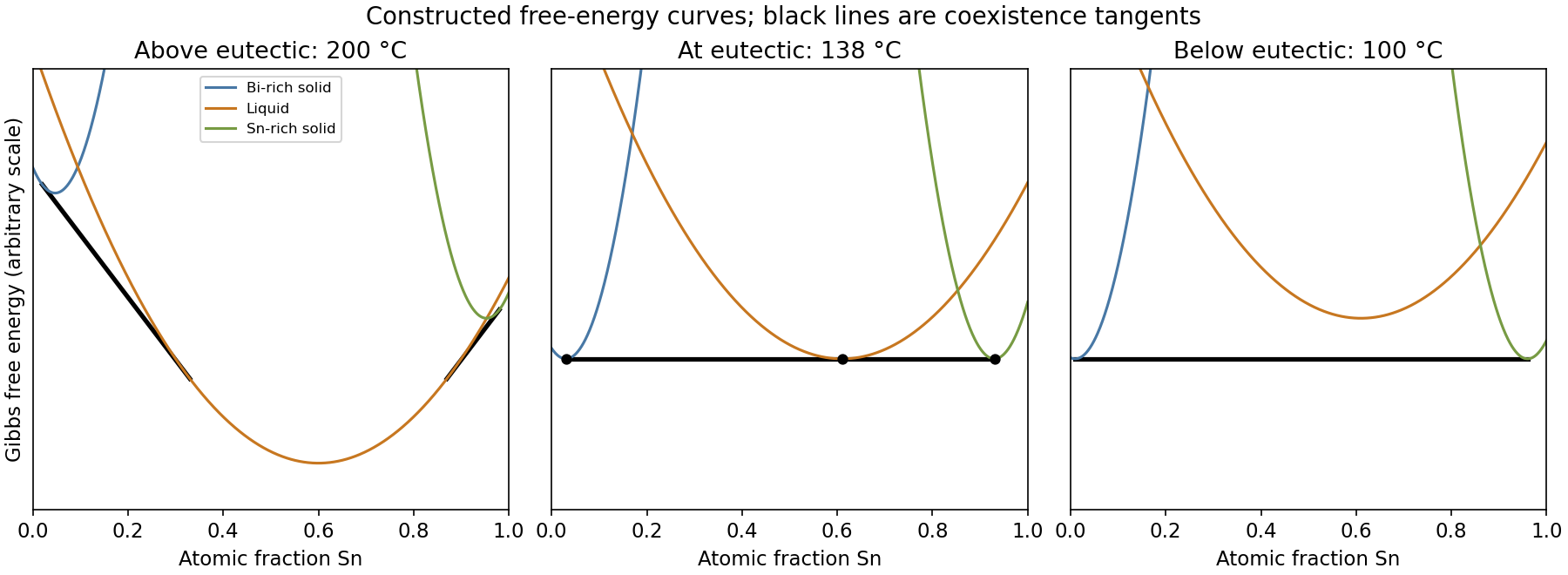
Qualitative Gibbs free-energy envelopes above, at and below a binary eutectic
. Original illustrative curves with constructed tangencies. Free-energy units and curvatures are arbitrary, not measured thermodynamic data for bismuth-tin. Details.
Articles by others on the same topic
There are currently no matching articles.