The function is strictly concave on . Its derivative is positive for , zero at , and negative for . Thus it rises from the limiting value as , touches the horizontal axis at its unique maximum , and then decreases to . It never crosses above the axis. The left endpoint is not included, and the slope tends to there.
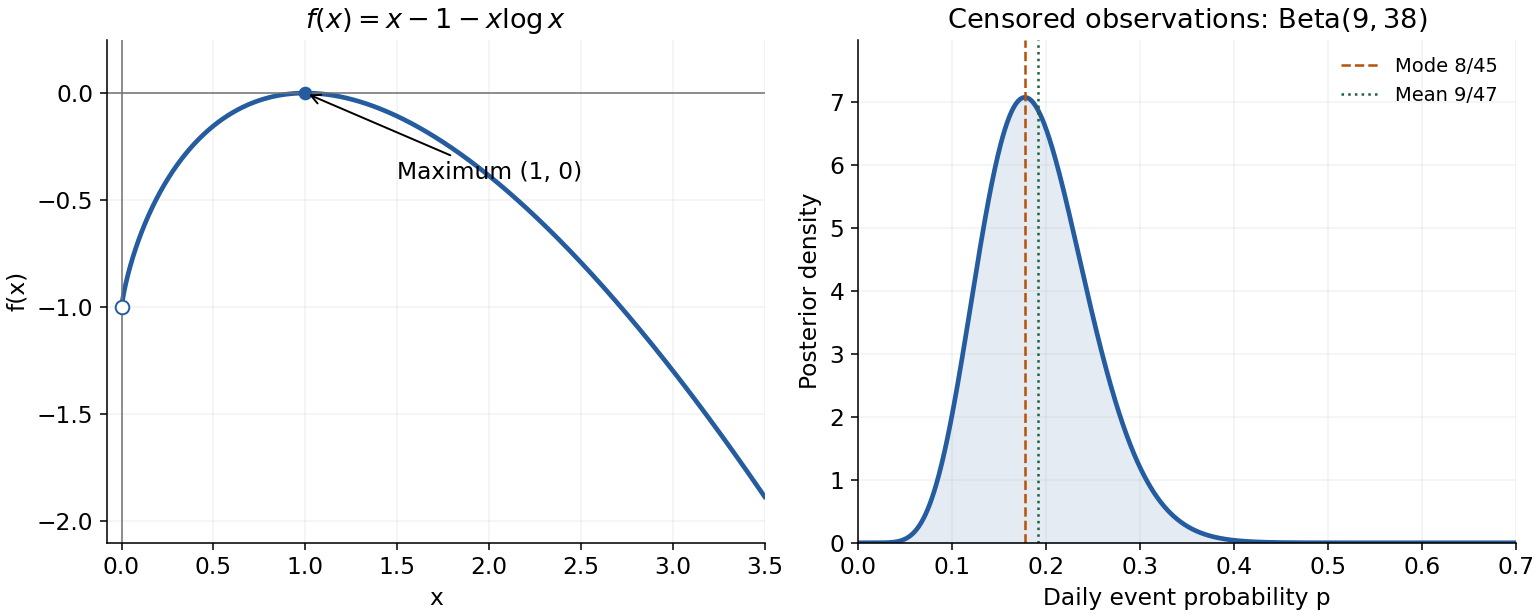

The left panel shows the required sketch; the right panel is used for question 6(e).
This is the Nicholson-Bailey model for a host-parasitoid interaction with discrete generations. The factor is the host multiplication factor in the absence of parasitism; measures effective attack or searching intensity per parasitoid; and is the number of next-generation parasitoids produced per attacked host, with any survival or unit conversion absorbed into it.
If the number of attacks on a host has a Poisson distribution with expected value , then the probability of no attack is . Consequently is the surviving, unparasitized host fraction, and is the attacked fraction. The two update equations count host descendants from surviving hosts and parasitoid descendants from attacked hosts, respectively.
At an equilibrium, and . Taking forces , giving extinction. If , the first equation gives and henceThese are the only isolated candidates obtained from the equations. There is an exceptional parameter case: at , and every is an equilibrium. Thus the assertion of exactly two equilibria needs , and only the positive candidate belongs to the biological state space when .
Since , the coexistence value is positive exactly when . Under that condition, as well. Therefore the required condition isFor , the formal nonzero candidate has negative parasitoid density and is not biologically admissible; gives only the host-only line of equilibria.
The Jacobian matrix of the update map isIts eigenvalues are and zero. The extinction equilibrium is locally asymptotically stable for and unstable for , by linear stability analysis for a discrete dynamical system. In the latter case, even a small perturbation along grows as .
At , an eigenvalue equals one, so the strict linear criterion does not decide stability. Directly, and . Starting sufficiently close to extinction therefore keeps both coordinates close for all time, proving Lyapunov stability in the nonnegative state space. It is not asymptotically stable, since every nearby is another equilibrium. This distinction makes the statement “stable when fails” precise.
Suppose and set . Substitution of the positive equilibrium into the Jacobian matrix givesPart (b) showed whenever . In particular,gives , whereasgives . The latter already violates the Jury stability criterion condition . More directly, the product of the two eigenvalues is greater than one, so at least one has modulus greater than one. Therefore the positive equilibrium is unstable. This is the instability of the Nicholson-Bailey equilibrium; parasitoid feedback in this simple model does not stabilize coexistence.
Articles by others on the same topic
There are currently no matching articles.