For , use . The inner product isThe stated nonnegative index range also includes . Since is the zero function, , so it must be removed from any proposed basis.
The product-to-sum formula givesWhen both indices are positive the two integer frequencies integrate to zero. If either index is zero the integrand already vanishes. This is Fourier orthogonality.
For positive integer indices, distinct members are orthogonal and each has nonzero squared norm . Thus is an orthogonal basis in the Hilbert space of odd L2 functions on . The zero-index member must be omitted. More precisely this is a complete Fourier sine basis, with generally infinite L2 norm convergence, rather than a Hamel basis with finite linear combinations. A claim about arbitrary real functions requires suitable integrability and a specified sense of convergence.
Taking the inner product with and using Fourier orthogonality isolates . Since is even, integration by parts givesConsequently the Fourier sine series isThe series converges to at each interior point and in the L2 norm. Its periodic extension has jumps at , where the Fourier series instead converges to the midpoint value zero. The overshoot near those jumps is the Gibbs phenomenon.
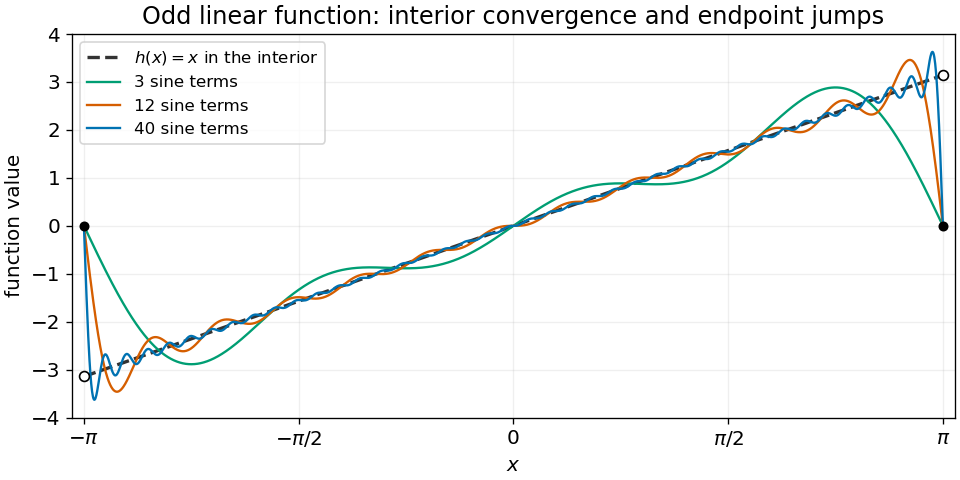
Fourier sine partial sums recover the odd linear function inside the interval, with endpoint jump overshoot
. Details. 
Every finite sum of the sine modes is odd, and so is a limit in the L2 norm of such sums. In contrast, is a nonzero even function. Its inner product with every odd sine mode vanishes, so all its proposed Fourier sine series coefficients would be zero. It cannot be represented by this basis on the symmetric interval. An even Fourier cosine series is the appropriate alternative there.
Articles by others on the same topic
There are currently no matching articles.