Source paper: www.whatdotheyknow.com/request/physics_preliminary_examinations/response/1162943/attach/3/Twain.7z?cookie_passthrough=1
The complex exponential factors as . Its positive real prefactor is its modulus, while its phase gives its complex argument:For the principal complex argument, reduce to the chosen principal interval.
The polar form gives . Multiplication therefore scales the modulus by and rotates the complex argument through :Equivalently the result is , whose complex argument is . If , its modulus is zero and its complex argument is undefined.
The determinant is an alternating multilinear map of its rows, so exchanging two rows gives the negative of the original determinant: . This also holds when the determinant is zero.
The determinant is unchanged by transposition: . In the Leibniz formula for determinants, replacing each permutation by its inverse interchanges the row and column roles without changing its sign of a permutation.
Scaling the whole matrix scales all rows. The multilinearity of the determinant therefore givesThis includes for .
Where and , the separable differential equation givesThe requested point selects the implicit solution . The two real branches approaching that point areThere is an important initial value problem qualification: the differential equation as printed has no classical solution through the specified initial point. Its right side is undefined at , and these branches have an infinite one-sided derivative as . They satisfy the differential equation on and extend continuously to the requested point. Multiplying by the vanishing denominator produces an implicit differential equation with a larger domain; it does not repair the original initial value problem.
The characteristic polynomial of the Hermitian matrix isSolving the two eigenvector equations and using the Hermitian inner product to normalize givesIndeed and both norms equal one. Multiplication of either eigenvector by any unit phase factor gives an equally valid normalized choice.
For an idempotent matrix, for every integer . Thus any scalar polynomial reduces toor equivalently . This expression describes all polynomials in , although its two coefficients need not be unique if or .
If for a nonzero eigenvector, idempotence gives . HenceThese are the only possible eigenvalues; either may be absent. In fact decomposes every vector into the image and kernel of , so every idempotent matrix is diagonalizable even when it is not an orthogonal projection.
The common real variable gives the parametric equation of the line:Write and . The point closest to the origin is orthogonal to , so . Its position is . The distance from a point to a line in three dimensions is therefore
Subtracting the first equation from the third gives . The second equation then becomes , and the third fixes . The linear system has the following three consistency cases:The first case is a unique solution, the second is an affine line in a vector space of solutions, and the third is an inconsistent linear system.
Normalize the normal vector , whose Euclidean norm is . The plane has the formThe scalar is the signed perpendicular distance from the origin in the chosen unit normal direction; the unsigned distance is . The nearest point is .
For , use . The inner product isThe stated nonnegative index range also includes . Since is the zero function, , so it must be removed from any proposed basis.
The product-to-sum formula givesWhen both indices are positive the two integer frequencies integrate to zero. If either index is zero the integrand already vanishes. This is Fourier orthogonality.
For positive integer indices, distinct members are orthogonal and each has nonzero squared norm . Thus is an orthogonal basis in the Hilbert space of odd L2 functions on . The zero-index member must be omitted. More precisely this is a complete Fourier sine basis, with generally infinite L2 norm convergence, rather than a Hamel basis with finite linear combinations. A claim about arbitrary real functions requires suitable integrability and a specified sense of convergence.
Taking the inner product with and using Fourier orthogonality isolates . Since is even, integration by parts givesConsequently the Fourier sine series isThe series converges to at each interior point and in the L2 norm. Its periodic extension has jumps at , where the Fourier series instead converges to the midpoint value zero. The overshoot near those jumps is the Gibbs phenomenon.
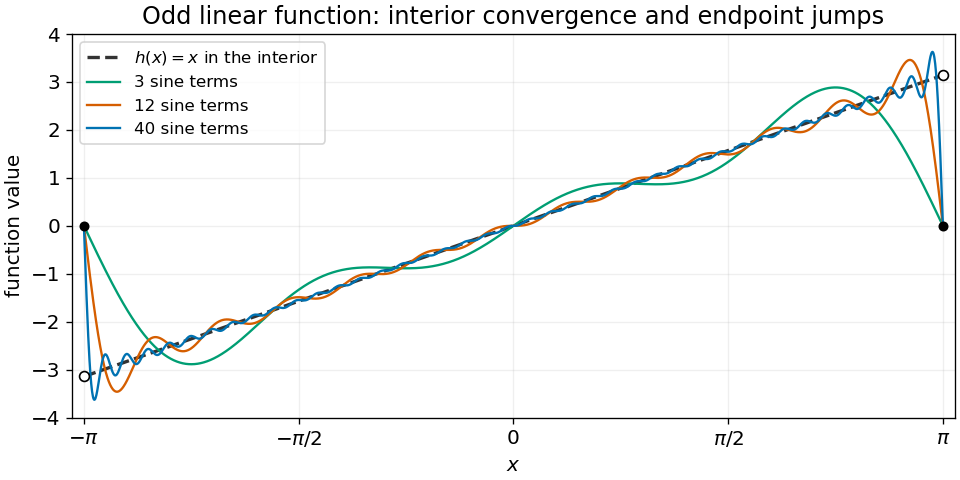
Fourier sine partial sums recover the odd linear function inside the interval, with endpoint jump overshoot
. Details. 
Every finite sum of the sine modes is odd, and so is a limit in the L2 norm of such sums. In contrast, is a nonzero even function. Its inner product with every odd sine mode vanishes, so all its proposed Fourier sine series coefficients would be zero. It cannot be represented by this basis on the symmetric interval. An even Fourier cosine series is the appropriate alternative there.
Put and . Expanding the nonnegative squared Euclidean norm of givesDividing by and taking nonnegative square roots proves the Cauchy-Schwarz inequality:Equality holds exactly when , equivalently when the nonzero vectors are linearly dependent.
Expanding the squared Euclidean norm and applying the Cauchy-Schwarz inequality givesBoth sides are nonnegative, so taking square roots proves the triangle inequality, . For nonzero vectors, equality requires a positive real proportionality factor.
With conjugation in its first slot, a complex inner product has conjugate symmetry, linearity in its second slot, and positive definiteness. For the proposed Hermitian inner product, direct expansion givesThe last expression vanishes exactly for the zero vector. Conjugate symmetry and linearity also give antilinearity in the first slot: . These verify all three axioms and the associated first-slot consequence.
Using the Hermitian inner product, the scalar product is . The two squared norms are and . The specified real angle in a complex inner product space therefore hasThe real part is essential: the complex scalar product itself need not be real.
Conjugating the first vector givesTheir squared norms are and , independently of . Thus the specified real angle in a complex inner product space obeysThe complex Cauchy-Schwarz inequality ensures that this real quotient lies in .
In components the scalar triple product is . A cyclic permutation has positive sign of a permutation, so . Relabelling the summed indices therefore giveswhich proves . Equivalently both expressions are the same three-column determinant.
Apply the contraction of two Levi-Civita symbols to the cross product:Thus the vector triple product identity is
Three vectors form a basis of exactly when they are linearly independent. The determinant with those vectors as columns is their scalar triple product, so the condition isGeometrically their parallelepiped must have nonzero volume.
If two indices of the n-dimensional Levi-Civita symbol are equal, exchanging them leaves the component unchanged. Antisymmetry of a multilinear map simultaneously negates it, so . Over the real numbers this implies .
If all indices are distinct and each lies in , their list is a permutation of . Sorting it takes some number of transpositions. The n-dimensional Levi-Civita symbol equals because its sorted component is . ThereforeThe parity of a permutation is independent of the chosen sequence of transpositions.
Reversal has one inversion of a permutation for every pair of indices, hence inversions of a permutation. The sign of a permutation givesIt is for and for .
Every nonzero component of the n-dimensional Levi-Civita symbol is , so its square is one. There are exactly permutations of the distinct indices; all remaining index lists have a repeat and contribute zero. Hence
Let be the square matrix whose th column is . The Leibniz formula for determinants is precisely the stated contraction:A square matrix has zero determinant exactly when its columns are linearly dependent, proving the required equivalence. One direction also follows directly from multilinearity and antisymmetry of a multilinear map: replacing one column by a linear combination of the others leaves only terms with repeated columns, each zero. Conversely, nonzero determinant gives an inverse matrix and hence independent columns.
For a nonzero real solution use the Bernoulli power substitution . Dividing the differential equation by gives . The integrating factor yieldsDirect substitution shows this formula also solves the equation at its zeros. Division temporarily discarded the additional solution . Since the real power is not locally Lipschitz at zero, the complete real solution family also permits waiting-time solutions of a sublinear Bernoulli equation: join a zero interval to a displayed branch at a root of . At a joining point the branch and its derivative are both zero, so the joined function satisfies the original equation. On each open nonzero interval every solution has the displayed form.
Set . Wherever , the chain rule and the given implicit differential equation giveThus and . Squaring without losing the square-root sign restriction giveswith either sign of on its interval of definition. These parabolas satisfy . Their vertex is a regular point as a parametrized curve but cannot belong to a differentiable graph satisfying the equation: there while . The degenerate case gives the separate solution in the differential-form interpretation printed in the paper. It would be lost by dividing the equation by .
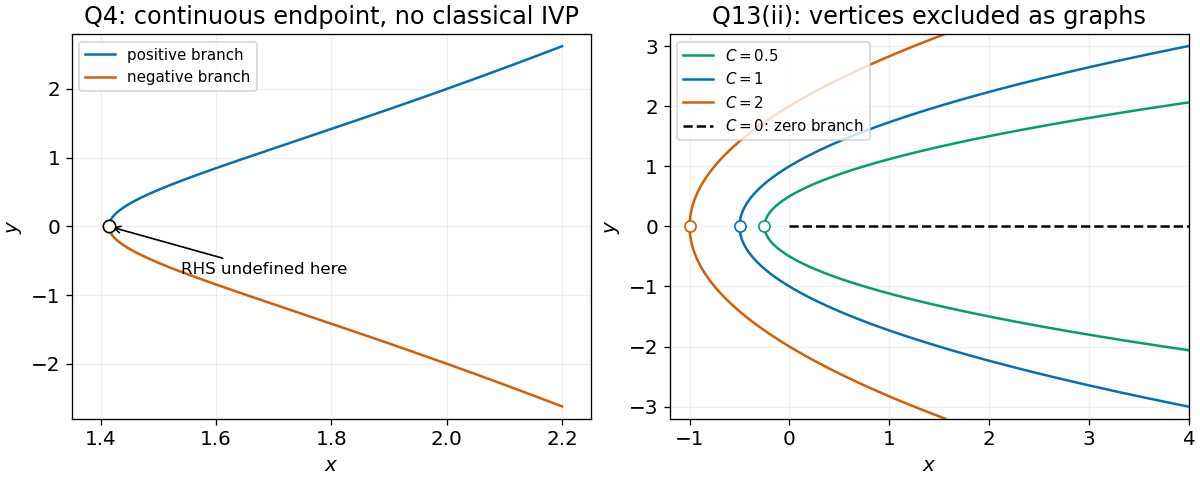
Singular initial-point branches and the parabolic integral curves, with their graph-domain restrictions
. Details. 
For the linear differential operator , the exponential function is an eigenfunction: . Distinct give the two homogeneous solutions, while the method of undetermined coefficients supplies a particular solution at the distinct forcing exponent :
With and , the first equation is . Multiplication by its integrating factor gives , henceThis holds whether or not . If , solving by a second integrating factor givesThe extra factor is the response to the resonance condition at the forcing exponent; the coincident-root case requires the next part.
When all three exponents equal , write . The exponential shift rule for differential operators gives and . Thus . Two integrations giveThe repeated characteristic root supplies and as homogeneous solutions; forcing at that same exponent needs the further factor.
Articles by others on the same topic
There are currently no matching articles.