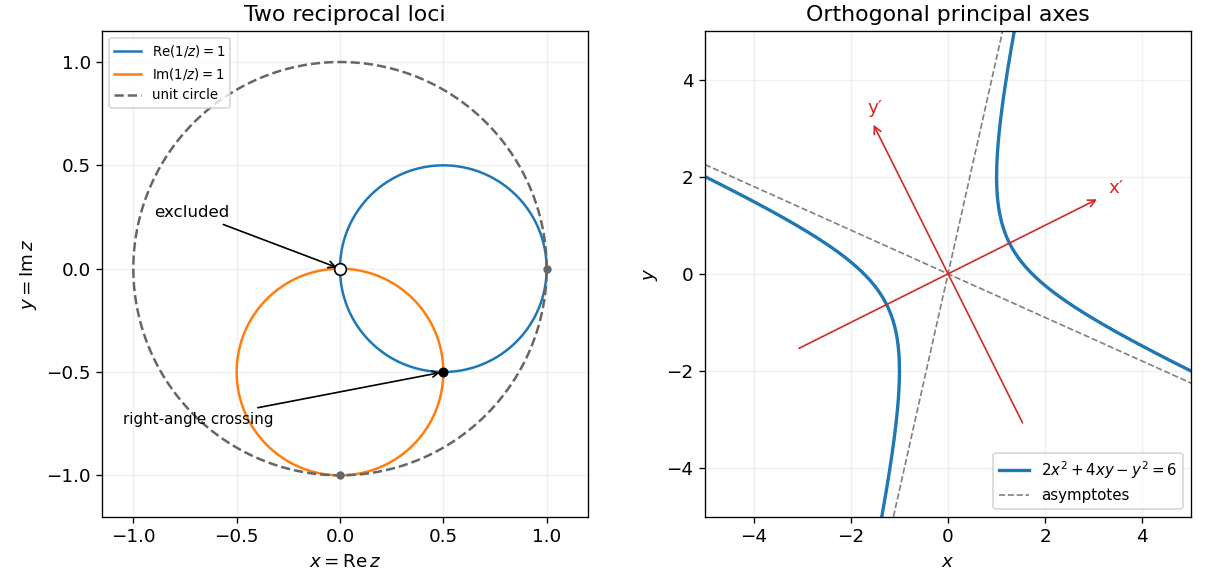
Write . Since , the two loci areThus they are radius- circles centred at and , each missing the origin. Their circle equations intersect at and , but only the latter belongs to the original loci. At that point the radius vectors are and , so the tangents meet at a right angle.
Every point on either circle has distance at most from the origin. Equality occurs only at on the first or on the second. The unit circle is therefore internally tangent to both and crosses neither. The sketch marks the excluded origin explicitly, rather than treating it as a second intersection.

The plane has normal vector of length seven. Projecting the displacement from any point on the plane onto the unit normal gives the distance from a point to a planeFor example the perpendicular foot is . Substitution places it on the plane, and its displacement from is parallel to , verifying that this is the minimum distance.
For nonzero vectors with angle , and . Hence gives Lagrange's identityIf either vector is zero both sides vanish, so this covers every case. Alternatively, expansion of the three cross product components gives the same identity without introducing an angle.
For the quadratic form of a squared cross product, express the two scalar terms as quadratic forms in :Then . In particular, for ,The cancellation is structural: , while its action on every vector perpendicular to a nonzero is multiplication by . Its eigenvalues are therefore ; for the whole matrix is zero.
Articles by others on the same topic
There are currently no matching articles.